
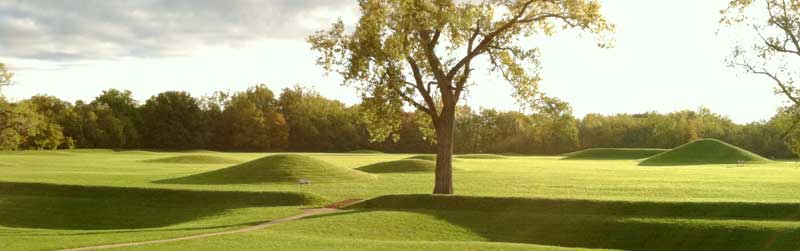
Hopewell Mound City group is in Chillicothe, Ohio, and is run by the National Park Service.
The Hopewell culture, also called the Hopewell tradition, is an archeological era of Native Americans that flourished along rivers from the Atlantic Ocean to the eastern Great Plains and from the Great Lakes region to the Gulf of Mexico. Thriving between 100 BC and 500 AD in the Middle Woodland period, the Hopewell tradition was not a single culture, tribe, or society but a widely dispersed set of related populations connected by a shared network of trade routes.
This trade network, the Hopewell exchange system, ran from the Crystal River Indian Mounds in modern-day Florida to the northern shores of Lake Ontario in Canada. Their trade goods spread far and wide and have been seen in many burials outside the Midwest.
The Hopewell people are said to have originated in western Illinois before moving to Ohio, where they built upon the local Adena mortuary tradition. Warren K. Moorehead applied the name “Hopewell” after he explored the Hopewell Mound Group in Ross County, Ohio, in 1891 and 1892. The mound group was named after Mordecai Hopewell, whose family owned the earthworks.

Hopewell Exchange Network by H. Roe, Wikipedia.
The Hopewell people lived near rivers in temporary villages of 1-3 rectangular homes made of posts with wattle and daub walls and thatched roofs. They practiced a mixture of hunting, fishing, gathering, and farming. The Hopewell used tools such as knives and projectile points made of high-quality flint, obsidian, hooks, and bone awls. Their pottery was more refined than earlier cultures and included new shapes such as jars, bowls, and stone pipes, some depicting various animal effigies.
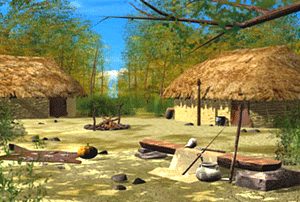
Hopewell Village.
Today, the best-surviving features of the Hopewell era are mounds built for uncertain purposes. These significant geometric earthworks are some of the most impressive Native American monuments throughout American prehistory. Rising to impressive heights, these giant sculpted earthworks often took the shape of animals, birds, serpents, and geographical forms. These mounds were places of ceremony, not settlements, and are evidence that people from different villages mobilized and worked together on these large projects.
Some scientists hypothesize that Ohio’s large octagon and circle-shaped earthworks may have been used as lunar observatories. Many of the mounds have been found to contain burials, adornments, and precious goods made of copper, mica, obsidian, silver, volcanic glass, and stones that were imported to the region from hundreds of miles away. Some Hopewell burials have large quantities of goods, suggesting some level of hierarchy in the culture.
Around 500 CE, the Hopewell tradition ceased, and mound-building stopped. Afterward, villages of the Late Woodland period shifted to larger communities that utilized defensive fortifications of palisade walls and ditches, probably due to wars. With fewer people using trade routes, there was no longer a network linking people to the Hopewell traditions.
“The building of all these great ceremonial landscapes was accomplished over four or more centuries and reflects an amazing level of social stability and societal commitment to monumental and ceremonial construction.”
— Mark Lynott, Midwest Archaeological Center
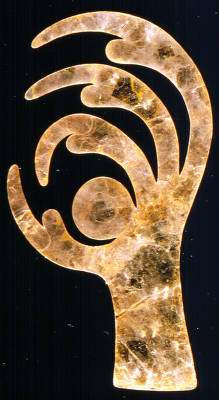
Hopewell Effigy hawk claw cut from sheet mica.
©Kathy Alexander/Legends of America, updated March 2025.
Also See:
Native American Archaeological Periods
Native Americans – First Owners of America
Native American Photo Galleries
Sources:
Archaeological Institute of America
Ohio History Central
Wikipedia