
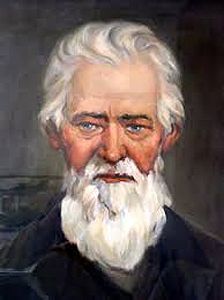
Lancaster P. Lupton.
Fort Lupton, also called Fort Lancaster, was a trading post established in 1836 by Lancaster P. Lupton in Weld County, Colorado.
Lancaster Platt Lupton was born in New York on September 21, 1807, to William Lupton, Jr., a New York City lawyer, and his wife, Julia Townsend. He grew up to attend West Point, graduating in 1829. He then joined the military, became a first lieutenant, and was a member of Colonel Henry Dodge’s Expedition in 1834-35. When they passed through the South Platte Valley in what would become the state of Colorado, Lupton saw the potential for a successful trading post.
Lupton was described as a “pleasant, well-informed little man but was a victim of intemperance.” After being threatened with a court martial for criticizing President Andrew Jackson at a dinner party, he resigned his commission. His commanding officer would say of the affair, “I attribute most of the difficulties here to the intemperate use of ardent spirits.”
With the financial help of Hiram Rich, a trader of Liberty, Missouri, Lupton returned to Colorado in 1836 to build a trading post. He chose a site along the South Platte River in northeast Colorado located about seven miles south of another fur trading fort called Fort Vasquez. In about the same year, Lupton married the daughter of an Indian Chief named Thomas. The couple would eventually have eight children, and unlike other fur traders, Lupton would spend the rest of his life with her.
His trading post began as little more than a log shelter, but he soon brought in skilled craftsmen and laborers from the Mexican village of Taos, New Mexico, to build a large two-story adobe fort. Modeled after Bent’s Fort to the south, it was estimated to be approximately 125 feet by 150 feet with walls 15-18 feet high. A circular tower stood at the northwest corner, several feet higher than the walls, and a bastion with portholes was situated on the opposing corner. The fort also had living quarters, a kitchen, a blacksmith area, a trading room, a corral, and storage rooms.
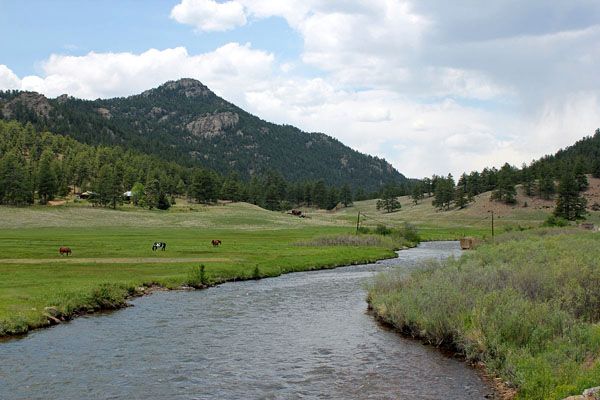
South Platte River, Colorado.
By 1837, he was trading with the Arapaho and Cheyenne tribes of the area. This was an active period for fur trading, and two more forts — Fort Jackson and Fort St. Vrain were soon built along the South Platte River along the Trapper’s Trail to the north. The Trappers Trail ran between Fort Laramie, Wyoming, down to the Arkansas River, and then along the Taos Trail to New Mexico. During this time, because the South Platte River was so shallow, it was unsuitable for transporting trade goods. Therefore, most of the supplies for the fort and furs destined for Independence, Missouri, had to be transported overland. To combat these expenses, Lupton tried to make the trading post as self-sufficient as possible by planting a large garden and raising livestock.
In about 1840, Lupton established another fur trading post in Wyoming. Called Fort Platte, it was located on the North Platte River, about a mile from the successful fort of Fort Laramie. This post eased Lupton’s supply situation, as goods could be brought up the North Platte River to Fort Platte and then packed overland to Fort Lancaster.
By 1842, the fur trade was beginning to wane. Fort Jackson had been abandoned in 1838, and Fort Vasquez was abandoned in 1842. That same year, Lupton declared bankruptcy, which resulted in Fort Platte being sold to Pratte and Cabanne and Fort Lancaster becoming the property of Hiram Rich and his partner, Albert G. Wilson, who were postmasters and merchants at Fort Leavenworth, Kansas, at the time. The following year, Wilson came west, taking control of Fort Lupton, and established another trading post below Bent’s Fort on the Arkansas River, which was known as “Wilson’s Houses.”
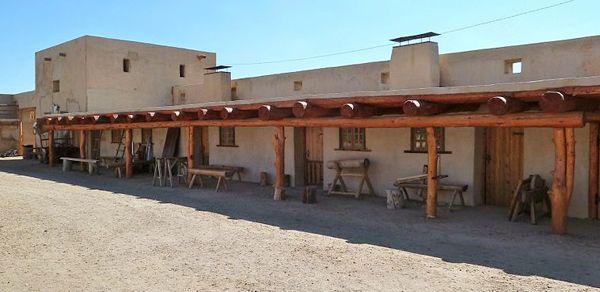
Fort Lupton, Colorado, courtesy Fort Wiki.
During this time, Lancaster Lupton continued to trade at Fort Lupton, but he and Wilson didn’t get along. After the two had a serious disagreement and a harsh blizzard temporarily closed the fort, Lupton and his family left in December 1844 and settled in Hardscrabble, Colorado.
Shortly after Lupton left, Hiram Rich and Albert G. Wilson closed the post. During its days as a thriving trading post, Rufus Sage, Kit Carson, and John C. Fremont visited it.
Lupton stayed at Hardscrabble and ran the trading post in its final days. However, when he heard about the California Gold Rush, he and his family followed the many other gold seekers to California in 1849. Six of their eight children who survived were raised primarily in Humboldt County, California. Lieutenant Lancaster Lupton died on October 1, 1885. He was buried at the Blue Lake Cemetery in Humboldt County, California. His wife died seven years later and is buried beside him.
In the meantime, Fort Lupton remained abandoned and was used only as a temporary shelter by travelers passing through the region. From 1845 until 1859, it was used for various purposes, including an overland stage station during the Colorado Gold Rush and the Civil War, as a temporary U.S. Army detachment camp in 1864. Later, it would serve as a private home and the headquarters for a ranch, and as the structure fell further into ruin, it was used as a corral for livestock. By the 1920s, only a wall of the old fort remained.
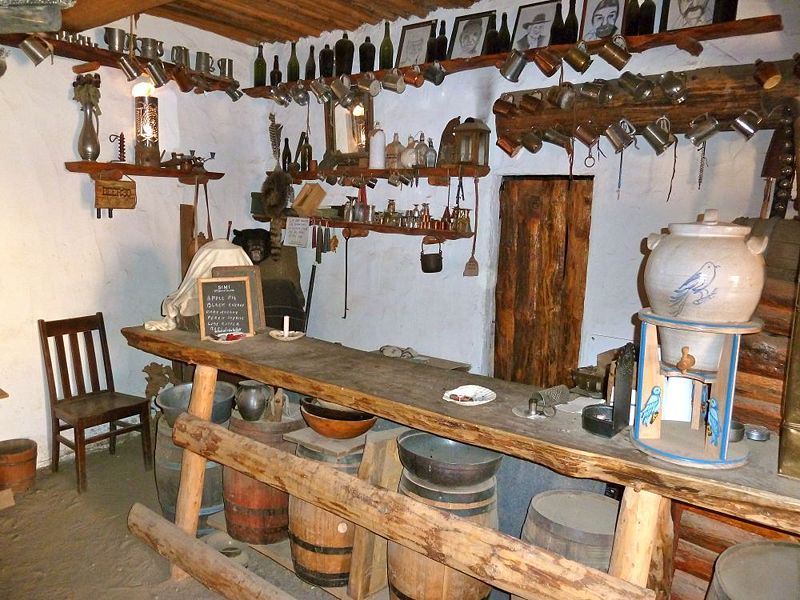
Fort Lupton, Colorado Tavern Room, courtesy Fort Wiki
In 2003, the South Platte Valley Historical Society began reconstructing Fort Lupton, using some of the original adobe bricks and part of an original wall several hundred feet south of the presumed original site. It opened in September 2011. The reconstructed fort is located at the South Platte Valley Historical Park, and it includes an old schoolhouse and a homestead from the gold rush era. The reconstructed fort includes living quarters, trade rooms, blacksmith and carpenter shops, a tavern room, and a storage room with historic artifacts. The original site of the fort is an archaeological site.
The South Platte Valley Historical Park is northwest of Fort Lupton, off Highway 85 at 2001 Historic Park Way. It is open on weekends only from May 1 to October 31.
More Information:
South Platte Valley Historical Society
PO Box 633
2001 Historic Park Way
Fort Lupton, Colorado 80621
303-857-1710
©Kathy Alexander/Legends of America, updated March 2025.
Also See:
Sources:
Fort Lupton’s Beginning
Fort Wiki
Lecompte, Janet; Pueblo, Hardscrabble, Greenhorn: Society on the High Plains, 1832-1856; University of Oklahoma Press, 1980.
Mountain Men