
Update: In April 2017, a reader notified us that the entrances to Sunnyside and its surrounding property are posted with “Private Drive” and “Private Property” signs. However, another reader commented later that, in addition, there is a guest book and sign welcoming you to tour but leaving it as you found it.
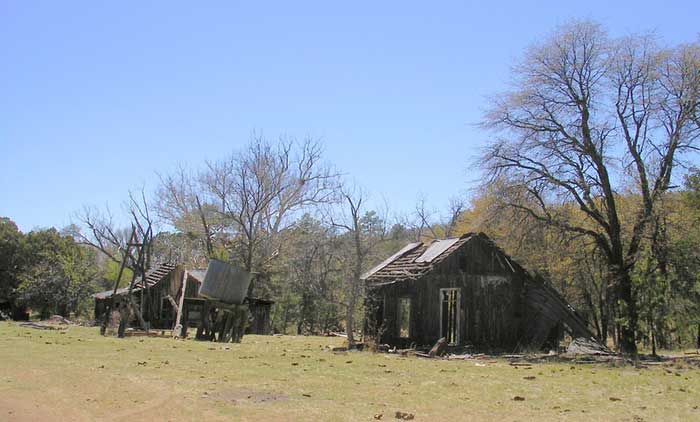
Buildings in the ghost town of Sunnyside, Arizona. Photo by Kathy Alexander, 2007.
Twenty miles northeast of Lochiel is the old ghost town of Sunnyside. Interestingly, Sunnyside is far removed from the “typical” Arizona ghost town in terms of its make-up, beginnings, and lifestyle, not to mention its remote location. Unlike other mining camps, it was not filled with saloons, brothels, and lawless elements but rather a religious community. If it existed today, modern writers would probably call it a commune or, worse, a “cult.”
It all began with a man named Samuel Donnelly, who popular history would have us believe was a hard drinker in San Francisco, California. However, he changed his ways when he stumbled out of a waterfront bar into a Salvation Army meeting in the early 1880s. Having “seen the light,” Donnelly stopped his drinking and became a Salvation Army preacher.
Though this is the more often told version of the tale, family members say that Donnelly was actually an immigrant from Barrhead, Scotland, who had recently arrived in San Francisco. Though a drinker, he was not a drunk. He did, in fact, “see the light” when he became affiliated with the Methodists (rather than the Salvation Army).
He first took a post preaching in Methodist churches in Los Angeles, but he was rapidly developing his religious ideals that did not suit those of the congregations’ leaders. Soon, he could find no pulpit in order to spread his “word.”
In 1886, he went to the lawless town of Tombstone to bring salvation to its rowdy elements. While there, he acted as a street preacher, continuing to spread his ideas, which often criticized major religious denominations of the day and their doctrines, actions, and social policies. At the same time, he also developed an interest in mining and eventually co-founded the Copper Glance Mine, which is about nine miles southeast of Sunnyside and some 50 miles southwest of Tombstone.
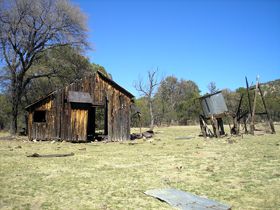
Sunnyside, Arizona by Dave Alexander.
A few of Sam’s converts followed him to the Copper Glance Mine to hear his preachings. In the meantime, Sam continued to prospect when he found the place he would call Sunnyside, high in the Huachuca Mountains. Soon, he led a group of about 20-30 of his followers to the new “colony” he founded in the wilderness.
Supported by the nearby Lone Star Mine, Donnelly established a communal camp where his followers ate, lived, worked, and worshipped together. In a socialist type of community, all money was pooled, and each person worked for the betterment of the entire camp. The early settlement had a shared kitchen, dining hall, barn, and one-room schoolhouse. Unlike many other mining camps of the time, this place had no saloons, “painted ladies,” or lawlessness. Though some eight miles from the nearest wagon trail, new followers and those looking for work would drift into the camp until it numbered almost 80 converts. But, new residents were required to work hard and show an interest in the Scriptures. If they did not, they were asked to leave.
Much like how such a place might be perceived today, the camp quickly drew controversy. On February 27, 1897, the Bisbee Weekly Orb printed an article entitled: “A False Report. A Man Who Claims To Be A Divine Teacher Sent By God. He Rules By Hypnotism. His Following Consists of some Twenty or Thirty Persons. An Investigation Needed.”
The defamatory article presented a grisly picture of Donnelly and his mining camp, accusing Donnelly of being “expelled from the Salvation Army” and making the members of the camp out to be deluded prisoners by saying: “All who join the camp must leave friends, relatives, children, wife or husband and follow God and Donnelly.” The article further claimed that the camp provided no privacy that a woman was being held against her will, and that Donnelly was involved in adultery.
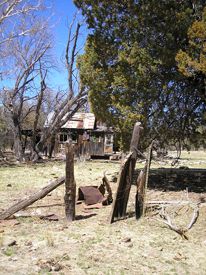
Sunnyside, Arizona by Kathy Alexander.
Donnelly sued the newspaper for libel, but the case never came to trial. Later, he was accused of aggravated assault on a child, stemming from rumors that when one woman tried to run away, she was forced to leave her children, who were, in turn, abused by Donnelly. Fighting the case, Donnelly took it all the way to the State Supreme Court, which said in part:
“The evidence, in this case, discloses the fact that up on top of the Huachuca Range of Mountains is a community located so that a wagon road will not come nearer than eight miles of the camp, and the balance of the way taken on foot or the backs of animals. So isolated, this man Donnelley [sic] has surrounded himself with a community of religious zealots who have surrendered to him absolutely.”
However, the facts found that the mother had voluntarily left her children while temporarily away and that Donnelly had disciplined one of them while acting as “schoolmaster.” The higher court did not totally exonerate Donnelly but returned the case to Cochise County, which dismissed the charges in May 1898.
That same year, the Lone Star Mine, which had never produced much more than enough to support the camp, was filled with water when the miners inadvertently opened an underground spring. Though they invested in pumps, they were unable to clear the mine of the water.
Late in 1900, Sam Donnelly fell ill from Bright’s disease and died on April 14, 1901. By 1903, everyone had left Sunnyside Canyon except one man. Later, around 1912, the camp revived itself for a time as a ranching community, but that, too, passed into history.
Over the years, Donnelly’s followers were often referred to as “Donnellites,” a term he abhorred because he hated denominations. His followers and family felt the same.
Today, Sunnyside is just as remote as it was when it began. Located 20 miles northeast of Lochiel or 32 miles southeast of Sonoita, it is best reached by taking AZ-83 south from Sonoita to Parker Canyon Lake, then FR-48 south to Sunnyside Road, which you would follow east to the town.
Though the history of this old town is fascinating, we probably wouldn’t recommend the trip. Signs to the townsite are almost nonexistent, there are numerous opportunities for getting lost, and the road was terrible (as of our 2007 trip). The area is also, according to the Border Patrol that talked to us nearby, rife with illegals and drug traffickers.
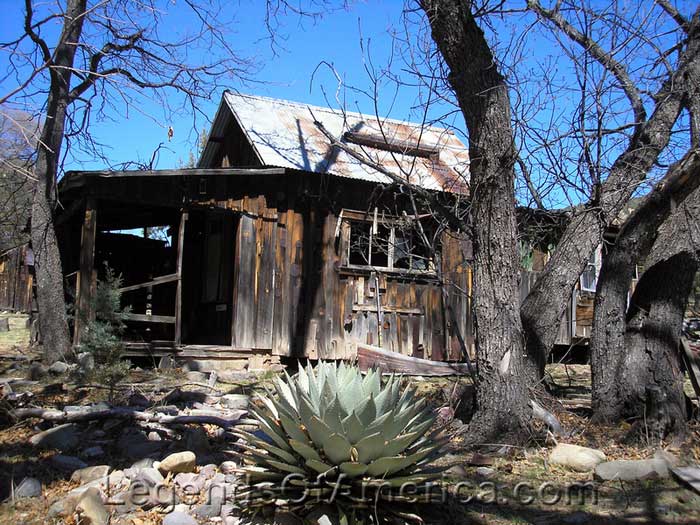
Sunnyside, Arizona by Kathy Alexander.
Compiled and edited by Kathy Alexander/Legends of America, updated March 2025.
Also See:
Arizona Ghost Town Photo Gallery
Arizona Ghost Towns & Mining Camps
Mining & Manufacturing in the West
See Sources.