
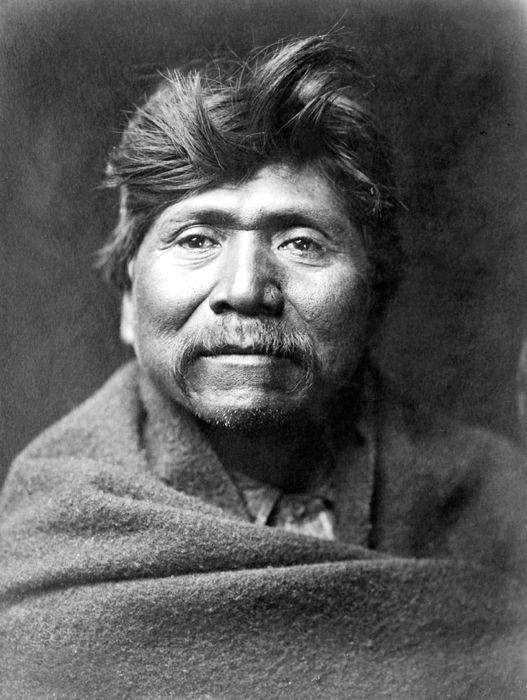
Pachilawa, Hualapai Chief by Edward S. Curtis, 1907.
The Hualapai tribe, also spelled Walapai, meaning “People of the Tall Pine,” have lived along the Colorado River and the Grand Canyon of Arizona for centuries.
The Hualapai are descendants of the “Pai,” whose earliest physical remains have been found along the Willow Beach bank near the Hoover Dam, dating back as early as 600 A.D. 600. They are close relatives to the Yavapai and with Paipai of northern Baja California.
Traditional hunters and gatherers, they also grew corn, beans, melons, and squash. Living in dome-shaped houses built with juniper branches, Spanish explorers first discovered them in the 1500s.
In 1857, Edward Beale carved a wagon road from Fort Defiance to the Colorado River, on the border between Arizona and California. The path cuts right through Hualapai territory. In 1863, gold was discovered in the Prescott Valley, and the gold rush brought a steady flow of miners and other settlers to the area. A toll road was built through the Hualapai territory between Prescott and Bull Head City the following year. Like other tribes, the Hualapai were disturbed by increased settler traffic upon their lands, but relations between them and the new settlers were generally peaceful until April 1865. Afterward, the Indians were involved in the Hualapai War from 1865 to 1870 due to encroaching settlers upon their lands.
The Hualapai continued to resist the advance of the Americans but were defeated in 1874 after being starved out in Meriwitica Canyon and deported to La Paz, south of Parker, Arizona. However, this reservation was unsuitable, and many died, so a new reservation was established by presidential executive order in 1883, when the tribe numbered around 700.
Today, the Hualapai live on a reservation encompassing a million acres along 108 miles of the Colorado River and the Grand Canyon. Their tribal capital is located at Peach Springs, Arizona, with a total population of some 1,600 members. Their economy is based on tourism, river rafting, cattle ranching, hunting expeditions, timber cutting, and the crafting of traditional and modern folk arts.
In recent years, Peach Springs has seen a large comeback due to the promotions of the Hualapai tribe and their exclusive access to one of the last undeveloped sections of the Grand Canyon. Visitors can tour the Grand Canyon West Rim on the Hualapai Reservation, stay at the Hualapai Lodge in Peach Springs, visit an authentic Native American village, and take a walk on the well-known Grand Canyon Skywalk — a glass bridge that juts out across the canyon, providing views some 4,000 feet down to the canyon floor.
The Hualapai Tribe is a sovereign nation governed by an executive and judicial branch and a tribal council. Its members receive a variety of social, cultural, educational, and economic services.

Hualapai Tourism at Peach Springs, Arizona by Kathy Alexander.
More Information:
Hualapai Tribe
P.O. Box 179
941 Hualapai Way
Peach Springs, Arizona 86434
928-769-2216
©Kathy Alexander/Legends of America, updated May 2024.
Sources: