
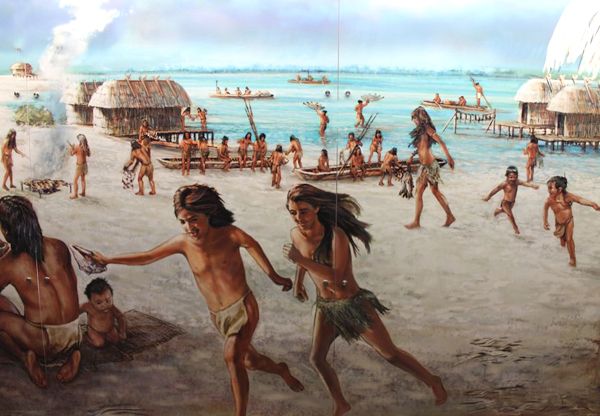
Calusa Tribe of Florida.
The Calusa people were an important tribe of Florida. They formerly held the southwest coast from about Tampa Bay to Cape Sable and Cape Florida, together with all the outlying keys, and extending inland to Lake Okeechobee. They also claimed authority over the tribes of the east coast, north to about Cape Canaveral. They were farmers to a limited extent but were better noted as expert fishers, daring seamen, and fierce and determined fighters, keeping up their resistance to the Spanish arms and missionary advances after all the rest of Florida had submitted.
The Calusa probably had some contact with the people of the West Indies. Still, all the prehistoric sites in this area are related to those of the Indians occupying the Southeastern States, and it is believed that these early inhabitants came into the peninsula from the mainland rather than from the islands.
Cruel, shrewd, and mercenary, they practiced human sacrifice of captives, scalped and dismembered their slain enemies, and were repeatedly accused of being cannibals. They first encountered Europeans in 1513 when, with a fleet of 80 canoes, they boldly attacked Ponce de Leon, who was about to land on their coast, and after an all-day fight, compelled their enemy to withdraw.
They murdered most of the priests, explorers, and adventurers who came among them or who were so unfortunate as to be shipwrecked on their coast.
Even at this early date, they were already noted among the tribes for the golden wealth they had accumulated from the numerous Spanish wrecks cast away upon the Keys in the passage from the south. Two centuries later, they were regarded as veritable pirates, plundering and killing without mercy the crews of all vessels, except the Spanish, so unfortunate as to be stranded in their neighborhood.
Escalante de Fontanedo, the only survivor of a Spanish vessel wrecked on the Florida Keys in 1545, was the first white man to spend any time in South Florida. During the 17 years of his captivity among the Calusa Indians, he was permitted to explore the peninsula and visit the camps of various tribes.
According to Fontanedo, the Calusa often killed their white captives, not out of fear or anger but out of sheer annoyance. The savages might ask the whites to dance or sing, and the captives could not obey because they did not understand the Indians, who thereupon put them to death.

Diorama of Calusa king receiving tribute from a Tequesta chief in the Florida Museum of Natural History, courtesy of Wikipedia.
In 1567, the Spaniards established a mission and fortified a post among them, but both seemed to have been discontinued soon after, although the tribe came later under Spanish influence. About this time, they numbered nearly 50 villages, from one of which the city of Tampa takes its name. By 1600, they were carrying on regular trade with Havana, Cuba.
The constant invasions of the Creek and other Indian allies of the English drove them from the mainland and forced them to take refuge in the Florida Keys. More were evacuated to Cuba, where many of them died. When Spain ceded Florida to Great Britain in 1763, the last remnants of the tribes of South Florida went to Cuba. Those few that remained on the mainland were absorbed into the Seminole tribe; however, their language and culture survived until the Second Seminole War ended.
©Kathy Alexander/Legends of America, updated January 2025.
Also See:
Native Americans – The First Owners of America
Native American Heroes & Leaders
See Sources.