
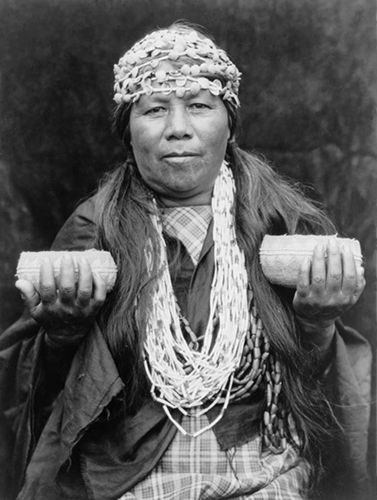
Athapascan Hupa Female Shaman, Edward Curtis, 1923.
The Athapascan Family was the most widely distributed of all the Indian linguistic families of North America, formerly extending over parts of the continent from the Arctic coast far into northern Mexico, from the Pacific Ocean to Hudson Bay at the north, and from the Colorado River to the mouth of the Rio Grande at the south. The languages that compose the Athapascan family are plainly related to each other and stand out from the other American languages with considerable distinctness because of certain peculiarities.
Phonetically, they were rendered harsh and difficult for European ears because of a series of guttural sounds, use of tone, many continuants, and frequent checks and aspirations. Albert Gallatin assigned the name Athabaskan to the language in his 1836 classification of the languages of North America.
The vast differences in physical type and culture, as well as the differences in language, point to a long separation of the family, likely spanning many centuries. The Athabaskan family is conventionally divided into three groups, mainly based on geographic distribution: Northern Athabaskan, Pacific Coast Athabaskan, and Southern Athabaskan. Northern Athabaskan was spoken in northern North America, particularly in Alaska and the Yukon, encompassing 31 distinct languages. The Pacific Coast Athabaskan languages were spoken in southern Oregon and northern California, comprising seven distinct languages. The Southern Athabaskan languages were spoken primarily in the Southwest, including Arizona, New Mexico, Colorado, Utah, and Sonora, Mexico. Various groups spoke the languages of the Apache and Navajo peoples.
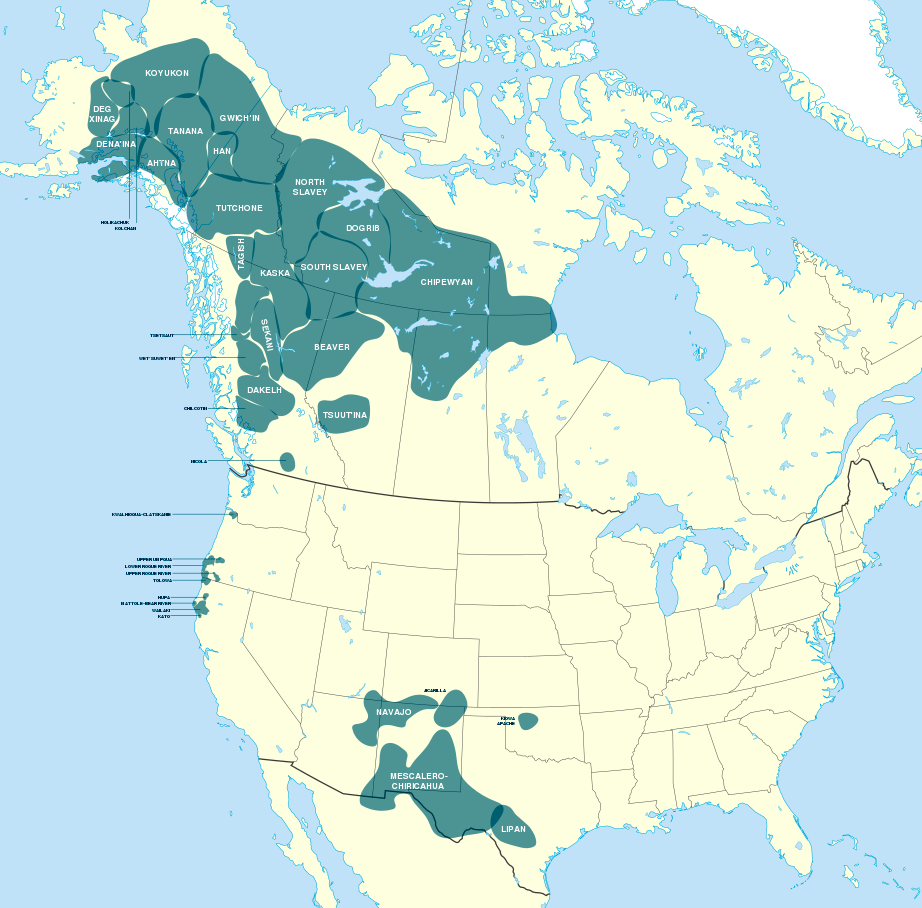
Athabaskan Languages courtesy Wikipedia.
Compiled by Kathy Alexander/Legends of America, updated August 2025.
Also See:
List of Notable Native Americans
Native American Heroes and Legends
Native American Photo Galleries
See Sources.