
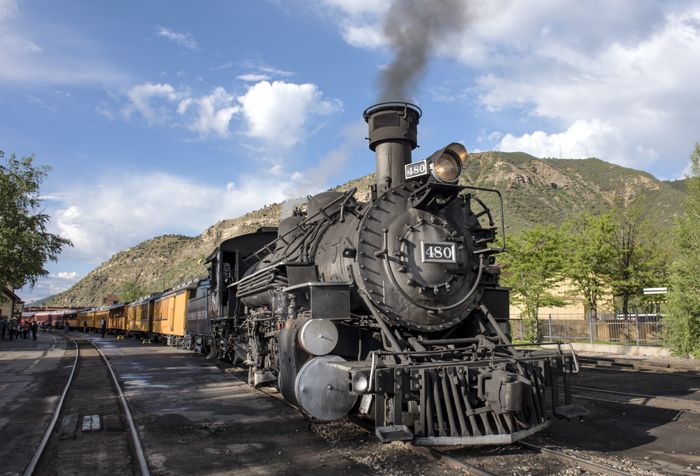
The Durango & Silverton Narrow Gauge Railroad is powered up and ready to leave the Durango, Colorado, station. Photo by Carol Highsmith.
The Durango & Silverton Narrow Gauge Railroad, in continuous operation since 1882, makes its way 45.4 miles from Durango to Silverton, Colorado, through the backcountry of the San Juan Mountains.
A National Historic Landmark, the three-foot narrow-gauge coal-fired, steam-powered railroad winds through breathtaking scenery along the same tracks that miners, cowboys, and settlers of the Old West took over a century ago.
The route was initially opened in 1882 by the Denver & Rio Grande Railway to transport silver and gold ore mined from the San Juan Mountains.
The narrow gauge offered definite advantages to railroad builders, particularly in the Rocky Mountains in the late 19th Century. The Denver & Rio Grande Railroad promoters pointed out that the narrow-gauge system could be constructed for at least 37% less than the broad-gauge system in the same terrain. These narrow-gauge railroads could also use the sharper curves necessitated by rugged terrain without sacrificing safety. They were more efficient in requiring less equipment weight per ton of payload.
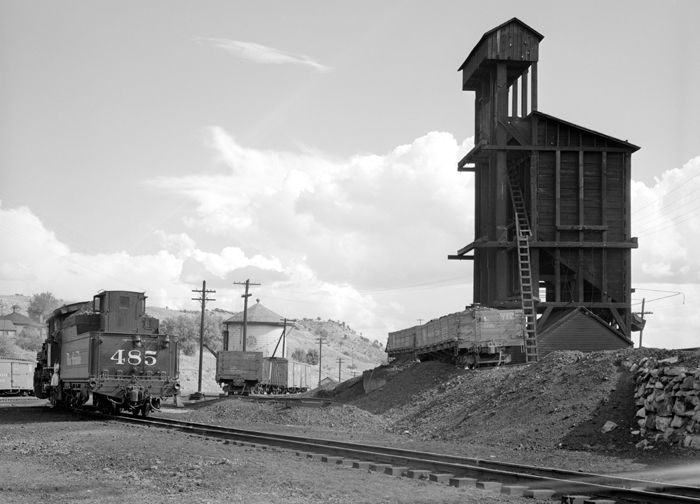
Durango, Colorado, railyard by Russell Lee, 1940.
The lure of the wealth in the “Silvery San Juans” induced the Denver & Rio Grande Railway to begin building westward from the San Luis Valley. Durango was founded by the railroad in 1880, and a line was extended from Antonito, Colorado, to Durango, arriving in July 1881.
By this time, Chief Engineer R.E. Briggs of the Denver and Rio Grande had assembled a staff of experts at locating and grading for narrow gauge construction. G.H. Wigglesworth, assisted by Edward Funke, located the line up the Animas River to Silverton, and grading crews went to work at several locations.
In the fall of 1881, tracklaying north of Durango began, and by December 11, it had been completed as far as Rockwood, while grading had been completed mainly to Cascade Park, nine miles beyond.
Grading and tracklaying proceeded in the gorge of the Animas River. On July 8, 1882, the first passenger train followed the tracklayers into Silverton, touching off a wild celebration that lasted several days. In that year, the “Silvery San Juan” produced $20,000,000 worth of ore, and by 1884, the Denver & Rio Grande had 1600 miles of narrow gauge lines in Colorado and Utah.
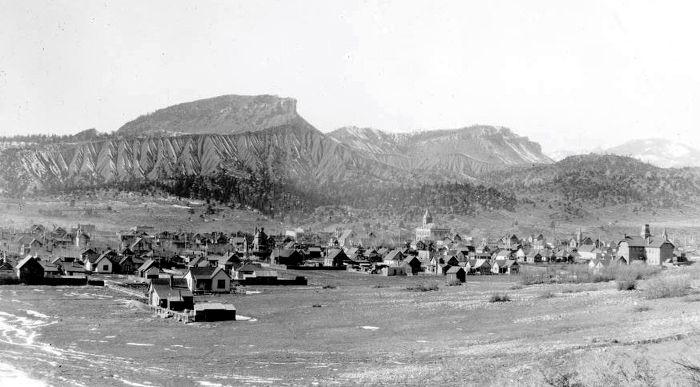
Durango, Colorado, about 1895, courtesy of the Denver Public Library.
Although the line was constructed primarily to haul mine ores, the railroad also promoted it as a scenic route for passenger service. Soon, two or more trains a day each way were available between Silverton and Durango.
Mother Nature often plagued the railroad when snow avalanches blocked the line and floods washed out the tracks. These events frequently halted the trains for several weeks, despite heroic efforts by special snow removal and repair crews.
In 1893, the Silver Panic led to the closure of several mines, but gold was soon discovered in the district. By 1897, gold accounted for half of the region’s mineral output, and newspapers reported that the extensive mining operations were so prolific that even the railroad struggled to transport the ore quickly enough.
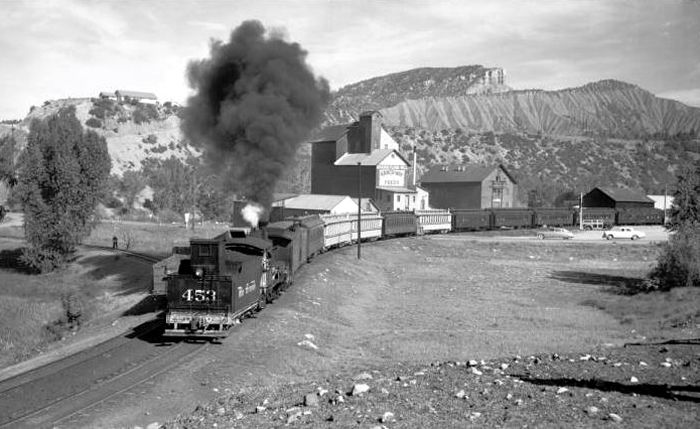
Denver & Rio Grande Railroad in Durango by Robert Richardson, 1951.
The turn of the century brought numerous challenges to the railroad, including snowslides, floods, war, and financial instability. When the U.S. Government entered World War I, it assumed the operation of the railroad. Shortly afterward, the Denver & Rio Grande reorganized due to financial difficulties. In the meantime, many of the mines in the area were beginning to play out.
When World War II began, the U.S. Government requisitioned narrow-gauge equipment for use in Alaska, and the smelter in Durango reopened to process uranium for use in the war. The smelter continued to process uranium instead of silver into the late 1940s.
By 1947, the Silverton railroad branch was in danger of being abandoned. However, a determined staff stepped in and helped to promote tourism to keep the line alive. Bolstered by national exposure from Hollywood movies being filmed along the line in the late 1940s, the railroad created “The Silverton,” a summer-only train service, which in 1947 carried 3,500 passengers.
By 1952, tourist interest had prompted the line management to increase the train’s passenger facilities significantly, and in 1953, summer operations were expanded to three times a week. That year, the railroad carried more than 12,000 passengers.
In 1955, the railroad began actively promoting the line as a tourist attraction, and for the first time in decades, seven-day-a-week operations were resumed during the Summer months.
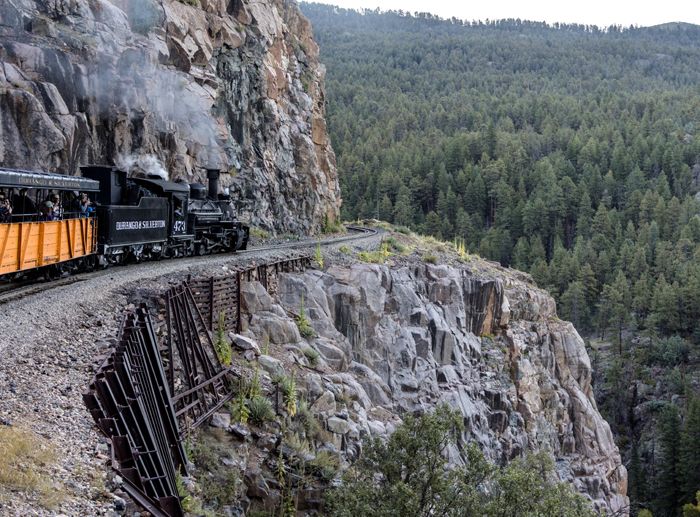
A Durango & Silverton Narrow-Gauge Scenic Railroad by Carol Highsmith.
By 1960, the Denver & Rio Grande did not see the Silverton Branch as worthy of maintenance and filed a petition to abandon the route. However, the Interstate Commerce Commission declined to grant the request due to increased tourist patronage.
The Durango–Silverton line was designated a National Historic Landmark in 1961, and the Denver & Rio Grande Railroad began actively promoting tourism. By 1962, it attracted more than 37,000 passengers during the summer season. The company began investing in additional equipment and maintenance, improved the Durango depot, and facilitated the opening of a Victorian-style shopping district. In Silverton, the rails were extended to Blair Street, delivering tourists directly into town. As ridership grew, the railroad operated a second train to Silverton on certain days.
The last Denver & Rio Grande Railway train to operate into Durango from the east was on December 6, 1968. The states of New Mexico and Colorado purchased 64 miles between Antonito and Chama, New Mexico, in 1970, and it operates today as the Cumbres & Toltec Scenic Railroad.
In 1969, the railroad abandoned the tracks south of Durango, isolating the Silverton branch and leaving the future of the line in question.
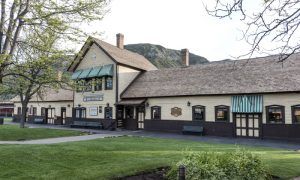
Durango & Silverton Railroad Depot by Carol Highsmith.
By 1971, the Silverton branch and nearby Cumbres and Toltec Scenic Railroad were the only remnants of the Rio Grande’s once extensive narrow-gauge system.
During the late 1970s, the Denver & Rio Grande was actively seeking to sell the Silverton branch. In 1979, Charles Bradshaw, a Florida businessman, expressed interest in purchasing the railroad. On October 5, 1980, the Silverton made its last run under Denver & Rio Grande ownership, marking the end of an era that had begun 110 years earlier.
Bradshaw then founded the Durango & Silverton Narrow Gauge Railroad and began to make improvements. Bolstered by the assistance of the former Rio Grande operating managers and a relatively sizeable staff of new employees, Bradshaw’s plans were set in motion immediately. The older locomotives were restored to operating condition, and the vintage coaches underwent a similar restoration. Durango’s tourist image expanded as new businesses and the revamping of the old railroad town continued to take shape. By 1986, four trains were running to Silverton, with a fifth running to Cascade Canyon Wye.
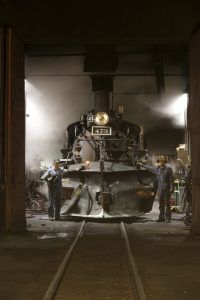
Steam locomotive in the Durango & Silverton Narrow Gauge Scenic Railroad roundhouse in Durango, Colorado. By Carol Highsmith.
Today, the Durango & Silverton Railroad is owned and operated by American Heritage Railways.
The vintage locomotives used to pull the train remain 100% coal-fired and steam-operated. Because of the railroad’s booming tourist business, more daily trains departed Durango today than at the height of the mining boom a century ago.
Though the mines and mills are closed, and ghost towns dot the mining districts, the old Denver & Rio Grande Railroad whistle still echoes from the canyon walls.
The railroad runs 45 miles from Durango to Silverton between May and October and 26 miles from Durango to the Cascade Station in winter. The trains take 3.5 hours to run the 45 miles each way between Durango and Silverton, with a 2.25-hour layover in Silverton.
The Durango & Silverton Railroad operates two museums, one in Durango and another in Silverton. Both feature historic locomotives and railway equipment.
More Information:
Durango & Silverton Narrow Gauge Railroad
479 Main Avenue
Durango, Colorado 81301
Reservations: 970-247-2733
General Information: 970-247-2733
530-622-3470
©Kathy Alexander/Legends of America, updated August 2025.

Durango & Silverton Railroad Map
Also See:
Silverton – High in the San Juans
Sources:
Durango, Colorado
Durango Train
National Park Service
Wikipedia