

Scary Plantation House
Delphine LaLaurie and Her Haunted Mansion
Margaret Haughery & the Infant Asylums of New Orleans
More Haunted New Orleans (See Below)
New Orleans, Louisiana, is said to be the most haunted city in the United States. For years, it has been known for its ghost sightings, haunted buildings, and gruesome tales. The city is so rich with dark secrets and lore that it has become an essential part of its character.

Marie Laveau, Voodoo Queen of New Orleans.
Famous for its practitioners of the mystical arts, including Voodoo queens, professed vampires, and witches, it comes as no surprise that New Orleans is a place where the dead refuse to rest.
Many of these restless spirits died during Yellow Fever epidemics that raged in New Orleans in the 1800s, peaking in 1853 with 7,849 deaths. Forty-one thousand died from yellow fever in the 19th and early 20th centuries. A mosquito-borne virus, yellow fever cases peaked during warmer months; the illness particularly ravaged immigrants new to the city. Once contracted, the sick suffered headaches, muscle soreness, fever, and jaundice that were often followed by liver and kidney failure, hemorrhaging, seizures, coma, and death.
For years, families who had the means to do so fled during the summer epidemics. During the worst of these, one out of every ten people who stayed behind would die. During these times, corpse wagons circled the neighborhoods, picking up bodies, and mass graves lined the city’s perimeter.
With New Orleans’ endless list of historic buildings and fascinating history, it is no surprise that dozens of places and buildings are allegedly haunted. Each year, hundreds of people visit and stroll through the city, encountering not only raucous revelers but also ghostly figures, cobwebbed mansions, haunted history, murdered slaves, pirate tales, disturbing stories, and more.
The city has also been the backdrop for occult-themed films and television shows, from True Blood and Interview with a Vampire to American Horror Story Coven.
There are numerous ghost tours available in New Orleans, ranging from haunted sites in the French Quarter to cemetery tours, haunted pub crawls, crime tours, a Ghost, Voodoo, Vampire Walking Tour; Ghosts, Gods, and Gangsters; and more. Visitors can also join a mystical seance, spend a night in a haunted hotel, or visit a restaurant, bar, or museum with a history of entertaining ghostly guests.
More Haunted New Orleans

Andrew Jackson Hotel in New Orleans, Louisiana.
Andrew Jackson Hotel – The first building at this site was an all-boys boarding school that opened in 1792 for children who lost their parents to the Yellow Fever epidemics. Unfortunately, in December 1794, a large fire swept through the city, destroying the boarding school. Several children perished in the fire. Afterward, The site became the home of a U.S. Federal Courthouse, most famously known for where Major General Andrew Jackson was fined $1,000 for contempt of court. The courthouse remained until the late 1800s when it was eventually demolished. In its place, the current two-story building began to be built in 1888. Today, the Andrew Jackson Hotel maintains its rich character and charm, which helps paint vivid pictures of its storied past. It is listed on the National Register of Historic Places and is also considered one of the most haunted hotels in New Orleans. The five students who died in the fire in 1794 still play and cause mischief, and their laughter and footsteps are often heard throughout the hotel and courtyard. The boys’ spirits, along with one believed to be a former housekeeper, move personal items and furniture around guests’ rooms, hide items as a joke, and the housekeeper fluffs pillows and straightens towels. The hotel is at 919 Royal Street.
Antoine’s Restaurant – Allegedly, Antoine Alciator, the founder of this famous family-owned restaurant, returns to check on his ancestors. Other spirits in 19th-century clothing have been seen peering from mirrors in the washrooms. It is at 713 St Louis Street.
Bourbon Orleans Hotel – This place started as the original Theatre d’ Orleans in 1806, but the War of 1812 delayed the opening until 1815, and it was destroyed by fire in 1816. In 1817, entrepreneur John Davis purchased the land, rebuilt the Orleans Theatre, and added the Orleans Ballroom. The 1,300-seat theatre placed New Orleans on the map as the opera capital of the United States throughout the 19th century, holding European operas, masquerade balls, carnival balls, and more for Creole society and was the setting for the most select affairs in New Orleans. In 1866, a fire swept through the area, destroying the theater but sparing the Ballroom. By 1881, the Sisters of the Holy Family acquired the Orleans Theater and Ballroom for use as a school, orphanage, and convent, where they remained for 83 years. In 1964, the Sisters sold the property to the Bourbon Kings Hotel Corporation, and a grand opening was held in July 1966. Today, the Bourbon Orleans Hotel offers the rich legacy of a historic hotel with modern amenities, gracious hospitality, and welcoming service. Once the home to the famous Quadroon Balls, a lonely ghost is often seen dancing beneath a crystal chandelier. Another spirit is a nun seen slapping a man working on a stairwell for swearing. Also spied are a ghostly Confederate soldier on the sixth and third floors and children running from nuns. The hotel is at 717 Orleans Street.

Carousel Piano Bar & Lounge, New Orleans, Louisiana.
Carousel Piano Bar & Lounge – Famous for being the only revolving bar in New Orleans, it serves a variety of patrons, but not all cash out at the end of the night. Rumor has it that the ghosts of former employees and previous guests of the Hotel Monteleone, where the bar resides, roam and sometimes engage in mischief in the bar and the rooms and hallways. Stories and sightings range from the mysterious opening and closing of locked doors to ghostly jazz tunes heard late into the night. It is located at 214 Royal Street.
Faulkner House Books – William Faulkner wrote his first novel while staying in this house in the 1920s. People swear they’ve seen his ghost sitting at the writing desk inside and say you can smell his pipe. It is located at 624 Pirates Alley.
Hermann-Grima House – Built in 1831 for prosperous Creoles, this house is said to be alive with pleasant, friendly Southern ghosts who scatter scented roses and lavender around the rooms and light the fireplaces to make it cozy. It is at 820 St Louis Street.
Hex Tomb – Within St. Louis Cemetery #1, there are many massive tombs known as society tombs that are mass graves for members of organizations. The Italian Mutual Benevolent Society tomb, also known as the “Hex Tomb,” is one of the most beautiful structures in the city, carved from imported Italian marble. It is the tallest structure in the cemetery. The tomb is believed to have a ‘hex on it because the man who built it was also the first to be buried inside it. In building it, he contracted yellow fever and never returned to Italy.

Hotel Monteleone in New Orleans, Louisiana, by Kathy Alexander.
Hotel Monteleone – Paranormal investigations at this hotel have involved contact with several spiritual entities, including several former employees and a friendly toddler named Maurice Begere. This place began when Sicilian-born Antonio Monteleone arrived in New Orleans in about 1880. After opening a successful cobbler shop in the French Quarter, Monteleone bought a 64-room French Quarter hotel on the corner of Royal and Iberville streets in 1886. Then, he called the Commercial Hotel and added multiple additions and expansions to the property. In 1908, the name of the hotel was changed to Hotel Monteleone. When he died in 1913, his son, Frank Monteleone, inherited the grand hotel, which stayed within the family for years. However, by 1954, its luster had faded, it was demolished, and a new hotel with a Beaux-Arts flare was built. Today, a stay at Hotel Monteleone has a dose of haunted history. Though several entities are said to lurk within its confines, the most famous is the ghost of a three-year-old boy named Maurice Begere, who still likes to play pranks on the 14th floor. In the late 1800s, Maurice’s parents were frequent guests of the Hotel Monteleone. One night, while his parents were out, Maurice was left with a nanny, fell gravely ill, and passed away. Today, guests have reported hearing his footsteps and laughter and seeing the toddler on the 14th floor where he perished. The hotel is at 214 Royal Street.
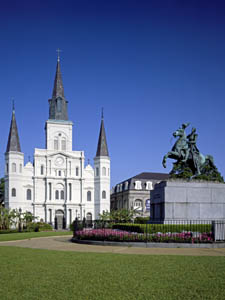
St. Louis Cathedral on Jackson Square in New Orleans by Carol Highsmith.
Jackson Square – Charming and picturesque, it’s easy to forget that Jackson Square was a site for public executions in the 18th and 19th centuries. More than 100 enslaved people were executed and decapitated there following the 1811 German Coast Uprising, known as the country’s largest slave revolt. Their bodies were left to rot, and their heads were placed on the city gates. It is located at 701 Decatur Street.
Jean Lafitte’s Blacksmith Shop – Lafitte’s Blacksmith Shop Bar, named after the infamous pirate Jean Lafitt, is one of the oldest operating bars in America and the second-oldest building in the French Quarter. Almost the entire bar is lit by candlelight, which brings on an appearance that emits a welcoming aura to ghosts. Most of the time, the ghosts here are seen in a corner in the mist or shadows and only disappear when people take notice. Over the years, as bar patrons await the last call, they’ve snapped photos or spotted a vision of a still-unknown woman in black, assorted pirates, and even Lafitte himself. It is located at 941 Bourbon Street.
Jimani House – On June 24, 1973, an unknown arsonist set a fire in the stairwell leading to UpStairs Lounge, a gay bar. The old dry wood and flammable carpeting quickly went up in flames, trapping dozens of men and women inside. Bars across the windows prevented them from leaping to safety. In the devastating blaze, 32 people lost their lives. It was the largest mass killing of LGBTQ people until the Pulse nightclub shooting in 2016. Though the Upstairs Lounge never reopened, the bar on the building’s first floor, The Jimani, is still in business. Patrons have heard voices or felt unseen presence throughout the building. It is located at 141 Chartres Street.
LaLaurie Mansion – This mansion is said to be one of the most haunted places in what is called the most haunted city in the United States. If this building does house some ghostly entities, it comes as no surprise because of the property’s history of brutality. Madame Delphine MacCarthy Lalaurie and her third husband, Dr. Leonard Louis Nicolas LaLaurie, moved into the mansion in 1832. Known for throwing lavish parties, a fire occurred during an event in 1834, and when firefighters entered the home to extinguish the flames, they uncovered unspeakable horrors in the attic, including the torture and mutilation of at least seven people. Stories mentioned horrific details of how LaLaurie performed twisted experiments on her slaves, severed limbs, and kept them in cages. A private residence today, it can only be seen from the street and is not available for public visits or tours. It is located at 1140 Royal Street in the French Quarter.

Le Petit Theatre in New Orleans, Lousiana, courtesy Wikipedia.
Le Petit Theatre – This theatre’s original structure was built in the 1780s but was destroyed during the second great fire in New Orleans in 1794. It was rebuilt a few years later. During the Civil War, Union General Benjamin Butler took over the theatre. In 1922, the Drawing Room Players bought the building. Like many theaters, it has its share of ghost stories, including the tragic tale of a young choral girl who took the eye of the producer and found herself starring in leading roles. Later, however, the producer moved on to another young girl, and she found herself demoted to lesser roles. As vengeance, she hung herself in the middle of the opening night performance of the largest production of the season.
Legend says she continues to appear to the audience each opening night as a shadowy form hanging against the stage’s backdrop. Another woman who was getting ready to be married committed suicide by jumping off the side of the theatre. Allegedly, her spirit can still be seen, standing in the very spot where she took her last breath of air before leaping to her death. Another tragic death occurred when an actress who was involved with one of the theatre’s maintenance workers was on an elevated service platform above the main stage when she lost her footing and slipped and fell to her death. The spirit of the actress is said to haunt the catwalk, appearing in the evening hours. One more ghost is the spirit of a former manager believed to have committed suicide in the staff office who is said to be fearsome. The night shift employees have reportedly experienced his presence, felt his eyes gazing upon them, their doors inexplicably slamming shut, and have had their belongings suddenly disappear. Some guests have also reported seeing the ghosts of the Union soldiers wandering the hallways and the sounds of muffled voices discussing military strategies. The theatre is at 616 St Peter Street, across from St. Louis Cathedral.
Marie Laveau’s House – Voodoo queen Marie Laveau lived on this site between 1839 and 1895. Her spirit is said to still conduct wild voodoo ceremonies here. It is at 1020 St. Ann Street.
The Mortuary – This cemetery-adjacent property was built as a home in 1872. By the 1930s, it was converted into a full-service funeral home. The funeral home operated until Hurricane Katrina in 2005. After the flood, the building survived but was left unkept. In 2007, the mansion was converted into a haunted house. It is located at 4800 Canal Street.

Muriel’s Jackson Square in New Orleans, Louisiana.
Muriel’s Jackson Square – This restaurant serves contemporary Creole Cuisine in an elegant 19th-century building on the corner of Jackson Square, alongside the Saint Louis Cathedral. However, the site where it stands was first home to a small cottage built in the 1700s and believed to have been used as a holding place for slaves and servants. In the late 1700s, Jean Baptiste Destrehan tore it down and built a grand home for his family. Over the years, the property had many owners until the Great New Orleans Fire destroyed part of it in 1788. Pierre Antoine Lepardi Jourdan purchased and restored the property to its original elegance and beauty. Unfortunately, Jourdan lost his beloved residence in a poker game in 1914 and afterward committed suicide on the second floor in what is now Muriel’s Seance Lounges. Today, the previous owner’s spirit continues to move throughout the building, and guests see a sparkling light drifting through the seance room. Objects sometimes appear to move of their own accord; dark shadows appear where there should be none, and voices and noises are heard from empty rooms. However, those who have seen or felt a presence in this establishment have never felt threatened. Muriel’s is located at 801 Chartres Street.
Napoleon House – This restaurant and bar has had a few different roles since it was built in 1797 as a residence. Because it served as a hospital during the Civil War, the ghost of a Confederate soldier can be spotted walking on the second-floor balcony. Other common ghostly phenomena are from the 20th century, including the figure of a little old lady sweeping the balcony and the mysterious reappearance of glasses on the bar once everything has been cleaned and put away for the night. It is located at 500 Chartres Street in the French Quarter.
Old Absinthe House – This 200-year-old bar is said to be haunted by famous customers who used to drink there, including General Andrew Jackson, voodoo queen Marie Laveau, and the pirate Jean Lafitte. The doors open and close independently, and bottles, glasses, and chairs have been seen moving around the bar. It is at 240 Bourbon Street.

Putting out the fire at the French Opera House in New Orleans in December 1919.
Old French Opera House Site – The French Opera House opened on December 2, 1859. Built in the style of European grand operas at the corner of Bourbon Street and Toulouse Street, it showed not only opera performances but also Vaudeville acts and comedies. In the 1800s, it was a cultural center and a theatre used during Mardi Gras as a meeting place for revelers before parades and to house the Mardi Gras balls. It was destroyed by fire in December 1919. Damages from the fire were estimated at $250,000, and despite efforts to rebuild, the theatre was closed for good. After the fire, the site was used for several purposes. It had sat vacant for 40 years before developers erected the five-story Downtowner Motor Inn. Today, the Four Points by Sheraton occupies the corner of Bourbon and Toulouse. This site is said to be haunted by Marguerite, the ghost of an aging Storyville madam. Spurned by her young lover, she committed suicide after leaving a note that read, “I will return and kill those that have hurt me!”

Omni Royal Orleans in New Orleans, Louisiana.
Omni Royal Orleans – Built on the site of a former slave market, the St. Louis Hotel was built by Creoles in 1838 as a place to relax, unwind, and party. The luxurious oasis in the city center was known in high society and was a significant slave trade hub in the South. Regular auctions were held at the hotel, and plantation owners and people seeking domestic servants would bid within the hotel’s walls. In 1841, a fire swept through the hotel, destroying it. Afterward, it was rebuilt with fire-resistant materials. During the Civil War, the hotel also served as a medical facility for Union Soldiers after the city was seized in 1862. During Reconstruction, the state purchased the hotel, and it became a government building. In 1915, it was battered by a hurricane and started deteriorating in the following decades. In about 1960, it was rebuilt and named the Omni Royal Orleans. Today, the staggering size and design of the four-story building in the French Quarter welcomes visitors and is one of the most highly regarded hotels in the Crescent City. However, its dark and dismal past of slavery, war, fire, and evil has left its mark on the hotel with several ghostly apparitions and paranormal experiences. The ghost of a housekeeper allegedly walks up and down the hallways, knocking on doors, tucking guests into bed, arranging their toiletries, and repacking bags. Others report seeing half-visible apparitions of African Americans looking lost, walking in hallways, before vanishing. More often, groans and crying are heard in the corridors. It is located at 621 Saint Louis Street.
Pere Antoine’s Alley – Pere Antoine was a beloved priest who worked tirelessly for the poor. Visitors to the alley alongside St. Louis Cathedral have said they could see Pere Antoine’s ghost in the early morning, clad in Capuchin black and sandals. He’s also been seen inside the Cathedral.
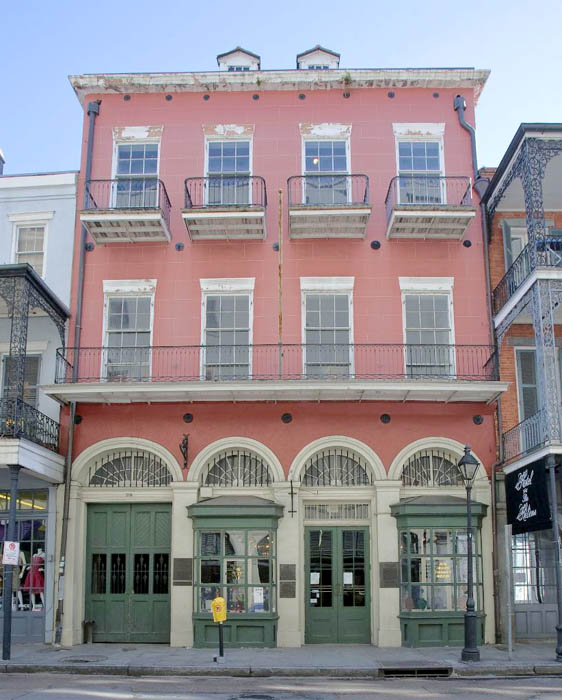
New Orleans Pharmacy Museum by John Riley, courtesy of the Historic New Orleans Collection.
Pharmacy Museum – This museum was originally home to the first licensed pharmacist in the United States. At that time, medicine was barbaric, and the pharmacists performed exploratory surgeries, such as drilling holes in the skull to release pressure to remedy headaches and using dangerous chemical cocktails, especially on women. The pharmacist’s ghost is said to haunt the building, opening cabinets, throwing books, moving items, rearranging locked displays, and frequently setting off the burglar alarm. Other ghosts are also said to lurk within the museum, including a woman that some think may have been a prior victim and two children. It is located at 514 Chartres Street.
Pirates Alley – Also known as Rue Orleans, this alley is 600 feet long and 16 feet wide and acts as a throughway between St. Peters streets. Establishments along this alley, such as the Faulkner House Books store, were initially known to harbor all kinds of spirits wearing pirate and sailor-like attire at night. Many have seen spirits walking down the road, only to vanish the minute they turn around to take a second glimpse.
Saint Louis Cemetery #1 – Often referred to as “The City Of The Dead,” this cemetery is known for its graves that sit above the ground in disintegration and collapse. Established in 1789, St. Louis Cemetery No. 1 is the oldest extant cemetery in the City of New Orleans. In 1788, the City of New Orleans suffered several significant setbacks, including the first of two great fires and an epidemic that taxed the already full cemetery located on St. Peter Street, bounded by St. Peter, Burgundy, Toulouse, and Rampart Streets. In response to concerns from physicians about the spread of diseases, the acting city government ordered the earlier cemetery to be closed and a new cemetery to be established further away from the population. The Church selected a 300-square-foot parcel bordering marshy swampland outside of the confines of the fortified city and about 40 yards from the rear garden of the then-location Charity Hospital as the site for the new cemetery. A picket fence was erected around its perimeter, and burials began immediately. In 1975, St. Louis Cemetery No. 1 was listed on the National Register of Historic Places.
It’s also considered one of the most haunted cemeteries in the United States. In just one block, this burial ground holds over 700 tombs and over 100,000 dead. The ghosts of St. Louis Cemetery #1 are numbered in the hundreds. For over 200 years, there have been reports of people having run-ins with the ghosts that call St. Louis Cemetery #1 home.
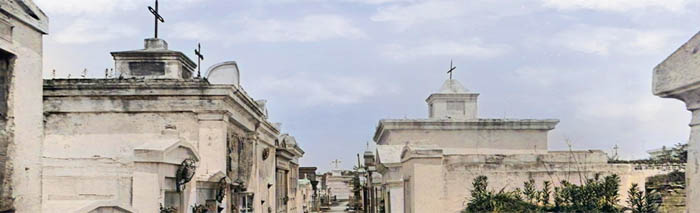
The St. Louis Cemeteries in New Orleans are called the Cities of the Dead.
It is the resting place of iconic voodoo queen Marie Laveau. A free person of color, Laveau worked as a hairdresser—and secret-holder—for many affluent locals, and she used that knowledge to leverage her status and influence in the city. Rumor has it Laveau’s spirit still grants wishes to those who perform a specific ritual at her grave. Another ghost is that of Henry Vignes, a 19th-century homeless sailor. Upon his arrival in New Orleans, he made his home at a local boarding house. However, he was constantly worried about his important papers while away. Before departing on another voyage, he asked the owner of the boarding house to keep his papers if he died. These papers included his family tombs. The owner promised he need not worry, but sold Henry’s family tomb while he was at sea. When he returned, he discovered the theft but could never rectify the problem. A short time later, he died, and his body was buried in an unmarked grave in the pauper’s section of St. Louis Cemetery #1. Today, his ghost is still seen wandering the cemetery and asking visitors if they know where the Vignes tomb is located. Another lost ghost is Alphonse, who wanders the cemetery, trying to find a place to rest his soul. His spirit has been known to take a visitor’s hand, and smiling widely, he asks them to bring him home. He is also seen gathering the flowers from other graves and placing the offerings on his tomb. The cemetery is located at 501 Basin Street. Tours of St. Louis Cemetery No. 1 are offered only by Cemetery Tours New Orleans.
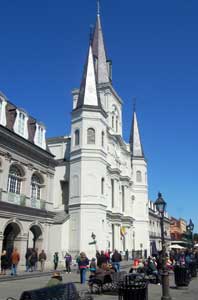
St. Louis Cathedral in New Orleans by Kathy Alexander.
St. Louis Cathedral – This majestic church is believed to have been haunted by Pere Dagobert, pastor of St. Louis Cathedral, in the mid-1700s. After worship, people have seen Dagobert’s spirit walking with his head lowered through the aisles.
St. Roch Chapel & Cemetery – St. Roch Chapel and Cemetery were built to show gratitude to the patron saint of plague sufferers after the saint answered the prayers of a local priest, sparing his entire congregation from the 1867 Yellow Fever Epidemic. Within the chapel is a room containing offerings from those wishing to be healed, including prosthetics, braces, private notes, anatomical casts, old dolls and stuffed animals, and locks of hair — all left as tokens of thanks or offerings to St. Roch, the patron saint of healing. Two apparitions are said to haunt the cemetery, including a cloaked figure known for walking through walls and a large, unearthly black dog. St. Roch is also the patron saint of dogs. It is located at 1725 Saint Roch Avenue.
Sultan’s Palace – Also known as the Gardette-LePretre House, This three-and-a-half-story mansion with cast-iron filigree balconies on its upper levels was built in 1836 by Philadelphia-born Joseph Coulon Gardette, a dentist who had arrived several years earlier. Though successful in his career, he sold the home several years later to Jean Baptiste LePrete, a wealthy bank merchant and plantation owner, in 1939. He owned it until 1878. At some point, Lepretre was approached by a man of Middle Eastern descent and asked if he would rent his city house to his brother, who was a sultan. Because he spent much of his time on his Plaquemines Parish plantation, he agreed. Soon after, a ship arrived in the port of New Orleans, disembarking with veiled women dressed in vibrant silks and satins, eunuchs dressed in dark military clothing, the Sultan, lavish furnishings, and a bounty of gold and jewels. Within no time, several extravagant private parties occurred.
LePretre didn’t know that the man was a fugitive, having stolen his brother’s riches and harem. A bad storm hit the city during his stay, forcing residents to shut themselves inside. The following day, when the storm cleared, a man strolling down the street found large amounts of blood trickling down the front steps of the Sultan’s Palace. When authorities arrived, they pushed the front door open and found corpses all over the floor. Some had been flayed open, while many of the others had missing limbs. They found a single hand sticking out from the ground in the courtyard with its fingers spread wide. It was none other than the Sultan’s brother. It was believed that a gang of assassins had been dispatched by the Sultan to descend upon the house and cut down the brother and the harem with swords.
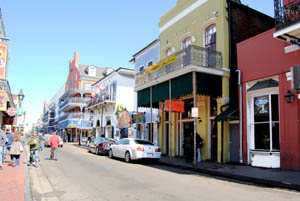
Bourbon Street in New Orleans, Louisiana, by Kathy Alexander.
Though the tale has long been considered more fiction than truth, some say the ghost of the Sultan’s brother still walks the halls of the house today. There are no extant newspaper accounts that lend credence to the tale. Still, the legend persists, with a spectral Confederate Soldier and an unknown woman wandering throughout the building and tales of moving and missing objects. The mansion is located at 716 Dauphine Street. Today, it is a private condominium that is off-limits to tourists or visitors.
Ursuline Convent – In the 1700s, the Catholic Diocese sent young girls from the French convents to New Orleans to find husbands. Legend says they arrived with casket-shaped chests containing personal effects and were dubbed the “Casket Girls.” When they were married off, the chests they had left behind were opened, but nothing was found inside. Some say the caskets held vampires from the old country. Many ghost hunters and curious visitors stop by the convent to observe the third-story shutters, which were said to be nailed shut by holy nails to keep the undead inside.
© Kathy Alexander/Legends of America, July 2024.
Also See:
Haunted Cities of the Dead – New Orleans
Jean Lafitte – A “Hero” Pirate
New Orleans, Louisiana – The Big Easy

Voodoo dolls at the Voodoo Museum in New Orleans, Louisiana.
Sources:
Andrew Jackson Hotel
Bourbon Orleans
Curbed New Orleans
Ghost City Tours
La Galerie Hotel
New Orleans.com
New Orleans French Quarter
Nola.com
USA Today
Where Y’at