
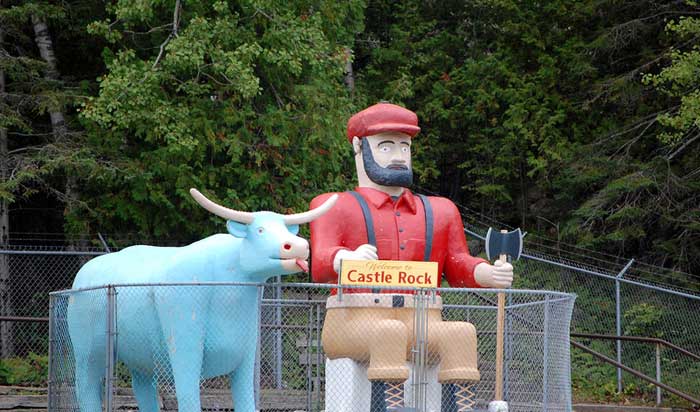
Castle Rock Paul Bunyan Blue Ox in St Ignace, Michigan.
Paul Bunyan is a giant lumberjack in American folklore who has long been the hero of the American logging camps. His exploits, which revolved around the tall tales of his superhuman labors, were told by the fires of bunkhouses in the northern camps from Wisconsin to Maine, from Minnesota to Oregon, to Washington and California for decades.
Customarily accompanied by Babe, the Blue Ox, his character originated in the oral traditions of North American loggers, and at one time, all lumberjacks believed or pretended to believe that this great man lived and was the pioneer in the lumber country. Some older men even claimed to have known him or his crew members. His supposed grave is even marked in Kelliher, Minnesota. Perhaps he was a “real” man who worked as a swamper, shaker, or lumberjack, more skillful and clever than average, about whose exploits grew.
After his death, his fame probably spread from camp to camp, and more tales were added to those told about him. Thus, gradually, he became, in time, an exaggerated type of lumberjack and the hero of more exploits than he could have carried out in his lifetime.
Where these tales originated is unknown, but they were passed down from one generation of lumbermen to another for years, dating back well into the early days of lumbering in the Northeast. In their slow migration westward, the Lumberjacks carried the tales freely from camp to camp into all of the lumbering states of the North and the forests of Canada.

Paul Bunyan in Eau Claire, Wisconsin by Carol Highsmith.
Bunyan stories were usually told in the evening around the fires in the bunk-houses, with many of the older narrators speaking in a French-Canadian dialect, and the stories were often full of the technical jargon of the woods. Usually, the stories were told to arouse the wonder of the tenderfoot or simply as contributions in a contest in yarning. They were often of a grotesque and fabulous type, and they were all, more or less, closely related to the exploits of Bunyan and his lumbering crew. “That happened,” said the narrator, “the year I went up for Paul Bunyan. Of course, you have all heard of Paul.” And so the tale began. A bigger yarn then matched it, and the series grew.
The scenes of the exploits narrated were often fictitious, like the Round River in section 37 of the Big Onion River, three weeks this side of Quebec. Often, too, the lumberjacks told of events that they said occurred on another lumbering stream than the one they were working on; thus, the men of the Flambeau camps told of the deeds of Paul Bunyan on the Wisconsin River or the Chippewa River. Sometimes, the storytellers abroad tell of his doings, for example, among the big trees of Oregon, or they would tell of what happened when Paul was a boy on his father’s farm. Usually, the tales were supposed to have occurred in the “good” days of lumbering, some forty or fifty years back when the country was new and in localities not far from the camps where the yarns were told.
Paul Bunyan was a powerful giant, said to have been seven feet tall and had a stride of seven feet. He was famous throughout the lumbering districts for his physical strength and ingenuity, which helped him to face difficult situations. He was so powerful that no man could successfully oppose him, and his ability to get drunk was proverbial. So great was his lung capacity that he called his men to dinner by blowing through a hollow tree a blast so strong that it blew down the timber on a tract of 60 acres, and when he spoke, the limbs sometimes fell from the trees. To keep his pipe filled required the entire time of a swamper with a scoop shovel. Bunyan had no skill in the gentle art of writing. He kept his men’s time by cutting notches in a stick of wood, and he ordered supplies for camp by drawing pictures of what he wanted. His ingenuity failed on one occasion; he ordered grindstones and got cheeses. “Oh,” says Paul, “I forgot to put the holes in my grindstones.”
No undertaking was too great for Paul. Lumberjacks said that he was the man who logged the timber off North Dakota. He also scooped out the hole for Lake Superior. This he used for a reservoir as he needed water to ice his logging roads. The Mississippi River was caused by overturning a water tank when his ox slipped. Over the years, his legend grew to include his cousin, Tony Beaver, who cut tall timber in the forests of the South, and his brother, Pecos Bill, who reigned over the cow camps and cattle trails from Texas to beyond the Canada boundary. Kemp Morgan, a waif whom Paul adopted, dug all the important oil wells in Texas and Oklahoma.

Lumberjacks in California.
Bunyan was assisted in his lumbering exploits by an incredible blue ox, a creature with the strength of nine horses and weighed, according to some accounts, 5000 pounds, and according to others, twice that. The ox measured from tip to tip of his horns just seven feet, exactly his master’s height. Other accounts declared that the ox was seven feet—or seven ax handles—between his eyes and fourteen feet between his horns. Initially, he was pure white, but one winter in the woods, it snowed blue snow for seven days, and Bunyan’s ox, from lying out in the snow all winter, became and remained a brilliant blue. Many of the Bunyan legends were connected with the feats performed by the ox. Bunyan’s method of peeling a log was as follows: He would hitch the ox to one end of the log, grasp the bark at the other end with his powerful arms, give a sharp command to the animal, and, presto, out would come the log as clean as a whistle. On one occasion, Paul dragged a whole house up a hill with the help of his ox, and then, returning, he dragged the cellar up after the house. Occasionally, as might have been expected from so giant a creature, the ox got into mischief about camp. One night, for example, he broke loose and ate up two hundred feet of tow-line.
One favorite tale connected with the blue ox was that of the buckskin harness. One day, old Forty Jones of Bunyan’s crew killed 200 deer by tripping a key log that supported a pile of logs on a hillside above the place where the animals came to drink. The skins were made into a harness for the blue ox. Some days later, while the cook was hauling a log in for firewood, it began to rain, the buckskin began to stretch, and by the time the ox reached camp, the log was out of sight around a bend in the road with the tugs stretching back endlessly after it. The cook tied the ox and went to dinner. While eating, the sun came out boiling hot, so he dried the buckskin harness and hauled the log into camp.
A lumberjack told one tale: When Paul Bunyan was driving a large bunch of logs down the Wisconsin River, the logs suddenly jammed in the Dells. The logs were piled 200 feet high at the head and were backed up for one mile upriver. Paul was at the back of the jam with the Blue Oxen, and while he was coming to the front, the crew tried to break the jam, but they couldn’t budge it. When Paul arrived at the head with the ox, he told them to stand back. He then put the ox in the old wise in front of the jam. Then, standing on the bank, shot the ox with a 303 Savage Rifle. The ox thought it was flying and began to switch his tail. The tail commenced to go around in a circle and upstream, and, do you know, that ox switching his tail forced that stream to flow backward, and eventually, the jam floated back also. He took the ox out of the stream and let the stream and logs go.
Most of Paul Bunyan’s exploits were centered around the Round River. Here, Bunyan and his crew labored all winter to clear the pine from a single forty. This was a most peculiar forty, shaped like a pyramid with heavy timber growth on all sides. The attention of skeptics who refused to believe in the existence of Pyramid Forty was sure to be called by the storyteller with a short leg, a member; the listener was solemnly assured of Bunyan’s crew, who got his short leg from working all winter on one side of the pyramid, and who thus earned the nickname of “Rockin’ Horse.” Bunyan’s crew cleared one hundred million feet of pine from this single forty, and in the spring, they started it down the river. Then began the difficulty, for it was not until they had passed their old camp several times that they realized the river was round and had no outlet. According to another version, this logging occurred on a lake with no outlet.
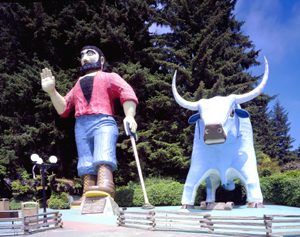
Statues of the legendary lumberjack Paul Bunyan and his faithful blue ox, Babe.
His logging crew on the Big Onion River, “the winter of the blue snow,” was so significant in about 1862 or 1865 that the men were divided into three gangs. Of these, one was always going to work, one was always at work, and the third was always coming home. The cooking arrangements for so many men were naturally on an immense scale. Seven men with seven wheelbarrows were busy wheeling the pruned stones away from camp. The chipmunks ate these and grew as big as tigers. The cook stove was so extensive that three forties had to be cleared bare each week to keep up a fire, and an entire cord of wood was needed to start a blaze. One day, as soon as the cook had put a loaf of bread into the oven, he started to walk around the stove to remove the loaf from the other side, but long before he reached his destination, the bread had burned to a crisp. Such loaves were gigantic —so big that after the crew had eaten the insides out of them, the hollow crusts were used for bunk-houses or, according to a less imaginative account, for bunks. One legend reported that the loaves were not baked in a stove but in a ravine, or dried riverbed with heat provided by blazing slashings along the sides. Paul had much trouble with his cooks. He always had to hire new ones. One got lost between the potato bin and the flour bin and nearly starved to death before he was found. The horn that Paul or the cook used to call the men to dinner was so big that it once blew down ten acres.
The next time, the cook blew it straight up, and that caused a cyclone. The dining room was so large that when a man told a yarn at one end, it grew so big by the time it reached the other that it had to be shoveled out. Two men carried doughnuts from the kitchen on poles, which they carried on their shoulders. Sometimes, they were rolled down the length of the tables, the men catching them as they went by. Big Ole, the blacksmith, cut the holes with a punch and sledge. Big Ole was Paul’s blacksmith at the Big Onion camp. He was a powerful man, and the metal ring could be heard in the following country when he struck his anvil. He alone could shoe Babe, the ox, single-handed. Once, he carried two of his shoes for a mile and sunk knee-deep in the solid rock at every step. Every time the ox was shod, a new iron mine had to be opened.
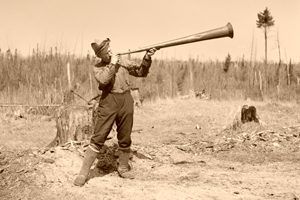
Cook blowing dinner horn for lumberjacks in Michigan.
Such a stove as Bunyan’s demanded, of course, a pancake griddle of monstrous size. Bunyan’s cook, Joe Mufferon, used the entire top of the stove for a griddle and greased it every morning by strapping hams to the feet of his assistant cooks and obliging them to skate about on it for an hour or so. There were several versions of this famous tale. According to one, the cook mixed his batter in a sort of concrete mixer on the roof of the cook shanty and spread it upon the stove utilizing a connecting hose. A version from Oregon shows the influence of local conditions upon the Bunyan tales; from this version, we learn that 200 Japanese cooks with bacon rinds or bear steak strapped to their feet skated upon the stove before the cook spread their batter. Bunyan employs his 24 daughters in a Minnesota version for the same menial task. By mistake, one day, the nearsighted cook put several fingers of blasting powder into the batter instead of baking powder into the batter. When the mixture was spread upon the griddle, the cooks made a rapid ascent through the cook-shanty roof and never returned to camp.
Paul Bunyan’s ingenuity in supplying his men with food and drink appears best in the pea-soup lake story, of which there were several versions, and the wondrous tale of the camp distillery. Near the Round River camp was a hot spring, into which the tote-teamster, returning one day from town with a load of peas, accidentally dumped the whole load. Most men would have regarded the peas as a dead loss, but not so Paul. He promptly added the proper amount of pepper and salt to the mixture and had enough hot pea soup to last the crew all winter. When his men were working too far away from camp to return to dinner, he got the soup to them by freezing it upon the ends of sticks and sending it in that shape. In another version, Paul deliberately made the pea soup; he dumped the peas into a small lake and heated the mess by firing the slashings around the shore. In a Wisconsin-sized version of the Michigan tale, the peas have become, for some reason, beans. A much-exaggerated version of this story comes from northern Wisconsin. According to this account, the tote-teamster was driving across a frozen lake when a sudden thaw overtook him. The teamster saved himself, but the ox was drowned. Bunyan dammed up the lake, fired the slashings around the shore, and then, opening the dam, sluiced down the river to his laboring crew an abundance of excellent hot pea-soup with ox-tail flavor.
The legend of the establishment of the camp distillery was one of the most entertaining of the Bunyan tales. Paul had trouble keeping any liquor in camp because the men sent to town for it drank it all up on the way back. The following is Mr. Douglas Malloch’s versified account of how he solved the difficulty:
“One day, the bull-cook parin’ spuds
He hears a sizzlin’ in the suds
And finds the peelin’s strange to say,
Are all fermentin’ where they lay.
Now Sour-face Murphy is at the door
Was standin’. And the face he wore
Convinced the first assistant cook
That Murphy soured ’em with his look.
And when he had the peelin’s drained
A quart of Irish booze remained.
The bull-cook tells the tale to Paul
And Paul takes Murphy off the haul
And gives him, very willingly,
A job as a camp distillery.”
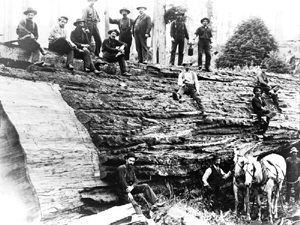
Lumberjacks in California.
Some of the tales of the camp exploits concern members of Paul Bunyan’s crew rather than the hero himself. One of the men, for example, had two sets of teeth, and, walking in his sleep one night, he encountered the grindstone and chewed it to bits before he was fully aroused to what he was doing. The adventure of another crew member is the familiar tale of the man who jumped across the river in three jumps. The crew sometimes showed ingenuity on their account, as when they rolled boulders down the steep sides of the Pyramid forty, running after them, ground their axes to a razor edge against the revolving stones. Big Joe Mufferon, the boss cook, was a very talented man. With his caulked boots, he could kick his initials into a ceiling eight feet high with one foot and wipe them out as fast as he kicked them in with the other. Next to Paul himself, Shot Gunderson was the best leg spinner in the camp. Taking a 75-foot log, he could spin it so fast with his feet that it slid out of the bark, and he walked ashore on the bubbles. Paul’s camp clerk was Johnny Inkslinger, a very efficient man. He kept the crews’ time, paid the men, purchased supplies, tended the camp stove, and performed many other duties that fell to a camp clerk’s lot. The first winter he was so employed, he hit on the plan of leaving off the dots from the i’s and the crosses from the t’s, thus saving Paul nine barrels of ink on the payroll alone. In his spare moments, Johnny surveyed the whole United States. He invented the fountain pen by attaching a hose to an ink barrel.
Lucy was Paul’s cow, and she supplied the milk and butter there in his camps. One winter, when there was a shortage of pasture, Lucy started to eat spruce and balsam boughs. Then, the men used her milk as cough syrup. The butter made from it was so tough that Paul used it to grease his tote roads. This enabled him to haul logs all summer. Paul had a little hunting dog called Elmer. One night, he thought that he heard a rat in the shanty. He flung an axe and cut his favorite dog in two. But, then he got up and .stitched the dog together again. This was done in the dark, and he got the hind end of the dog the wrong way, with the legs pointing up instead of down. When Elmer got well, he became one of the smartest dogs in the North Woods. He could catch any animal in the bush. He would run on one pair of legs until he was tired, then turn over and use the other pair.
When Paul was cutting big timber in the St. Croix River region, his men were harassed by the mosquitoes. These were so large and strong that they carried away and devoured many a juicy lumberjack. Paul would have lost all of his crew had not someone told him of a race of big bumblebees down in the Gulf Country. He sent Jim Liverpool down to get some of them. Jim jumped all the big and little rivers on the way and returned in record time. The bumblebees and the mosquitoes began to fight each other, and many bloody battles occurred. After a time, the two declared a truce. They became friends and intermarried. The offspring were far worse than either parent. They were armed with stingers at both ends. But Paul had finished his work and moved his camp to Minnesota.

Oney’s Roadhouse along the Sunset Highway, near Buxton, Oregon by Carol Highsmith.
Connected frequently with the Bunyan tales were accounts of fabulous animals that haunted the camp. There was the bird who laid square eggs so they would not roll downhill and hatched them in the snow. Then there was the side-hill dodger, a curious animal naturally adapted to life on a hill because it has two short legs on the up-hill side. Of this creature, it was said that by mistake, the female dodger once laid her eggs wrong end around, with the terrible result that the little dodgers, hatching out with their short legs downhill, rolled into the river and drowned. The pinnacle grouse are birds with only one wing, adapted by this defect for flight in one direction about the top of a conical hill. There was little doubt that these animal stories existed outside the Bunyan cycle and were appended to the central group of tales.
The story of Bunyan’s method of paying off his crew at the end of the season shows the hero’s craftiness. Discovering in the spring that he had no money on hand, Bunyan suddenly rushed into camp shouting that they had been cutting government pine and were all to be arrested. Each man seized what camp property lay nearest his hand and made off, but no two men were taking the same direction. Thus, Bunyan cleared his camp without paying his men a cent for their labor.
Not all the Bunyan stories concerned Bunyan’s life in the Round River or the Big Onion camps. There were several accounts of his exploits far from the forests of the north-central states. It was said that when he was once dredging out the Columbia River, he broke the dredge and, sticking it into his pocket, walked to the nearest blacksmith shop in South Dakota, had it repaired, and returned to the Oregon camp before dark. Besides his blue ox, Bunyan had, according to some versions, so many oxen that their yokes, piled up, made twenty cords of wood. One day, he drove all these animals through a hollow tree that had fallen across a great ravine. When he reached the other side, he found that several of the oxen had disappeared, and, returning, he discovered that they had strayed into a hollow limb. Occasionally, one would hear some account of Paul Bunyan’s boyhood exploits on his father’s farm. It was said that, on one occasion, he and his father went out to gather a colossal watermelon that was growing on a side hill above a railroad track. They carelessly forgot to prop the melon up before they severed the stem with a cross-cut saw, and as a result, it broke loose, rolled downhill, burst open on striking the rails, and washed out 200 feet of track.
Paul Bunyan’s folklore character originated in the oral tradition of North American loggers. Freelance writer William B. Laughead later popularized it in a 1916 Red River Lumber Company promotional pamphlet. Throughout the better part of the century, Paul Bunyan’s name and image continued to promote various products, cities, and services. He has also been the subject of various literary compositions, musical pieces, commercial works, and theatrical productions. Today, his likeness is displayed in several oversized statues across the country. A significant portion of these were produced from the 1960s through the 1970s by International Fiberglass as part of their “Muffler Men” series of giant fiberglass sculptures.
Compiled and edited by Kathy Alexander/Legends of America, updated March 2025.
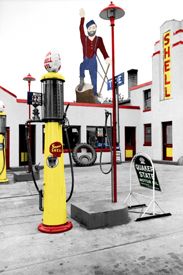
Paul Bunyan Gas Station in Minnesota.
Also See:
Pecos Bill – A Legend of Frontier Spirit
Legend of Rip Van Winkle (Charles Skinner, 1896)
Jackalopes in Wyoming – Myth or Reality?
Legends, Myths, & Campfire Tales (main page)
Sources:
Brown, Charles E., American Folklore – Paul Bunyan Tales, State Historical Museum in Madison, Wisconsin.
Stewart, K. Bernice, and Watt, Homer A.; Transactions of the Wisconsin Academy of Sciences, Arts, and Letters, Volume 18, Part 2, Madison, WI, 1916
Wikipedia
Wisconsin Historical Society