
[Editor’s note: This was written in the early 2000s, but is still a good reference]
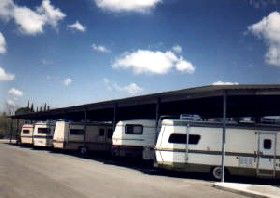
RV Storage.
Storing an RV, tow vehicle, or toad for up to a year or more is fairly simple IF you follow some simple steps, take some basic precautions, and avoid the big myth:
Myth: Park the thing and have someone start the engine and run it for a while every couple of weeks to “top off” batteries and “exercise” the engine.
Truth: Engines don’t need “exercise.” Starting an engine every two weeks will cause wear and tear on the engine and transmission. You shouldn’t start the engine unless you’re prepared to move the vehicle a minimum of 30 yards both backward and forward (what auto dealers do, and they only do it every few months). Further, running an engine to “top off” batteries is as about as inefficient as you can get (in addition to causing unnecessary wear).
Your starting battery (if good) will be topped off in just a few minutes. House batteries, probably not at all. Doing it properly requires careful reading of a digital multimeter. Doubtful that your caretaker would want to fool with all that (they might not know how to do it).
Parking can be a problem. Ideally, you’ll want your rig near you. Like in the backyard so that you can keep an eye on it. But you may be storing it so you can go somewhere else. Check out commercial storage places (though they’re usually too expensive). Check out local farms and ranches for a covered barn or shed that you might get cheap (and the farmer might agree to be a caretaker). A hail storm can really wipe things out if not under cover.
You’ll want to find somewhere to park so the RV will be reasonably level. BUT, fuel, over time, will “migrate” (for lack of a better word) toward the (usually lower) front end of a parked vehicle and can saturate emission canisters, etc. Ensure that if your fuel tank is “kind of” high, you elevate the front end slightly. (I keep my front end about 4-6″ above level.)
Do not use hydraulic leveling jacks when storing an RV. They will eventually leak. Worse, after a while, they will get “stuck” in position, and you will have a hellova time when you get back.
I do not recommend wrapping the RV in one of those “bags” they sell for big bucks at RV stores. Most of the ones I see are in shreds and lying on the ground. Worse, if still in place, they aren’t sealed around the edges, so when you unwrap them after months, it’s not fun to find wasps, squirrels, and bird nests.
I suggest you take care of the battery problem as follows:
Get an automotive battery charger (the automatic version–cheap at any auto store in 10 amp capacity). Plug it in, connect it to the starting battery, and bring it to full charge. Then connect to house batteries and bring them to full charge. Do NOT attempt to charge the starting battery and house batteries simultaneously. This should not have to be done more than once a month–maybe less (assuming you have good batteries). The rule of thumb for charging stored batteries is Below 40°F = Every 6 months. 40-60° = Every 2 months. 60° or more = Every month. (Never charge a battery with ice in it.)
The above assumes that the batteries are good and fully charged when stored, that the water level in the batteries is correct, and that nothing in the RV is consuming battery power.
Note–particularly, the things people don’t pay any attention to: TV antenna booster? Digital clock? 12V TV and Radios? (even if TV/radios and similar are turned “off,” some continue to use battery power to run the memory that stores preset stations, etc.). Reefer? (again, even if off, some models continue battery power to the circuit board). Ensure the “Kill Switch” (if your MH has one) is in the proper position. Gas valve? (If you have an automatic gas shut-off valve, it will use a LOT of battery power. Pull fuses are the best/easiest way to avoid these “phantom” loads.
Do NOT attempt to rely on your RV converter as a battery charger unless you have one of the rare RVs that actually has a user adjustable, multi-stage battery charger as part of your converter or as an independent unit. Standard RV converters will either cook your batteries or fail to charge them fully. In either case they will die. If you have old, cheap RV batteries, it’s often easier (and economical) to remove them or just let them sit without charging and replace them when you return.
You might invest in a digital voltmeter to make things easier for the caretaker. You can get a cheapie from Radio Shack that reads to one decimal point for $20. Far better, and every Rver needs one anyway, is a digital meter that reads voltage to two decimal points (called 3½ digits) and 20 amps of current. As long as the batteries read 12.6VDC (with nothing turned on), no charging is needed except under the “topping off” schedule above (if at all). A perfect meter for RVs is cheap ($40 Metex brand #M3800, JAMECO part# 27115) from JAMECO, 1355 Shoreway Rd., Belmont, CA 94002 (800) 831-4242.
Water: Drain tank. Draining most tanks completely is almost impossible, but a mostly-drained tank won’t freeze enough to create a burst. Many fresh tanks have an access port on top. If you remove the plug and cover the hole with a screen, leftover water evaporates. The problem might be when you get back and have crud in the tank if it didn’t evaporate fast enough or was stored in a warm place. No big deal. It can be treated and flushed again with the “freshener” sold in RV stores.
Disconnect the pump line and make sure the pump isn’t filled with water (or it will freeze and damage the pump). If left with water, the pump will also grow disgustingly colored algae before you get back.
Drain the water heater. Attach “blow out” plug (any RV store) with tire-filler-type air valve (called Schrader valves) to the RV’s city water input. One at a time, open faucet handles, turn on compressed air, and let water and crud blow out the line. (If you’ve never done this, you’ll be amazed at what comes out of there.) Go to open the next one a bit before fully closing the previous faucet. Repeat. Caution: if you close everything and let air pressure run, you could blow a water line.
Sewage tanks: Dump and wash out (as best you can, but you needn’t be too fastidious). Close valves. Disconnect the hose (slinky) and clean it and store it. Before closing valves the final time, I suggest cleaning them thoroughly and giving them a coat of silicone grease (see later). If you don’t do this, the “O” rings and seals WILL stick and you’ll end up with leaks after you return and use them.
Propane: Turn it off at the tank. Make sure the auto-safety shutoff isn’t turned on and using electricity. You might wrap the regulator in a piece of mesh or screen to keep bugs—spiders especially—from building a nest in the vent hole.
Toilet: You can fill the bowl with water to keep the seals lubricated. The water will evaporate in a few weeks (depending on where you park). I’ve found that leaving the toilet empty but carefully cleaning the seal and coating it with plumber silicone grease (at any hardware store, it’s used to lubricate faucet valves) works better and lasts over a year. Vaseline works, but not as well.
Shower and sink drains: The water in them will evaporate also. There is no problem with seals in this case, but the RV will stink when you return. Pour an ounce of cooking oil (slowly) into them to keep the water from evaporating.
Tires and underside: Air tires to normal pressure and cover to prevent the sun from rotting sidewalls. If the tires are good, no problem. If they’re lousy, you’ll need to replace them anyway when you get back. Do not completely wrap the tires (or you’ll end up with critters making a home in there).
Sprinkle abundant “Comet” cleanser or “Green Light” ant killer (far better) all around anything touching the ground. Ants and such won’t (usually) be a bother. If you’re fortunate enough to have a caretaker, the ant killer can be reapplied after rain (or snow?).
Make sure holes on the underside (into the RV) are either plugged with stainless-steel wool (not regular steel wool) pot scrubber pieces or taped with aluminum duct tape (not just the gray tape). Either will keep (usually) rodents out.
Gas Tank: Here’s where you can screw up the whole thing if you don’t do it right…
1. Before going into storage, you must get the tank nearly empty. Then (or before if you’re a careful planner), go to the auto store and get “Stor-Gas” or similar gas treatment. This is NOT the alcohol crap they sell to absorb water in gas tanks (which you should never use anyway). This is the stuff that people put into lawnmowers and boat engines during the “off” season. Ask for help if you need it. Read the label carefully to determine how many ounces of the brand you buy will treat how many gallons of gas. Good auto stores will have large cans of this stuff, which is cheaper. Discount stores will have tiny bottles of the same stuff for small engines like lawnmowers (cost more, but it’s the same thing). Buy what they call for, plus a bit more.
2. On your last drive before going into storage, with the tank fairly empty, pour Stor-Gas in and fill the tank with fuel. Then, store your rig. The Stor-Gas will have permeated your whole gas system (including carb or injectors) by the time you park. This maneuver will keep your gas from turning into a sludgy varnish paste (which gasoline WILL do if left in a tank, without this treatment, for more than a few months). Do NOT neglect this step, you don’t want a fuel system full of varnish.
Diesel systems are treated similarly. Check with auto store or, better yet, with a “John Deere” store for proper chemical. (I have done all this and left RV in storage for over 2 years and it started right up–but see below.)
ENGINE: Let’s assume some things. Before you put your RV in storage, you’ll have done the above: had the transmission serviced (including change of fluid), lubed, and changed the oil and filter.
• It isn’t necessary to remove spark plugs and squirt oil in each cylinder then reinsert plugs unless the RV will be in storage for more than a year.
• If it will be in storage for more than six months, you should get a pint of “Marvel Mystery Oil.” When you run the engine the last time, at idle, with the air cleaner removed, slowly pour oil into the main (front) carb throttle bores (or throttle body air inlet on fuel injection systems). When it is down to about ½ a pint, pour faster to stall the engine out. Do not start it again. Your cylinders and upper valve train will be nicely coated with preservative oil.
• There’s little to do in the engine compartment. Cover the air cleaner with a screen or aluminum foil. Taped with aluminum duct tape to keep critters from getting into the filter element. Some people spread mothballs around, but I can’t see that it does much good. If you park in a rodent-infested area, they may very well eat wire insulation, hoses, etc., anyway.
Removing from storage:
- Don’t forget to clean the air cleaner.
- Inspect hoses, fuel lines (the only rubber the critters ate in AZ), general wiring, and belts (they eat those too).
- Make sure you clean out critter nests.
- Check radiator water.
- Check transmission fluid.
- Check batteries.
- Check the power steering fluid.
- Change oil and filter (it will have turned acidic if you’ve been gone more than six months).
- Do not start the engine up right away. Disconnect coil wire (check manual–some vehicles need a different step) and turn the engine over several seconds to get oil up to valve train, etc.
- Reconnect the coil and start the engine. In most cases, it will start right up. Sometimes, gas at the carburetor or injectors will have evaporated. Pump the hell out of the thing, and it’ll usually start.
- Don’t drive it until you have run it through all the gears a few times.
- Make sure the brakes are OK. Sometimes, critters chew the flexible lines near wheels.
 Answers to some questions:
- Don’t leave heat and electricity on (unless you have a caretaker).
- Don’t forget to turn off AC circuit breakers to unused circuits.
- Don’t forget to pull fuses to unused 12-volt circuits–especially the water pump.
- Reefer: Clean it out! Never leave it running with anything in it if you or a reliable caretaker aren’t there (if electricity is disconnected or your LP tank runs out (even if going away for a short time, you do NOT want your reefer to quit while it has food in it), you’ll have the equivalent of a dead body in your RV–no fun to clean up). Some people put an open can of coffee in to keep a fresh smell. I open the door and use lightly wadded newspapers and a box of baking soda.
- Should you cover the windows on the inside with aluminum foil? Loosely only. Too tight a seal can crack a window if heat builds up. There are enough natural air leaks in most RVs so closing it up is OK.
- An uncovered plastic garbage can containing about 20-30 gal of water will evaporate and provide enough humidity for a few months to prevent cracking and peeling inside.
- Cover roof vents. Plywood boxes and bricks aren’t usually needed and can become deadly missiles in a storm. Scraps of foam or bubble-packaging material taped down (and over air conditioner and reefer vent) are ordinarily OK.
- Solar panels shouldn’t need a cover.
- A screencap over the end of an exhaust pipe, more screens or ready-made screens over the furnace and water heater vents, and a screen taped to the inside of the reefer rear access panel help.
Are all the storage steps necessary? It depends on how long it will be stored. The Stor-Gas/diesel stabilizer step is recommended for 2 months or more, and water draining for 3 months.
phred Tinseth © 1998-2002 Reproduction Permitted. Updated May 2024.
Also See:
RV Tips, Tricks, Travel Information & More