
[Editor’s Note: This article was written in 2005, but remains a good guide. Of course, there are many other ways now to find and post listings.]
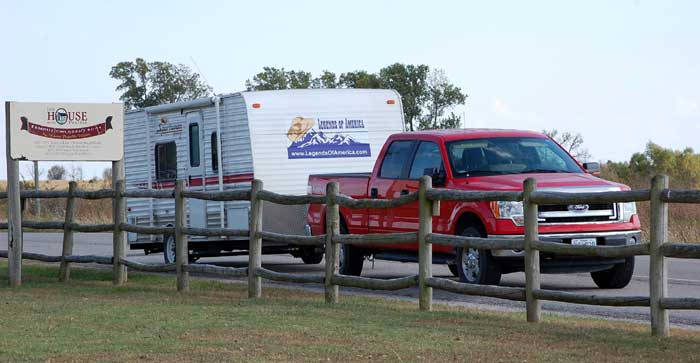
On the road in Kansas
By William H. Smith, 2005
If you are on a tight budget and can’t afford a new model RV, you might consider buying a used RV. Here are a few suggestions for finding a used, affordable RV:
1 Check newspaper listings. Look at the classifieds in your local or state daily paper. Most towns and cities have a free shoppers circular that is mostly classified listings.
2. Check for consignment lots in your area. RV owners who aren’t interested in having strangers in their homes often park their RVs at consignment lots.
3. Run a “want to buy” listing in the classified section of your local paper.
4 Watch for campers parked curbside, in driveways, or front yards with “For Sale” signs posted on them.
5 Drive through local RV and Mobile Home Parks and watch for RVs with for-sale signs posted on them.
When you find an RV you are interested in purchasing, don’t fall in love with it and be too eager to buy You could regret a hasty decision for a long time If you aren’t familiar with an RV’s functioning, bring a friend along who is The chances are excellent that one or more (usually more) components will not work and will have to be repaired.
Keep a notebook with you when you do an inspection and make a note of every fault. You’ll find problems, but that isn’t necessarily a bad thing. RVs can be repaired, and you’ll use your inspection checklist to negotiate a price on your terms.
It is a good idea to have the owner with you while you inspect the RV so that he or she can observe your inspection notes. When you have completed your inspection, you’ll likely have a lengthy list of needed repairs. This will be your leverage to make a low-ball offer on the trailer. After all, you will either have to pay for the repairs or live with them as is.
If the RV owner doesn’t accept your low offer, don’t worry too much. Go on to the next RV. Give them your name and telephone number and tell them to call you if they change their mind.
Let two or three weeks pass, and call them back to see if they have sold the RV yet They may be very happy to hear from you and accept the offer you made If you are really interested in the RV, offer a slightly higher price this time If they don’t accept your offer, don’t worry; call them back in another three or four weeks.
Sooner or later, you’ll find a genuine bargain on an RV. You’ll have possibly saved quite a bit of money and, in the process, learned some negotiating skills.
RV Parking.
Inspecting a Used RV
Now, let’s explore what you should look for when inspecting a used RV you’re considering buying.
Knowing what to look for when buying a used RV is the key to getting a good bargain instead of a lemon. Here is a helpful checklist to help with your search.
1 Does the trailer jack work?
2 Do the propane bottles need updating and inspection If they need to be replaced, this can be costly Generally, if an RV propane tank is older than twelve years, it will have to be re-inspected every five years Also, the propane tank must have an OPD valve If you don’t know what an OPD valve is, the official description is “Overfilling Protection Device.”
3 Check the hoses leading away from the propane bottle for cracks and splits You do not want a leaking propane connection Check the nut that screws into the propane tank Is it worn If so, it may need to be replaced.
4 The LP Gas regulator is usually located just a few inches away from the propane tanks. You’ll see the hoses leading from the propane tanks into a device with one pipe at the bottom of it that runs beneath the RV. Regulators begin to leak when they are approximately ten years old. For your information, leaking propane is not a good thing. Don’t hesitate to replace the regulator if it is leaking.
5 Batteries are often dead or not too far from dead in an older RV. Check and make sure they still work. If the bulbs inside burn bright, the battery(s) may still be in decent condition.
6 Does the converter still work What’s a converter Well, it is a device that recharges your battery and converts regular household electrical current from AC to DC, allowing your 12-volt fixtures and appliances to operate Test this by plugging in the electrical cord and unhooking the battery (unhook the battery before you plug in the RV power cord to prevent electrocution) If the 12-volt lights and water pump still work, the converter is still working.
7 Do the stabilizers beneath the trailer still let up and down? You’ll be glad to have stabilizers when you park in an area with constant wind gusts like the South Texas coast.
8 Are the tires still in good condition? Check for cracks and splits, and check the tread depth on all tires.
9 It is absolutely mandatory that you understand the condition of the braking system. Have the owner hook up the RV, allow you to tow for a short distance, and test the brakes. Brake repairs are expensive. Your life and the safety of your vehicle and RV depend on the RV brakes functioning correctly every time.
10 Does the doorstep go up and down easily?
11 Can you open and close all outside compartments easily? Do the gaskets need to be replaced? Worn or missing gaskets permit air and moisture to penetrate the RV.
12 Make sure that all the windows open and close easily. Latches can rust shut. Are the screens on the windows and vents rusted or torn?
13 Open and close roof vents and make sure that the vent fans run properly.
14 Fire up the hot water heater and make sure it works.
15 Test the refrigerator on both the gas and electric settings Repairs can be expensive, so you’ll want to use both Watch for frost beginning to form in the freezer to confirm that it is cooling properly Make sure the door will latch and lock securely When you’re on the road, you don’t want the fridge contents strewn through your RV.
16 Check the furnace. Does it blow hot air? Please don’t wait until it’s thirty degrees outside to find out.
17. Crank up the air conditioner. Does it blow cold air? If it has a heating element, does that work as well?
Big Rig.
18 Turn on the water tap without being hooked up to city water. Does the water pump work?
19 Check out the toilet. Does it flush properly?
20 Hook up the city water. Check for leaks inside and outside the RV.
21 Inquire about the condition of the wastewater valves. Better yet, if the RV is hooked up to a sewer drain, open and close the valves to make sure they work.
22 Check the cooking range and oven. Do all burners function? Does the oven burner function?
23 Do all interior cabinets and drawers open and latch securely? If not, your belongings may be scattered throughout your RV when you are in transit.
24 Check for soft spots on the floor, particularly in the bathroom area. The plywood may be rotted through.
25 Is the flooring in good condition? How about the interior walls?
26 Check that the curtains are not dry-rotted. Can they be easily cleaned? Are the blinds still in good condition?
27 External lights – Test the external running lights If you tow at night, and you likely will, you’ll want to make sure that the rear taillights are operable Hook up to the tow vehicle and turn on the headlights You’ll also want to make sure that the brake lights work, that the right and left turn signal lights work, and that the backup lights work If there is a problem, it could be a faulty bulb or the bulb fixture needs cleaning Otherwise, you may be faced with an electrical problem.
28 Test exhaust vent fans to make sure they work. They are typically found in the living area, over the cooking range, and in the bathroom.
29 Does the TV antenna crank up and down easily? Better yet, find a hobby and skip TV.
Added July 2005, updated May 2025.
About the Author: William Smith lived and traveled full-time in an RV travel trailer for over 12 years, and maintains a website dedicated to educating people about the RV lifestyle. Visit https://www.happyvagabonds.com to learn more.
Also See:
RV Tips, Tricks, Travel Information & More