
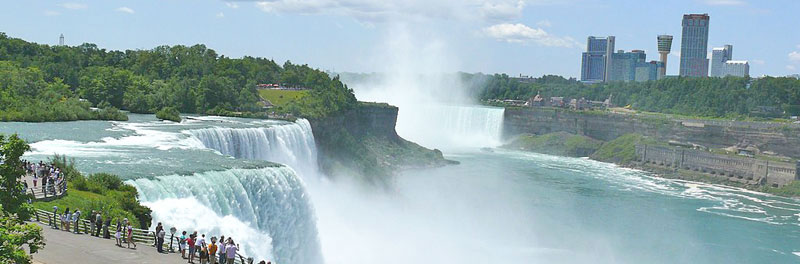
Niagara Falls, New York by Ad Meskens, courtesy Wikipedia.
The Niagara Falls National Heritage Area, situated in western New York, comprises a diverse collection of historical, natural, and cultural resources that span from Niagara Falls to Old Fort Niagara. The heritage area encompasses one city, two towns, two villages, numerous parks, historic sites, and attractions along the Niagara River.
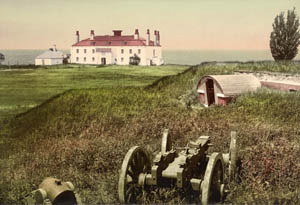
Old Fort Niagara, New York by Detroit Publishing, 1900.
The Niagara Falls region has significant historical associations with American Indians, early European exploration, the French and Indian War, the American Revolution, the War of 1812, and the Underground Railroad.
More than 12,000 years ago, Niagara Falls extended seven miles downriver to present-day Lewiston, New York, and Queenston, Ontario, Canada. Over the years, the brink has eroded to its present site, sometimes at a rate of as much as six feet per year.
Before Europeans came to the area, it was dominated by the Neutral Nation of Native Americans.
Father Louis Hennepin, a French priest, was the first European to report on Niagara Falls with his account of his 1678 visit. Hennepin was a member of Robert de la Salle’s expedition that explored and claimed the Great Lakes, as well as the Mississippi and Ohio Rivers, for France. In 1679, La Salle and his men built Fort Conti at the mouth of the Niagara River, utilizing it as both a trading post and a base for boat-building.
The region had already become a key crossroads in the North American fur trade by then.
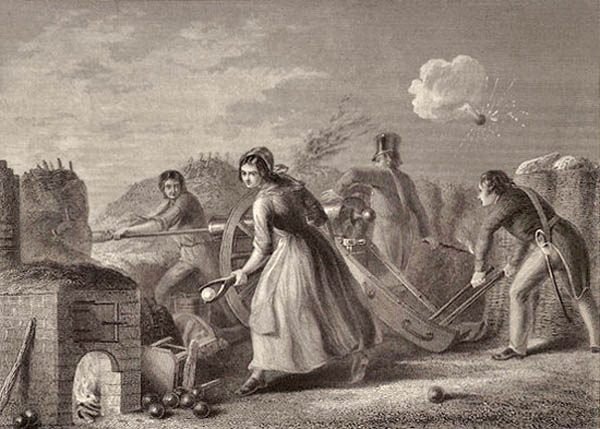
Soldier’s Wife at Fort Niagara, New York.
A bloody war had been taking place between the Iroquois Confederacy and the Algonquin-speaking tribes in the area. Later, during the conflict between empires, the Iroquois Confederacy was formed by the Mohawk, Onondaga, Oneida, Cayuga, and Seneca in the mid-16th century and tended to be allied with the English. In contrast, the Algonquin tribes were allied with the French. The Seneca settled the area east of the Niagara River and played an important role in maintaining the portage around Niagara Falls. In 1722, the Tuscarora, an Iroquoian group that had been displaced from North Carolina by English settlers and relocated to western New York, joined the Iroquois Confederacy.
During the 18th century, the Niagara area remained a place of contention between the French and British Empires. The influx of newcomers was probably a catalyst for already hostile native tribes to turn to open warfare in competition for the fur trade.
When the French and Indian War ended in 1763, all French possessions in North America were awarded to Britain, and Fort Niagara became a British outpost. Fort Niagara was a British base for launching raids against the Americans and a safe haven for the Iroquois during the American Revolution.
The Treaty of Paris in 1783, which concluded the American Revolution, drew a boundary line down the middle of the Niagara River, awarding the east bank to the United States and the west bank to Britain and its province of Canada.
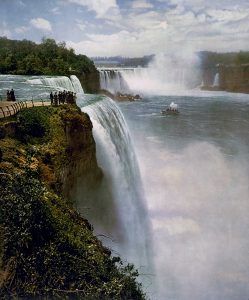
Prospect Point, Niagara Falls, by William Henry Jackson, Detroit Publishing Co., about 1900.
After the American Revolution, Americans started settling in the Niagara Falls area. Although the Treaty of Fort Stanwix in 1784 and the Treaty of Canandaigua in 1794, between the United States and the Six Nations of the Iroquois, acknowledged Indian ownership of most land in western New York, American settlers and speculators soon pushed into the area. Under the Big Tree Treaty in 1797, the Seneca sold the rights to most of their land in western New York. However, the treaty secured the Cattaraugus, Buffalo Creek, Tonawanda, and Tuscarora Reservations. These treaties and the rights of Indian tribes in western New York remain in effect but are somewhat strained to this day. Many members of the Six Nations moved to the Canadian side of the Niagara River after the American Revolution and still have a reservation at Ohsweken, Ontario.
Britain turned Fort Niagara over to the Americans in 1796, moved its garrison across the river to Fort George, at today’s Niagara-on-the-Lake, and built a new portage road on the Canadian side of the river.
As American settlement progressed, Niagara Falls became a tourist destination. In about 1800, the land around the falls was cleared, allowing visitors to enjoy the magnificent vistas of the scene. As the largest
The known waterfall in North America, Niagara Falls, became a principal object of interest.
Establishing the international boundary along the Niagara River made the Niagara Frontier one of the most contested theaters of the War of 1812. Americans invaded Canada and were repulsed; the British took control of the American side of the river. The Treaty of Ghent, which ended the war in 1814, restored the previous boundary.
Niagara Falls continued to be a barrier for waterborne transportation between the Great Lakes region, the St. Lawrence River, and the Atlantic Ocean. The first step towards uniting a country divided by geography began in 1817 with the construction of the Erie Canal. This canal linked New York’s Hudson River with Lake Erie at Buffalo. The Erie Canal opened in 1825, immediately benefiting New York and its surrounding areas.
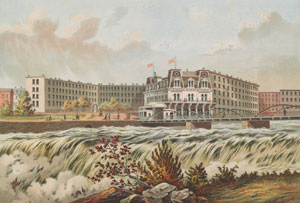
International Hotel at Niagara Falls, New York, 1876.
By this time, it became feasible for tourists to visit Niagara Falls. The first hotel opened on the Canadian side in 1822, and the completion of the Erie Canal facilitated travel from the Eastern Seaboard to Niagara. The first American travel guide, “The Fashionable Tour” (1825) by Gideon Minor Davison, sketched out a “Grand Tour” of North America that included New York City, the Hudson River Valley, the Catskill Mountains, Saratoga Springs, and Niagara Falls, as well as Montreal and Quebec City.
Entrepreneurs discovered that tourists were seeking activities to do at the Falls and that there were numerous opportunities for profit by serving them. As hotels increased, so did museums, curiosity shops, boat rides, and guided tours behind the Falls. The first of many sensational events at Niagara occurred in 1827 when the condemned merchant ship Michigan was sent over the Falls with a cargo of screaming animals on board. Thousands looked on and purchased refreshments and souvenirs. As the years passed, daredevils walked on tightropes over the Niagara Gorge or attempted to plunge the rapids and Falls in barrels.
Access to Niagara Falls improved when the first railroad line reached the Falls in 1838.
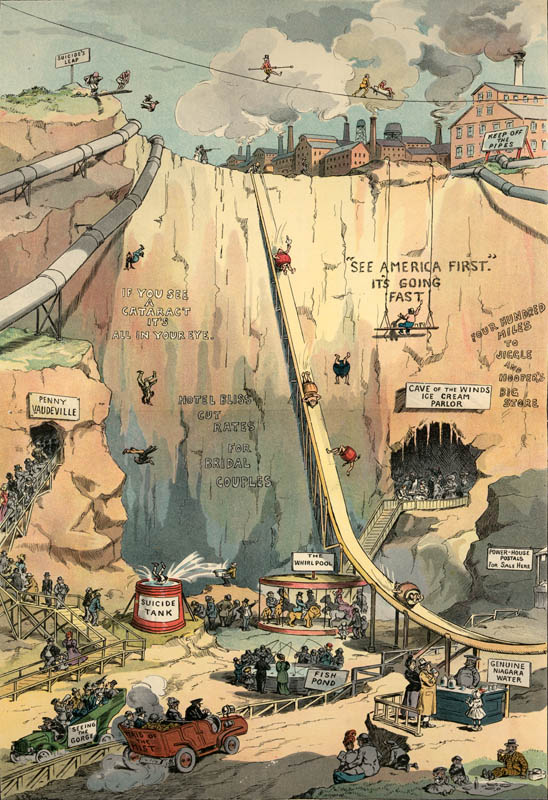
Save Niagara Falls by J.S. Pughe, 1906.
At one time, before Goat Island became part of Niagara Falls State Park, Cornelius Vanderbilt, Sr., the railroad titan, envisioned the island as a smaller, more exclusive attraction space, complete with hotels, shopping, and restaurants. Conversely, P.T. Barnum, of circus fame, fought heavily to make Goat Island one of the country’s largest circus grounds.
But tourist accommodations and special events quickly crowded the place’s mystical splendor. Unfortunately, hoaxes and carnival acts became so integral to the Niagara Falls experience that a guidebook, The Humbugs of Niagara Falls, was published in 1884 to pinpoint the tourist traps.
The history of Niagara Falls followed the course of tourism development in the United States. After being a pastime for the leisured elite before the Civil War, tourism became an activity of the emerging middle class. Building a vast national railroad network enhanced their interest in pleasure travel.
With the automobile came a new proliferation of tourist attractions, souvenir shops, motels, and eating places, especially on the Canadian side of the Falls. One of the early experiences in mass tourism was the honeymoon, and by the 1920s, Niagara Falls had established itself as the “honeymoon capital” of North America. Upper-class honeymooners had been attracted to Niagara Falls during the 19th century, but the honeymoon only became a widespread middle-class ritual in the 1920s.
During the 1940s and 1950s, working-class couples joined the honeymoon parade. The decline of Niagara Falls as a honeymoon destination and tourist attraction in the 1960s reflected increasing competition from more glamorous honeymoon sites around the globe and the failure of Niagara Falls to keep up with its allure.
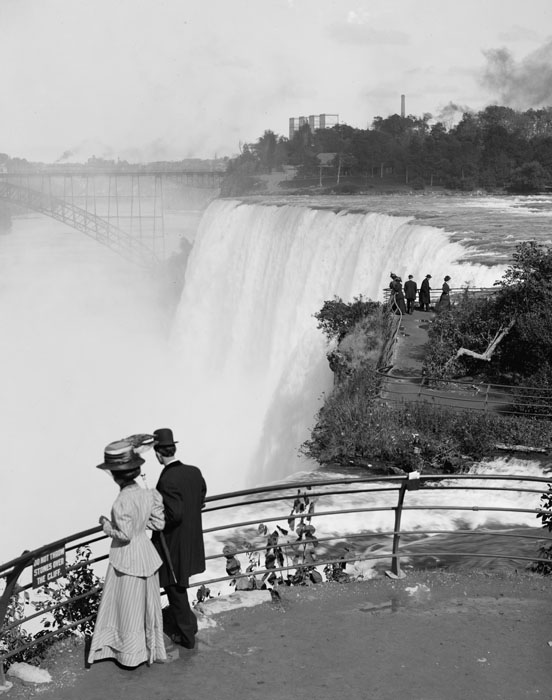
A couple at Niagara Falls, 1910.
The contrived tourist attractions at Niagara Falls represented an early wave of mass entertainment, which later evolved into amusement parks, such as those at Coney Island in the 1890s. The theme parks, such as Disneyland, of the second half of the 20th century. These well-capitalized, up-to-date, popular attractions surpassed the appeal of Niagara Falls, which suffered as a tourist draw. Interestingly, one of Niagara’s strategies for reinventing itself was to build gambling casinos, including one in Ontario in 1996 and another in New York in 2003, in an attempt to emulate the glitzy seductions of Las Vegas. Other tourism strategies related to improving the experience for those interested in the nature, history, and culture of the Niagara Region include upgrading the Niagara Falls State Park and the Niagara Gorge Trail, as well as establishing a national heritage area.
Four of the five Great Lakes — Superior, Michigan, Huron, and Erie — drain into the Niagara River before emptying into Lake Ontario. These five Great Lakes comprise almost one-fifth of the world’s freshwater supply. Today, 3,160 tons of water flow over Niagara Falls every second. This accounts for 75,750 gallons of water per second over the American and Bridal Veil Falls and 681,750 gallons per second over the Horseshoe Falls.
Niagara Falls National Heritage Area contains three National Historic Landmarks: the Adams Power Transformer House, the birthplace of the modern hydroelectric power station; the Niagara Reservation, designed by landscape architect Frederick Law Olmsted and considered the oldest state park in the country; and the Colonial Niagara Historic District, in Lewiston and Youngstown, which includes Old Fort Niagara.
The “Falls to Fort” region offers the world-famous Niagara Falls, various heritage tourism activities, quaint village shops and restaurants, a vibrant downtown area, and a range of outdoor activities, including boating, fishing, and hiking.
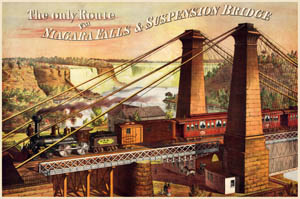
Great Western Railway Suspension Bridge, at Niagara Falls, 1876.
Niagara Falls State Park is the oldest state park in the U.S., established in 1885 as the Niagara Reservation. It was the first of several such reservations that eventually became the cornerstones of the New York State Office of Parks, Recreation, and Historic Preservation.
Old Fort Niagara State Historic Site is located within Fort Niagara State Park. Old Fort Niagara is a New York State Historic Site. The history of Old Fort Niagara spans more than 300 years. The fort was occupied by three nations: France, Great Britain, and the United States. Old Fort Niagara is also a National Historic Landmark included in the Colonial Niagara National Historic Landmark District. Visitors to the fort today will encounter the oldest buildings in the Great Lakes region, as well as living history programs, exhibits, and special events.
The park, recognized as the oldest state park in the United States, contains the American Falls, the Bridal Veil Falls, and a portion of the Horseshoe Falls (also known as the Canadian Falls).
Fort Niagara Light is also located within Fort Niagara State Park; the stone lighthouse was constructed between 1871 and 1872. This lighthouse played a crucial role in the development of transportation on Lake Ontario. The light is owned by the U.S. Coast Guard and managed under an agreement with the Old Fort Niagara Association. The Fort Niagara Light is listed on the National Register of Historic Places.
Today, over eight million people visit the oldest state park in the United States yearly to gaze at the mighty waters of Niagara Falls. Representing 20% of the world’s freshwater, the importance of Niagara remains “key to the whole continent.”
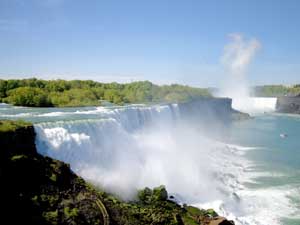
Niagara Falls, New York, by Carol Highsmith.
More Information:
Niagara Falls National Heritage Area
P.O. Box 1932
125 Timon Hall
Niagara University, New York 14109
©Kathy Alexander/Legends of America, updated July 2025.
Also See:
Scenic Byways & Historic Trails
National Parks, Monuments & Historic Sites
Sources:
National Park Service
Niagra Falls State Park
Wikipedia
Wikipedia – 2