
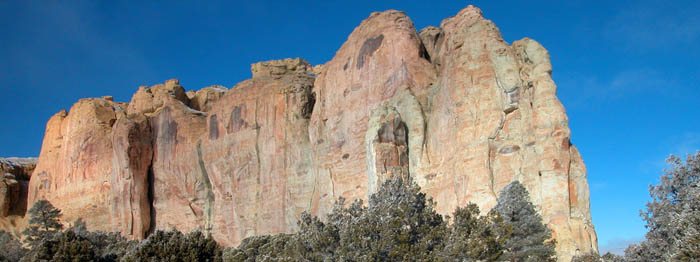
El Morro National Monument, New Mexico, by the National Park Service.
El Morro National Monument in Cibola County, New Mexico, preserves the remains of a large prehistoric pueblo atop a great sandstone promontory with a pool of water at its base. This site later became a landmark where many centuries of explorers and travelers left historic inscriptions that survive today.
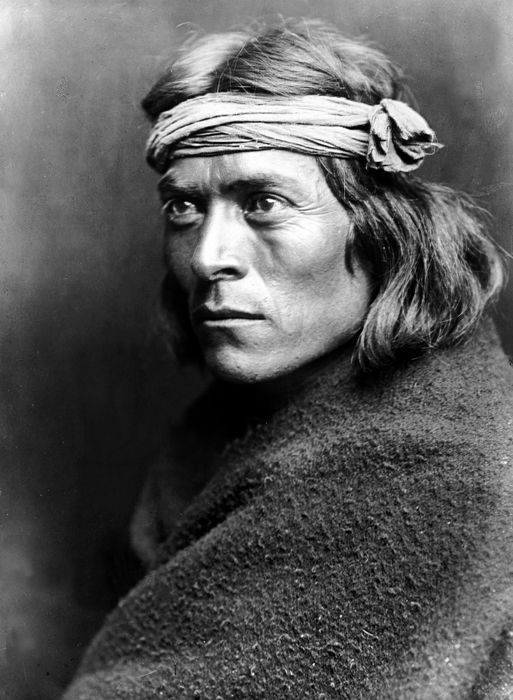
Zuni Governor, Sate Sa, by Edward S. Curtis, 1910.
The monument, located on an ancient east-west trail in the western part of the state, displays over 2,000 carvings at the base of a sandstone bluff that records the presence of ancient peoples and later travelers who transformed El Morro into a well-preserved historical document. Each pre-Columbian petroglyph and later signatures, dates, and messages inscribed at El Morro have a unique and significant story to tell about the people of different cultures who were there. Until the turn of the 20th century, people left their mark at the base of this monument, including the Zuni Indians, whose ancestral ruins stand at the top of this historic headland, the Spanish, and Americans. Today, El Morro National Monument preserves the ruins and petroglyphs of the Ancestral Puebloans and the Spanish and American inscriptions inspired by the ancestral Zuni scribes. Archaeological investigations of Spanish exploration and Latino heritage connections to the region are ongoing and contribute to our understanding of El Morro’s long cultural and historical significance.
Attracted by the permanent pool of fresh drinking water formed from rain and melted snow, Ancestral Puebloans established their village atop El Morro in the late 1,200s. The Zuni Indians call this place Atsinna, meaning “place of writings on the rock.” The sacred Puebloan ruins at the site offer great insight into the culture of the Zunis and their ancestors. Believed to have formed about 2,000 years ago, the Puebloan culture consisted of skilled farmers and master builders, whose earliest structures were mostly underground pit houses. Eventually, their pueblos evolved into above-ground, multi-storied towns, which the people constructed using flat sedimentary rocks piled one on top of another and cemented with clay. The Atsinna ruins, archaeologists unearthed in the 1950s, demonstrate the advanced building skills of these Ancestral Puebloans.
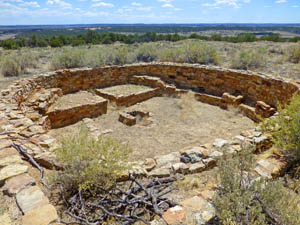
Atsinna Pueblo at the El Morro National Monument in New Mexico.
Until its abandonment in about 1400, this 200 by 300-foot pueblo above El Morro could house between 300 and 400 Puebloans in the 355 interconnecting rooms surrounding the open courtyard. Still visible today are the square and circular underground kivas within the Atsinna courtyard that the Zuni ancestors built. They performed religious ceremonies to bring rain and abundant crops, traditionally consisting of corn, beans, and squash. As skilled farmers, the Atsinna community grew crops in fields that the people irrigated with the rainwater collected in cisterns atop the mesa. The Ancestral Puebloans also irrigated their fields with the water from the pool at the bottom of the headland, which they reached by using still evident hand and toe steps etched into the face of the cliff. The Puebloans left El Morro for the Zuni pueblos the Spanish encountered in 1540 for reasons still debated.
Although the Ancestral Puebloans abandoned Atsinna long before the Spanish arrived, the petroglyphs they left behind inspired Don Juan de Onate on April 16, 1605, to record his stay at El Estanque de Penol, which is Spanish for “pool at the great rock.” His name is the first of thousands of Spanish inscriptions carved at El Morro, including the standard phrase paso por aqui or passed through here, followed by the traveler’s name and date of passage. These inscriptions tell over 200 years of New Mexico’s Spanish history, including the Reconquista of Don Diego de Vargas, who recorded the Spanish reconquest following the Pueblo Indian revolt in 1692. Eventually, as America began fulfilling its Manifest Destiny by expanding westward, a new generation of explorers attracted to the dependable water source at El Morro would record over 50 years of American expansion in the southwestern United States.
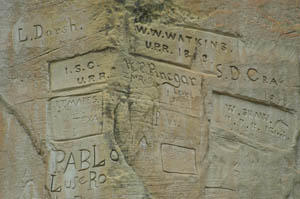
Inscriptions at El Morro National Monument by the National Park Service.
After the United States acquired New Mexico at the end of the Mexican-American War (1846-48), Lieutenant James H. Simpson, a topographical engineer for the U.S. Army, immediately began surveying the Zuni and Navajo territory. In September 1849, he came across the beautiful inscriptions of El Morro, and he and artist Richard Kern, who was also on the expedition, began copying the symbols, signatures, and dates carved by those who had passed by the impressive headland that Simpson called Inscription Rock. Their work became the first written description and drawings to record El Morro’s history, and like those who passed there before them, Simpson and Kern left their marks on Inscription Rock. Their inscriptions are two of more than 20 Anglo-American names carved at the base of El Morro. As trains facilitated travel across the Southwest, the historical record at Inscription Rock faded as the passage through El Morro became unnecessary.
A 1906 federal law prohibited further carving at El Morro, but tourists can take photographs of the beautiful historical inscriptions to record their passage through El Morro National Monument. Visitors may start their tour at the visitor center, where the Inscription and Mesa Top trails begin. On the ½-mile Inscription Trail, visitors can see the precontact petroglyphs and hundreds of Spanish and Anglo inscriptions at El Morro. When hiking the two-mile Mesa Top Trail, tourists can appreciate the views of the Zuni Mountains and the El Malpais and El Morro Valley volcanoes. On the Mesa Top Trail, visitors can also tour the partially excavated Ancestral Puebloan ruin, Atsinna, or “place of writings on rock.”
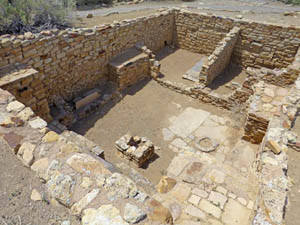
Atsinna Pueblo at the El Morro National Monument in New Mexico by the National Park Service.
An orientation video and virtual tours on the center’s computers prepare visitors for what they will see at the visitor center. The nine-site campground offers camping, and picnicking at the tables near the visitor center is also popular.
El Morro National Monument is located on El Morro National Monument Rd. in Ramah, New Mexico. The visitor center is open daily, except on December 25 and January 1; the visitor center and trails’ hours vary seasonally.
Compiled & edited by Kathy Alexander/Legends of America, updated May 2025. Source – National Park Service.
Also See:
Ancient Cities of Native Americans
Ancient Puebloans of the Southwest