
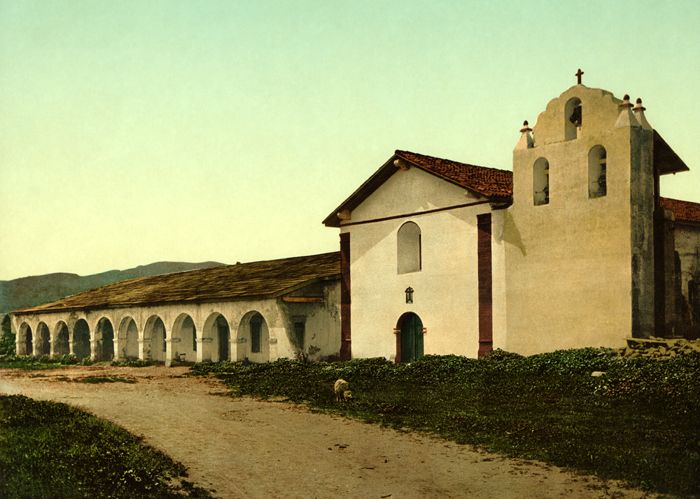
Mission Santa Inez, California by the Detroit Photo Co., 1898.
Santa Ines Mission in Solvang, California, was the 19th of 21 California missions established by the Franciscan Fathers during the 18th and early 19th centuries. Today, it is an active parish, a National Historic Landmark, and one of the best-preserved Spanish mission complexes in the United States.
The Missionary Franciscan fathers had considered the founding of a mission between La Purisima and Santa Barbara for several years because an inland Mission north of Santa Barbara would solidify their work in the area, relieve overcrowding at the two existing missions, and create a buffer zone to the militant Tulare tribe who lived to the northeast. In 1798, Father Fermín Lasuen directed Father Estevan Tápis of Mission Santa Barbara to accompany Captain Felipe de Goycoechea to survey possible Mission sites northeast of the coastal mountains. Though they found a suitable site for the new mission, it would be six years before it was founded between Mission Santa Barbara and Mission La Purísima Concepción.
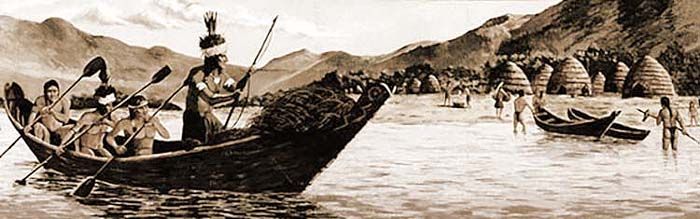
Chumash Indians.
Father Estevan Tapís, president of the California mission chain, founded Mission Santa Ines, and construction began on Mission Santa Ines in 1804 with one row of buildings. The building was constructed with the aid of Chumash Indian converts, Missions Santa Barbara, and La Purisima. This wing, measuring 232 feet in length and 19 feet in height and width, contained the temporary church, a sacristy, the padres’ quarters, and the granary. The 30-inch thick walls were made of adobe, and the roof consisted of poles covered by sticks laid side by side and then by a layer of adobe soil that hardened, thus sealing out the weather. On September 17, 1804, Father Tápis officially dedicated the mission to Saint Agnes and constructed a temporary brushwood shelter at which 200 Indians attended High Mass. By the end of 1804, the baptismal register already contained the names of 112 Chumash converts of all ages.

Mission Santa Inez Cemetery by the Keystone View Co., 1925.
Fathers Jose Romualdo Gutierrez and Jose Antonio Calzada were selected as the first resident priests. Construction continued over the next several years with two more rows of buildings. This last building completed a square design, which was the typical design for California Missions. Each side of the square measured 350 feet, and within the quadrangle stood a blacksmith, potter shops, weaving and basket-making facilities, a soap factory, and other work areas. In addition, five double houses were built for the soldiers and their families, plus a storehouse and a guardhouse.
In 1812, the population of Chumash at the Mission reached 718, the highest number throughout the Mission Era. That same year, an earthquake near Santa Barbara destroyed most of the original church, part of the division wall, and the bell tower. Afterward, a new church was built that was dedicated on July 4, 1817. This church and its bell tower continue to stand today.
Changes in the political air soon affected mission life. After the beginning of the Mexican War of Independence against Spain in 1810, financial support for the missions ceased. The Missions were then required to become self-sustaining. In addition, the soldiers stopped receiving their salaries, and the annual ship from Mexico carrying provisions for the soldiers and their families was also canceled. At that point, the officers at the Presidio made greater demands on the Missions to supply food and clothing to the soldiers and their families.
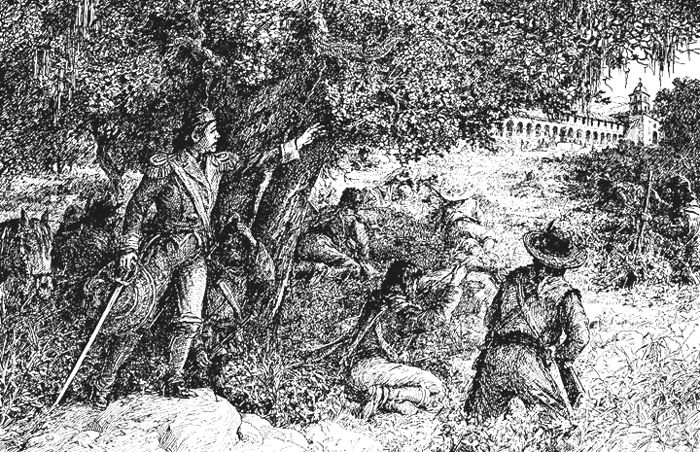
Chumash Revolt by Alexander Harmer.
After Mexico gained independence from Spain in 1821, life at the California missions changed. The Chumash were forced to work for the Mexican army, receiving payment in IOUs, which caused mounting frustration. In February 1824, the beating of a Chumash by a Santa Ines soldier sparked an armed revolt that rapidly spread. Fires destroyed many Santa Ines buildings and smoke-damaged paintings and decorations in the sanctuary. The large insurrection spread outside Santa Ines to Mission Santa Barbara and Mission La Purisima. The revolt was California’s most significant organized resistance movement during the Spanish and Mexican periods.
Another consequence of Mexico’s independence was secularization, which led to the decline of mission life. In 1834, the Mexican Assembly passed the Secularization Laws, which shifted responsibility for mission temporalities from the church to the government. The new laws confiscated the mission lands, produce, and animals and placed them under the administration of local Mexican ranch owners. The mission priests were allowed a small parcel of land for their use and administered to the remaining neophytes’ spiritual needs. All priests had to take an oath of allegiance to the Mexican government, and those who remained loyal to Spain were deported to Spain. The mission churches became parish churches administering to the spiritual needs of the growing settler population. Ultimately, secularization caused the Spanish missionaries’ departure, most of the Chumash converts, and the eventual decline of Mission Santa Ines.

Santa Ines Mission in Solvang, California, by Carol Highsmith.
As the population at Mission Santa Ines dwindled, the Bishop of Alta California, Francisco Garcia Diego, established Santa Ines as a learning institution, opening the College of Our Lady of Refuge, the first seminary in California, in 1843. The seminary provided education to the young men of the landowners. The school eventually was moved outside of Santa Ines and was renamed College Ranch because it provided education for the sons of local ranchers.
In 1851, the United States government rescinded the illegal sale of the Mission lands. At that time, several priests from different religious orders administered the college seminary, and other improvements were made to the mission.
A decree signed by President Abraham Lincoln on May 24, 1862, formally returned all California Missions to the Catholic Church. Santa Ines was then under the supervision of the Bishop of Monterey.
Supervision of the college seminary was transferred to the Christian Brothers from 1877 to 1881 and then closed. The Bishop then sold off 20,000 acres, some of which became the town of Santa Ynez.
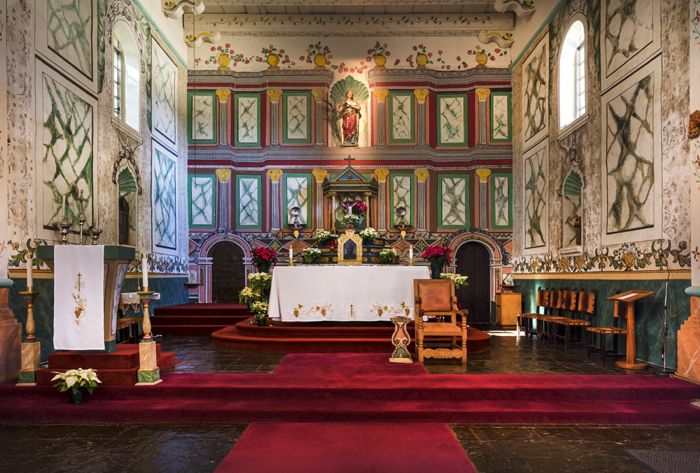
Santa Ines Mission Church Interior by Carol Highsmith.
The first serious commitment to restoring the Mission came with the assignment of Father Alexander Buckler, who the bishop directed to improve the mission in 1904. However, the job was daunting. Buckler established what became known as the Hobo Hotel, inviting many struggling American and European men to stay at the mission in exchange for labor. The system worked. Roofs were retiled, the reservoir system was improved, and the church interior was restored. Father Buckler retired to Santa Barbara in 1924.
Afterward, the Capuchin Franciscans moved in, installing electricity and modern plumbing to improve the living conditions and restoring and improving the gardens. The complete restoration began in 1947, when extensive repairs were made to the roof of the church and residence, and sections of the south end of the building were completely remodeled. The plan was to restore the mission to its appearance before the earthquake of 1812.
Today, the Mission Santa Ines District consists of 15 buildings, structures, and sites that reflect the period between 1804 and 1855, when local Chumash lived in one of Spain’s and then Mexico’s primary colonizing institutions. Surviving historic buildings include the massive original adobe church and the priests’ residence wing. Archeological remains include the original priests’ residences, the Chumash village of traditional and adobe dwellings, the soldiers’ residence, the temporary church, and the ecclesiastical college of 1844-1868. The mission also has a largely intact water system, the site of the mission garden, and a complex of reservoirs and mills.
A National Historic Landmark today, the mission is an active parish, but visitors can tour its grounds and buildings for a small admission fee.
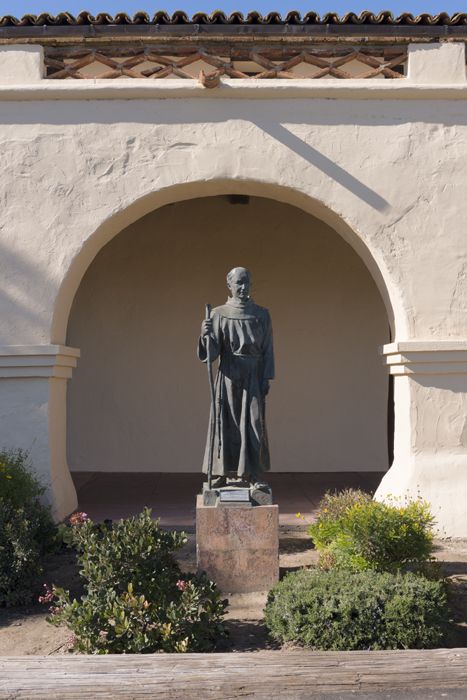
Statue of Friar Junipero Serra at Santa Ines Mission by Carol Highsmith.
More Information:
Mission Santa Ines
1760 Mission Drive
Solvang, California 93463
805-688-4815
Compiled and edited by Kathy Alexander/Legends of America, updated March 2025.
Also See:
Missions & Presidios of the United States
Sources: