
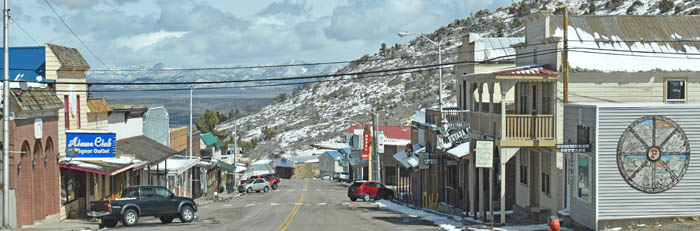
Pioche, Nevada Main Street by Kathy Alexander
Once one of the wildest towns in the American West, Pioche, Nevada, is the county seat of Lincoln County.
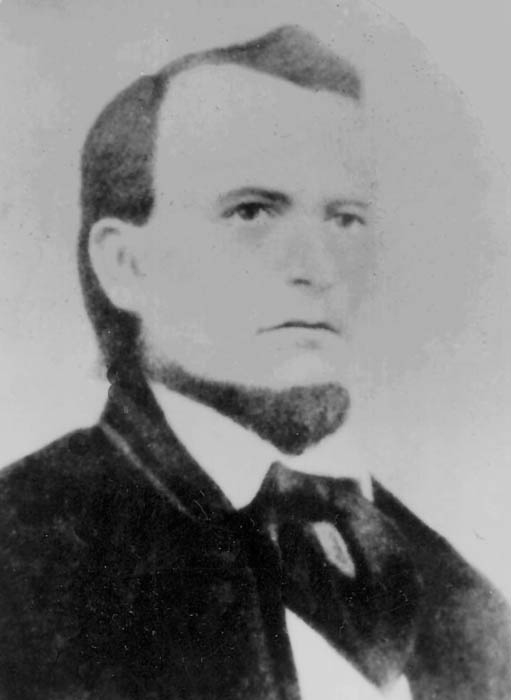
William Hamblin
This region was originally home to the Southern Paiute and Western Shoshone. In 1863, William Hamblin, a Mormon scout and missionary, befriended a Paiute Indian named Moroni, who showed him a piece of glittering ore. Moroni called the good specimen of silver ore “panacker.”
Hamblin continued to scout and took samples of several other locations and sent them to Salt Lake City, Utah. The Mormons then sent several expeditions. The first expedition, in April 1864, was made by J. M. Vandermark and Stephen Sherwood, who, along with William Hamblin, organized the Meadow Valley Mining District
The next month, Francis Lee and six other Mormon families moved from Santa Clara, Utah, to Meadow Valley, where they established an agricultural settlement of Panaca. Soon, a silver mine was opened, drawing in numerous prospectors.
When first settled in 1864, the area was still a part of Utah Territory. However, that changed when Nevada officially became a state in October 1864.
Approximately 60 miles west of Meadow Valley, the Pahranagat Mining District was formed in 1865, and William H. Raymond and John H. Ely moved a mill from Los Angeles, California, to process the ore.
Though the future looked prosperous, some settlers abandoned the area when local Indian tribes launched a series of raids and massacres. Other delays occurred due to the Civil War, such as the length of time it took to get mining equipment from San Francisco. Very little work was done between 1864 and the early part of 1868.
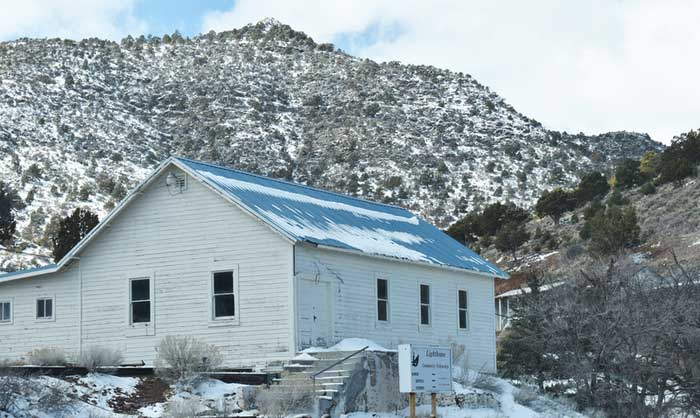
The Stockum House in Pioche, Nevada is one of the oldest buildings in the town by Kathy Alexander.
The Stockum House on upper Main Street was built in 1866 and is one of the rare survivors of fires in this area. Over the years, it has been used for multiple purposes, including a residence, boarding house, hotel, art gallery, and a church.
The first provisional Lincoln County seat was established at Crystal Springs but was short-lived. When Governor Henry Blasdel and 20 people decided to venture from Carson City to organize the county, they found there were not enough voters. A year later, in 1867, the Lincoln County government was organized in nearby Hiko.
More people came to the area when more discoveries were made in the Ely Mountains near Pioche. Pioche was first settled by Joseph Grange and E. M. Chubard, who erected a small furnace in 1868. However, the project failed, and they soon abandoned the location.
In the spring of 1868, San Francisco financier Francois Pioche sent Charles E. Hoffman to the area to purchase property and mining claims. A smelter was built, and the Meadow Valley Mining Company was incorporated.
A town sprang up around the claims on the “panacker ledge.” In 1869, P. McCannon, L. Lacour, and A. M. Bush plotted out a townsite, and the town was named Pioche City for Francois Pioche, the San Francisco businessman. Later, it became known as Pioche.
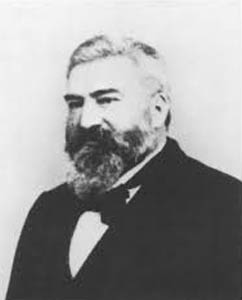
Francis Pioche.
The same year, John H. Ely and William H. Raymond, who had earlier been operating in Pahranagat Valley, arrived in the area. They first ran a five-stamp mill at Hiko, but because the ore from nearby Logan City was low-grade, the mill failed. They then traveled to Panaca, where they hired a few Mormons to haul the mill to a sloping hillside with abundant water between Pioche and Panaca. This site would later become known as Bullionville. An immediate success, they milled their own ore and that of the Mormons and could pay off their debts.
The two men then organized the Raymond & Ely Company. The Meadow Valley District was reorganized and renamed the Ely District in honor of John H. Ely.
However, getting the ore out of the area was difficult. Railroad service for the Pioche district first came in 1868 through Palisade station on the Central Pacific Railroad, 270 miles to the north. This meant an arduous journey by wagon with either 20-mule teams or ox teams over challenging mountain passes.
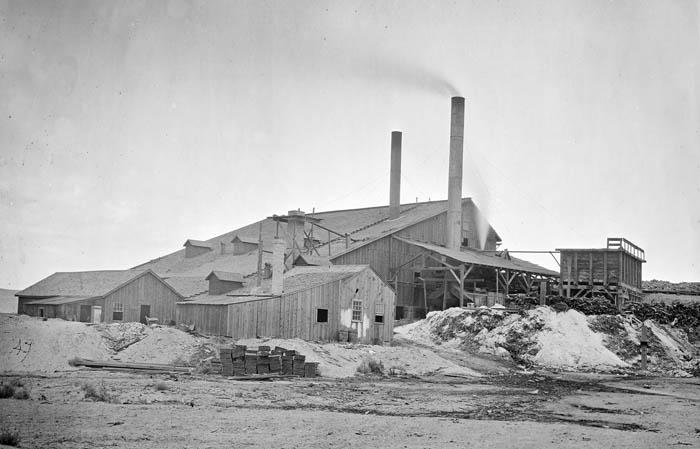
Meadow Valley Mining Company near Pioche, Nevada, 1871.
In the next years, the Meadow Valley Mining Company and the Raymond & Ely Company competed in their rush to find and process silver ore and became great rivals. The Raymond & Ely ore and those from many other claims in the district were processed at Bullionville. The Meadow Valley ore was treated at a large mill that the company built about 10 miles northeast of Pioche in Dry Valley, where they sunk a well to obtain water.
Within no time, thousands more prospectors and miners drifted into the area and staked claims, sometimes overlapping prior ones.
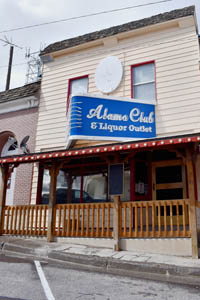
Alamo Club, Pioche, Nevada, by Kathy Alexander.
One of the first business buildings in Pioche was the Wells Fargo Freight Office and Pioche Bank in the 1860s. In 1901, the building became home to the Alamo Club Bar. Due to the violence that had occurred years earlier on Main Street, the bar was nicknamed the “Bucket of Blood Saloon!” Over the years, the building changed hands several times, and though sometimes renamed, it has remained a saloon all these years. The building also held a brothel for many years until 1950, when Lincoln County outlawed them. Now called the Alamo Club & Liquor Outlet, the building still holds the large original bank vault in the rear of the building. It is located at 723 Main Street.
By the early 1870s, Pioche had become the largest and most important silver mining town in southeastern Nevada, with an estimated population of 10,000 people by 1871. That year, the county seat was moved from Hiko to Pioche in February. It remains there today.
The Pioche mines produced $600,000 in 1870, and the following year, that number jumped to $3,600,000. The banner year was 1872, with $5,500,000. Amongst the mines, Raymond and Ely lead the way.
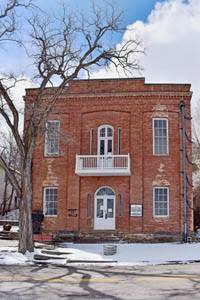
The “Million Dollar” courthouse in Pioche, Nevada, by Kathy Alexander.
Immediately, the city began to build what has become known as the “Million-Dollar Courthouse.” Edward Danahue designed it to be constructed of brick and stone in the Classical Revival style of architecture. The original plan budgeted for the courthouse and jail was $26,400. However, from the beginning, local politicians produced “cost overruns,” made alterations, mismanaged the project, and were said to have taken kickbacks. They also delayed payments with mounting interest.
The courthouse was completed in 1872 for $88,000, far exceeding the initial estimates and budget. The original loan was refinanced repeatedly with bonds totaling nearly $1 million. The loan wasn’t paid off until 1937, four years after the building had been condemned. The old courthouse still stands as well as the original town jail, with its 16-inch walls and tiny windows. The jail was so secure that not a single inmate ever escaped. The building is located on Lacour Street (Highway 93).
One of the worst fires in the West occurred on September 15, 1871. It began in a Main Street restaurant shortly after midnight during a celebration commemorating Mexican independence. Quickly spreading, it reached the Felsenthal Store, which held a stone fireproof structure in the cellar where 300 barrels of blasting powder were stored. The intense heat ignited the blasting powder, erupting into an explosion that shot nearly 400 feet into the air. The eruption was so strong it blew a 1,000-pound door clear out of town, showered the community with flaming debris, and left most of the population homeless. It also killed 13 people and injured 47. The destruction was estimated to have been for $500,000.
As thousands of miners and prospectors continued to pour into the area, Pioche soon gained a reputation for being one of the “toughest” towns in the West. With guns as the only law, the city’s violence soon overshadowed even that of other booming mining camps such as Bodie, California, and Tombstone, Arizona.
Boothill in Pioche, Nevada, by Kathy Alexander.
Residents of the town were often confused over the exact location of mining claims, so much so that mine owners resorted to hiring guards and gunfighters to protect their mining claims. The gunmen often made as much as $20 per day, which was a large salary at the time but much cheaper for the mine owners than settling disputes in court, where bribery often determined the outcome. The sheriff’s office was worth $40,000 a year in bribes alone.
During this time, it was reported that 75 men died “with their boots on” before anyone in Pioche died of natural causes. Nearly 60 percent of the homicides reported in Nevada during 1871-72 took place in and around Pioche. Many of these outlaws and gunfighters who died by violence are immortalized in Pioche’s Boot Hill. This is a sectioned-off part of the town’s cemetery where outlaws were buried separately from respectable folk.
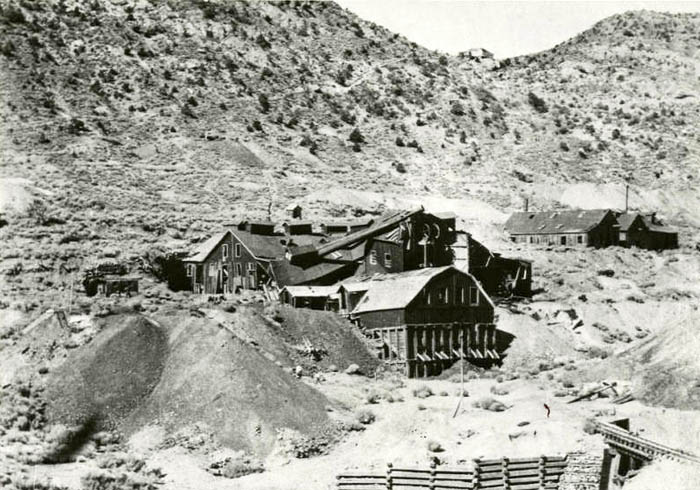
Raymond & Ely Mine, Pioche, Nevada.
In 1872, William Hamblin would be an essential witness in court battles being waged between Raymond & Ely and the Hermes Mining Company over control of the mineral wealth in the camp. However, before he could testify, he was administered a lethal drink. After he realized he had been poisoned, he started for home in Gunlock, Utah. However, after reaching Barclay in Clover Valley, he could travel no farther, and he died there. Hamblin was buried in the Barclay cemetery.
Another fire struck the town on May 5, 1872, in which 12 buildings were lost for $50,000.
Despite the violence and tragedies, Pioche was booming, with a population of about 6,000 in 1872. At that time, the city boasted a daily line of six-horse Concord stagecoaches carrying the U. S. Mail and a Wells Fargo express stagecoach that made its way to the Central City Railroad at Palisade, Nevada. The Gilmer & Salisbury stagecoach company also had three daily lines, with two running six-horse Concord coaches to Bullionville.
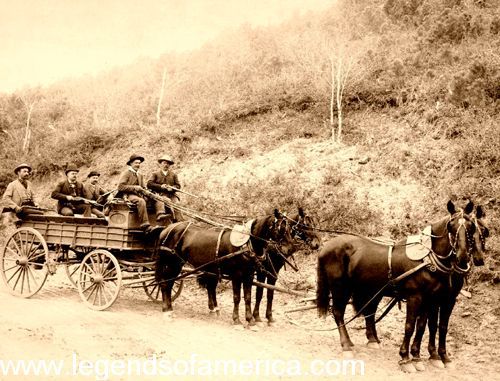
Wells Fargo Express
The first independent narrow-gauge railroad in Nevada was built in 1873 with the Pioche & Bullionville Railroad, which was formed to haul ore from the rich Pioche-area mines 20 miles to the milling facilities at Bullionville. Three railroads were also organized to build lines to and from Pioche. These included The Salt Lake, Sevier Valley & Pioche Railroad, the Palisade, Eureka & Pioche from the north, and another from the south.
Pioche had two telegraph offices — the Western Union to San Francisco and the Desert Telegraph (Brigham’s) through Salt Lake City. The town also had 32 steam hoists that blew a chorus of whistles, a fast freight line running day and night, providing delivery in five days, its narrow-gauge railroad from Pioche to Bullionville, and two daily newspapers. One of those newspapers was the Pioche Record, which started in May 1870. Today, it is called the Lincoln County Record and is the second oldest continuously printed weekly newspaper in the state.
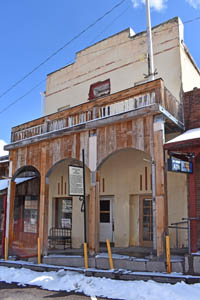
Odd Fellows Hall in Pioche, Nevada, by Kathy Alexander.
The city had 72 saloons, three hurdy-gurdy houses, 32 brothels, two theaters, two breweries, two gravity-fed water systems with street mains and fire plugs, two fire companies, and a livery stable maintaining 300 horses.
The Pioche Oddfellows Lodge was built in 1872 and was originally J.J. Halpin’s Hardware Store. Over the years, it has been used for many lodge functions, community dances, parties, and social gatherings.
In 1872, the two great mining rivals were at peak production and continued producing ore abundantly until 1876.
The Orr Garage was built of stone in the early 1870s, probably to use as a blacksmith shop or harness shop. In later years, starting in 1915, it was used as an auto repair garage.
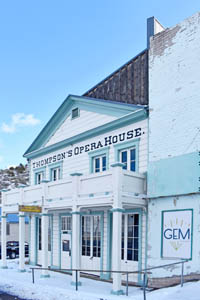
Thompson’s Opera House, Pioche, Nevada, by Kathy Alexander.
In March 1873, the Brown Opera House was built by Aleck Brown. It was constructed of wood in a classic revival style and an early pioneer board construction. Almost two decades later, it was renamed the Thompson Opera House in April 1892. Years later, it was used as a movie house. However, when the Gem Theater was built next door, the Opera House was used for weekly dances for many years. Today, the Brown/Thompson Opera House stands on Main Street.
On May 3, 1876, another destructive fire ripped through the town, causing the loss of 21 buildings and an estimated $40,000 in damages.
By the 1880s, many of the principal mines had shut down, and the fortunes of Pioche diminished. In the next years, the population varied with the surges and mining and railroad activity downturns.
In 1890, following a slump in mining activity, the Raymond & Ely, Meadow Valley, and Yuba mining companies were merged into the Pioche Consolidated Mining & Reduction Company, with the well-known Salt Lake City magnate William S. Godbe at the helm.
The Pioche Consolidated Mill, also known as the Godbe Mill, was built in 1891 at the site of the original Raymond & Ely No. 1 shaft just to the east of Pioche, at a place called West Point. The smelter processed ore for Pioche, Jackrabbit, and other nearby camps. The same year, the Pioche Consolidated bought the remaining assets of the abandoned Pioche & Bullionville Railroad in the immediate area and, in 1891, started construction of the Pioche Pacific Railroad, which would serve the Pioche, Jackrabbit, and Bristol mines. The mill burned in 1893 but was quickly rebuilt.
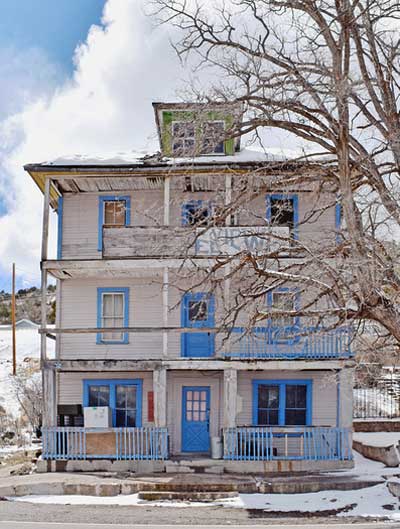
Old Mountain View Hotel in Pioche, Nevada, by Kathy Alexander.
In 1895, the Mountain View Hotel was built by the Ely Valley Mines to house their guests. It combines “Shingle” and early 1900s “Classic Box” styles. This old hotel served the lodging needs of dignitaries visiting Pioche on court business. President Herbert Hoover is said to have stayed in 1930. No longer serving as a hotel and needing restoration, the building is still a great example of turn-of-the-century Western architecture. It is located on Main Street next to the old courthouse.
Several buildings were erected at the turn of the century, including the Nevada Club, located on the site of the original Pioche assay office that a fire had destroyed. The structure is constructed of brick, concrete, and stone to reduce fire hazards. Today it is a lively bar on Main Street.

Pioche, Nevada 1906, colorized.
The Pioche Hotel dates from about the same time. The hotel operated until the mid-1950s and now serves as a private residence. Next door is the Commerce Cottage, one of several lending libraries in Pioche that commercial establishments operated in the late 1800s. In 1940, the Lincoln County Library system was started by purchasing this building, a jewelry store. It served as a library for ten years. After several years of neglect, this building was refurbished in 1984 to become the Pioche Chamber of Commerce Commerce Cottage.
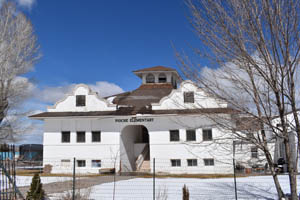
1909 Elementary School in Pioche, Nevada, by Kathy Alexander.
In 1907, Union Pacific Railroad built a standard-gauge railroad line from Caliente to the Pioche Consolidated mill, using some of the former Pioche & Bullionville grades through Condor Canyon. The new rail line allowed cheaper transportation for lower-grade ores to the mills and smelters in the Salt Lake City area.
In 1909, the Pioche Elementary School opened. Designed in Mission Revival architecture, the building initially contained four classrooms. Additions were made in the 1930s and 1940s, and for years, it was the oldest continually operating school in Nevada. In 1999, a new school was built, but the old mission-style school still stands.
The Combined Metals Reduction Company Mine & Mill was acquired by the Amalgamated Pioche Mines & Smelter Corporation in 1912. In 1913 rails were laid by the Prince Consolidated Mining Company, allowing ore from the Prince Mine west of Treasure Hill to be transported to the mill. The Amalgamated Pioche Corporations made no developments after 1917.
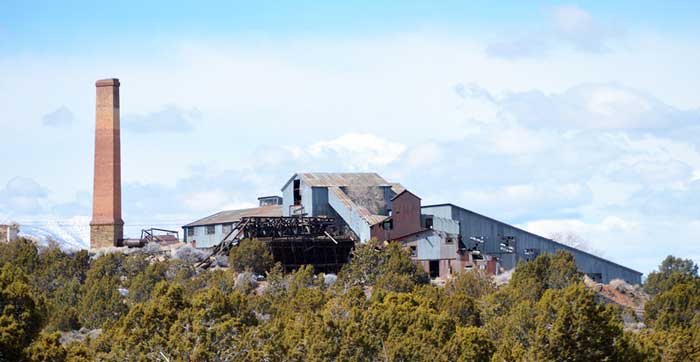
Godbe’s Mill, Pioche, Nevada, by Kathy Alexander.
In 1923, the property was leased to the Combined Metals Reduction Company, and that year and the Godbe Mill was reconfigured into a 250-ton flotation concentrator. In 1926, the mill was processing 4,000 tons a month. It burned again in 1929 but was rebuilt yet again.
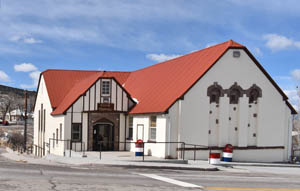
Town Hall in Pioche, Nevada, by Kathy Alexander.
Around this time, an aerial tramway was built to transport silver and nickel ore from Treasure Hill to Godbe’s Mill. The gravity-operated mill, supported by a five-horse motor, was built by the Pioche Mines Company.
In 1936, the Mormons began to build a meeting house at Hinman and Main Streets. It was dedicated in 1950 when it was finished and paid for. In 1986, when the new Mormon chapel was built, the old building was sold to the Town of Pioche, which is now the city’s town hall.
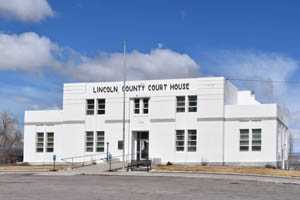
Lincoln County Courthouse, Pioche, Nevada, by Kathy Alexander.
In 1938, a new Lincoln County Court House was constructed to replace the historic courthouse on the hill. It is a simplified version of the modern Art-Deco style, which continues to house almost all of Lincoln County’s government functions. The Sheriff’s Office and Jail have been moved north of town off S.R. 322.
The Overland Hotel & Saloon building was built in 1940 by Bob Free. It has been burned and rebuilt several times over its colorful past. It originally had a bowling alley in the basement, and the west half was rented to Allen’s Cash Store for over 30 years. Today, the business is dedicated to keeping the look and feel of the beautiful western saloon of years past, complete with an 1884 hand-carved solid cherrywood Brunswick bar. It is located at 662 Main Street.
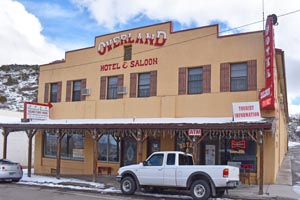
Overland Hotel & Saloon, Pioche, Nevada, by Kathy Alexander.
During World War II, an economic boom occurred when profitable lead-zinc deposits were developed. Before long, Pioche was the nation’s second-largest lead and zinc producer. The lead-zinc-silver ore was actively mined until 1959, resulting in 3.2 million tons mined over the years.
The Pioche Pacific Railroad ran sporadically until 1948 when it was finally abandoned.
In 1950, the last mines and mills closed down, and Pioche soon became a sleepy little town.
Railroad service to Pioche ended in August 1984, when United Pacific Railroad began dismantling its Pioche Branch between Caliente and Pioche.
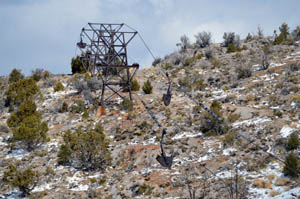
Pioche Tramway by Dave Alexander.
The Gem Theater continued to show movies until 2003 when high winds blew the roof off, and the owners could not afford to repair it.
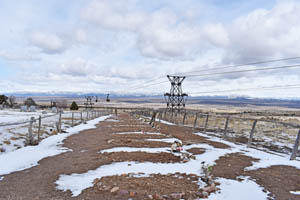
The abandoned tramway still stretches over town today, with many original ore buckets intact. Several headframes and mining buildings continue to dot the area, and the old Godbe Mill still stands in the valley behind a fence.
More history is to be seen on Main Street, where the Lincoln County Museum displays relics from the town’s rich past. One such building was erected by A. S. Thompson around 1900. A fire victim, it was rebuilt once, then later remodeled in 1929. Operated a mercantile and clothing store, it was later donated to Lincoln County in 1962 to become a museum.
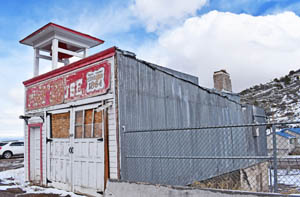
Old Pioche Firehouse by Kathy Alexander.
There are several other historic buildings in Pioche, such as the old Pioche Mercantile on Main Street, the old Fire House located at the junction of Main and LaCour streets, and the 1869 Masonic Lodge building. Check out Lincoln County Driving Tours Here.
Today, Pioche has little mining activity, and the main focus, as the county seat, is the administration of the Lincoln County government. Other occupations include agriculture, cattle ranching, the railroad, and tourism. The town is called home to about 1,000 people.
Nevada’s most notorious and liveliest ghost town is also the gateway to Echo Canyon and Spring Valley State Parks, where visitors can camp, boat, fish, and view wildlife via the Mount Wilson Backcountry Byway or along one of the trailheads of the Silver State ATV Trail.
Pioche is located on U.S. 93, about 93 miles north of Las Vegas.
©Kathy Alexander/Legends of America, updated February 2025.
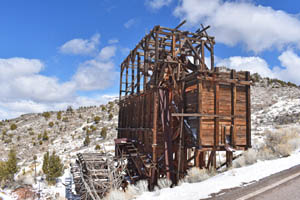
Pioche, Nevada Mine by Kathy Alexander.
Also See:
Caliente – Steeped in Railroad History
Pioche Land Jumpers and the Death of Jack Harris
Ghost Towns, Mining Camps, History & More
Sources:
Lincoln County Driving Tour
Lincoln County, Nevada
Nevada Expeditions
Pioche Nevada
Silver State Specialties
Utah Rails