
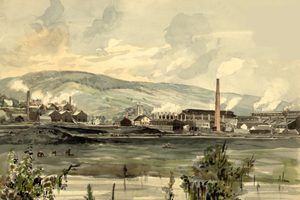
Pennsylvania Factories, 1857.
If New England provided the brains and dollars for 19th-century American expansion, the Middle Atlantic states provided the muscle. The region’s largest states, New York and Pennsylvania, became centers of heavy industry (iron, glass, and steel).
A wider range of people settled in the Middle Atlantic region than in New England. Dutch immigrants settled in the lower Hudson River Valley, now part of New York State. The Swedes went to Delaware. English Catholics founded Maryland, and an English Protestant sect, the Friends (Quakers), settled in Pennsylvania. In time, all these settlements fell under English control, but the region became a magnet for people of diverse nationalities.
Early settlers were primarily farmers and traders, and the region served as a vital link between the North and South. Philadelphia, Pennsylvania, midway between the northern and southern colonies, was home to the Continental Congress, the convention of delegates from the original colonies that organized the American Revolution. The same city was the birthplace of the Declaration of Independence in 1776 and the U.S. Constitution in 1787.
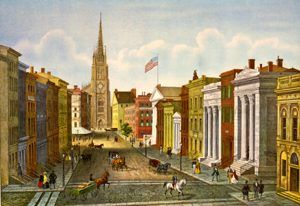
Wall Street, New York City, Augustus Kollner, 1847.
As heavy industry spread throughout the region, rivers such as the Hudson and Delaware became vital shipping routes. Cities on waterways — New York on the Hudson River, Philadelphia on the Delaware River, Baltimore on the Chesapeake Bay — grew dramatically. New York is still the Nation’s largest city, financial hub, and cultural center.
Like New England, the Middle Atlantic region has seen much of its heavy industry relocate to other areas. Other industries, such as drug manufacturing and communications, have taken up the slack.
Including New York, New Jersey, Pennsylvania, Delaware, Maryland, Washington D.C., Virginia, and West Virginia, this region has a varied geography with a broad, flat coastal plain lining the Atlantic and Gulf shores from the Texas-Mexico border to New York City. Much of the American Revolution was fought in this region, and the Declaration of Independence was signed in Philadelphia on July 4, 1776. The Nation’s capital, Washington, D.C., is located along the Potomac River. With numerous industrial areas, this region attracted millions of European immigrants and gave rise to some of the East Coast’s most significant cities: New York, Baltimore, and Philadelphia. The climate in the northwest is humid, with cool summers in the northernmost areas. Snow falls during the winter as the temperatures are regularly below freezing. Major geographical areas of the region include the Appalachian Mountains, the Atlantic Ocean, and the Great Lakes, and it borders Canada to the north.
Frederick Jackson Turner wrote in 1893 about the significant role the Mid-Atlantic, or “Middle region,” had played in shaping national American culture. He defined it as “the typical American region.”
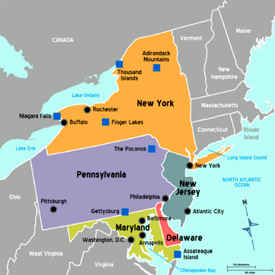
Mid-Atlantic States
The Middle region, entered by New York Harbor, was an open door to all of Europe. The tidewater part of the South represented typical Englishmen, modified by a warm climate and servile labor, and living in a baronial fashion on great plantations; New England stood for a special English movement —Puritanism. The Middle region was less English than the other sections. It had a broad mixture of nationalities, a varied society, a mixed town and county system of local government, a varied economic life, and many religious sects. In short, it was a region that mediated between New England and the South, as well as the East and the West. It represented the composite nationality that the contemporary United States exhibits, a juxtaposition of non-English groups occupying a valley or small settlement, and presenting reflections of the map of Europe in their variety. It was democratic and non-sectional, if not national; “easy, tolerant, and contented,” rooted firmly in material prosperity. It was typical of the modern United States. It was least sectional, not only because it lay between North and South, but also because, with no barriers to shut out its frontiers from its settled region and with a system of connecting waterways, the Middle region mediated between East and West and between North and South. Thus, it became the typical American region. Even the New Englander, who was shut out from the frontier by the Middle region, tarrying in New York or Pennsylvania on his westward march, lost the acuteness of his sectionalism on the way.
Compiled and edited by Kathy Alexander/Legends of America, updated August 2025.
Also See:
Source: U.S. Department of State