
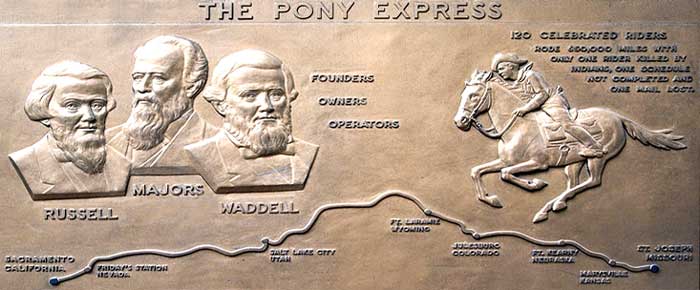
Pony Express Plaque in San Francisco, California.
Russell, Majors, and Waddell, a freighting and staging firm, first based in Lexington, Missouri, was a partnership between William Hepburn Russell, Alexander Majors, and William B. Waddell.
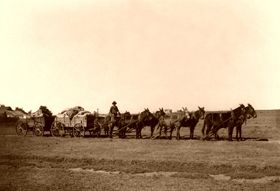
Freighter on the Plains.
Getting its start in 1854 to supply military posts in the American West, the company played a significant role in the history of transportation in the Great Plains. It would later operate various transportation and communications services, including stagecoach services, private express mail service, and the brief operation of the Pony Express in 1860 and 1861. In 1862, the partnership’s stagecoach operations, which retained value after the collapse of the rest of the company, were bought out by Ben Holladay, and the company ceased to exist.
The founding of the partnership was rooted in the U.S. Army’s need for an efficient means of transporting military supplies between a new depot in Santa Fe, New Mexico, and six new army posts in New Mexico Territory, which were established at the end of the Mexican-American War in 1848.
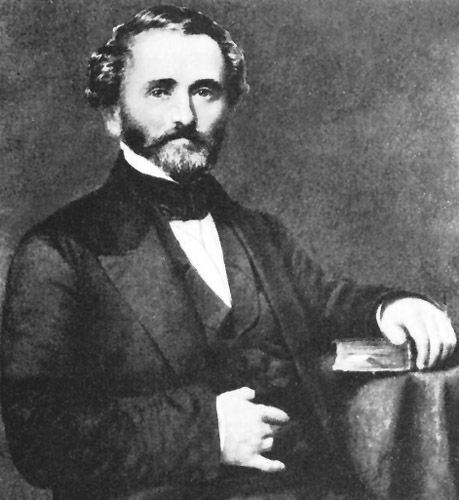
William Hepburn Russell
Lexington, Missouri, businessman William Hepburn Russell had made a fortune by taking financial risks early on. By the 1850s, he had already had a hand in two railroads, banks, land speculation, and a couple of other businesses. In 1850, he partnered with a man named James Brown to ship military goods to Santa Fe. Their partnership flourished until November 1850, when Brown was stricken with typhoid fever and died the next month. In 1853, Russell partnered with another Lexington, Missouri, businessman named William B. Waddell to form a wholesale firm to ship military supplies again. Waddell & Russell was soon hauling military supplies by wagon train to Fort Riley, Kansas, and Fort Union, New Mexico. Their strongest competitor was Kansas City freighter Alexander Majors.
In 1854, the War Department eliminated awarding yearly contracts to freighters in favor of two-year contracts, and the company awarded the contract would freight supplies from Fort Leavenworth, Kansas, to all military posts in the West and Southwest. The new contract would net huge profits but required a significant upfront investment. Rather than continuing to compete with Alexander Majors, the two firms merged into Russell, Majors, and Waddell in December 1854. On March 27, 1855, the new firm signed a contract with the government to freight supplies for two years. It was the largest freighting contract in history at the time. A month later, they relocated to Leavenworth, Kansas, and invested some $400,000 in offices, warehouses, a blacksmith and wagon shop, and a store for their employees. In addition to shipping military freight, the company was also busy transporting civilian goods on a large scale.
For two years, the company turned huge profits. However, their success would begin to spiral in 1857. At the outbreak of the 1857 Mormon War, the quartermaster at Fort Leavenworth requested that Russell, Majors, and Waddell move some 2.5 million pounds of freight to Salt Lake City, Utah. Though the request far exceeded the company’s contract and was a risky venture, they didn’t want to jeopardize its position as the chief army contractor and agreed to haul the freight. To fulfill the request, they borrowed heavily, anticipating payment of the goods after the government delivered them. However, when the company’s 52 wagons arrived in Utah Territory, the Mormons attacked the massive caravan. The company’s loss of $494,762.61 exceeded two years’ worth of profits, and the U.S. Army never reimbursed them.
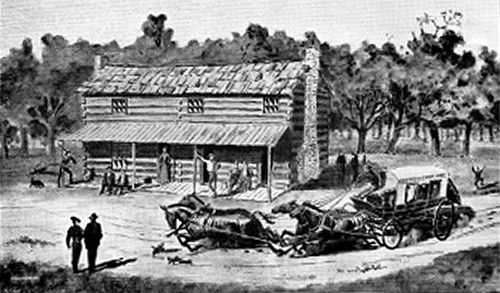
Pike’s Peak Express at Leavenworth, Kansas.
Despite the loss in Utah, the company continued to bid on government contracts, which were its primary source of livelihood. Though the company continued to freight supplies to the western forts and Santa Fe, New Mexico, it sank deeper into debt. A series of transactions over the next few years, including Russell’s insistence on developing the Leavenworth and Pikes Peak Express, continued to erode the partners’ finances. In the spring of 1858, the firm began freighting from Nebraska City, Nebraska, on a government contract to transport all provisions for all western forts. The supplies were brought up the Missouri River by steamboat and then taken out by wagon train. Part of this agreement was to move their headquarters to Nebraska City.
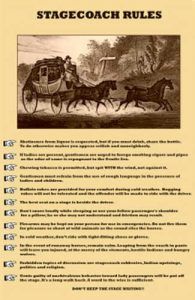
Stagecoach Rules
In 1860, despite growing financial trouble, Russell created the firm’s most enduring legacy by convincing his two reluctant partners to support the establishment of the Pony Express. As a result, the firm, once again, won the government mail contract, which Russell was sure would save them from falling into bankruptcy. The Pony Express began operations on April 3, 1860. However, it, too, would be a failure, losing upwards of $1,000 a day.
That same year, Russell found that he could no longer honor his financial obligations and became mixed up in a scandal involving Secretary of War John Buchanan Floyd and Godard Bailey, a clerk for the Department of Interior. Through a series of illegal transactions, money had been obtained from the Indian Trust Fund. Russell and others were indicted in the scandal, effectively ruining the reputation of the firm.
This affair, coupled with the completion of the telegraph lines, ended the brief era of the Pony Express in October 1861. In 1862, the company filed for bankruptcy. Its remaining stagecoach operations, which retained value after the collapse of the rest of the company, were bought out by Ben Holladay.
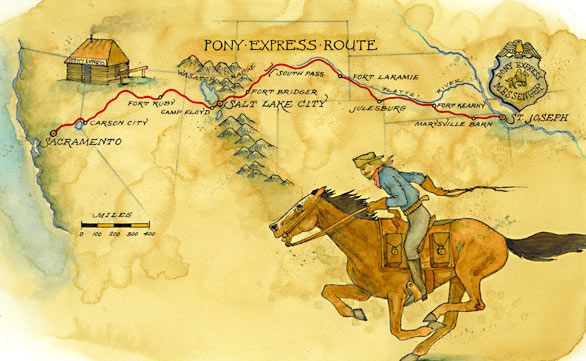
Pony Express Route.
©Kathy Alexander/Legends of America, updated August 2025.
Also See:
Stagecoaches of the American West
Ben Holladay – The Stagecoach King
Pony Express – Fastest Mail Across the West
See Sources.