

The Thin Line between Progressive and Insanity in American Auto History
by Jim Hinckley

Milton Othello Reeves “Octoauto” in 1911.
The line between visionary or eccentric, between progressive thinking, and outright insanity is often relatively thin. During the formative years of the American automobile industry, the unbridled manifestations of a creative imagination blurred this line on thousands of occasions.
As an example, the optional swing-away, electrically heated steering wheel available on the 1917 McFarlan would be on the visionary side of the line. Indicative of the eccentric side are the eight-wheeled Octoauto with an astounding 180-inch wheelbase or the six-wheeled Sextoauto, devised by Milton O. Reeves.
Straddling the line quite nicely would be the automobiles built by Benjamin Briscoe of the Jackson, Michigan-based Briscoe Motor Corporation. The 1914 models sported a single Cyclops headlight mounted dead center in the upper radiator shell and laminated paper-mâché body panels. The 1916 models sold with four-cylinder engines and a promotion proclaiming, “Buy the Four. Use it for a month. If then you decide you want the Eight, simply pay the difference and a small installation fee.”
Often, what appears as eccentricity today was innovative technology during the first decades of the industry. Promoted as “The Friction Drive Car,” the 1907 Lambert was a vehicle that served to pioneer the type of transmission capitalized on with the patented developments of Byron Carter.
Between the creation of the first experimental models by William Lambert in 1891 and the company’s demise in 1917, a wide array of “interesting” vehicles rolled from the company’s manufacturing facilities in Anderson, Indiana. Engines mounted in the rear, front, or middle came in two-cylinder and four-cylinder configurations and provided power to one or two wheels, depending on whether it was a three-wheel or four-wheel model.
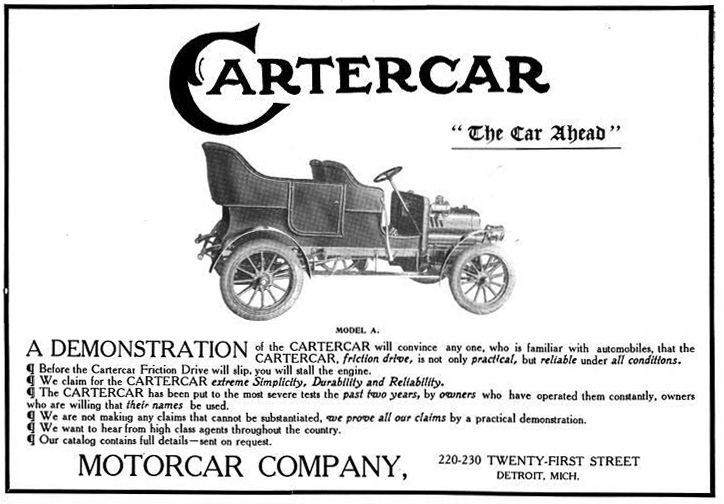
1906 Carter Car Ad. Click for larger view
Byron Carter perfected the friction transmission designed by Lambert, and the resultant Cartercar received rave reviews from the automotive press, even though many manufacturers had turned him away as he sought a producer. Heralded as the future, with promotional billing the car as “The car of a thousand speeds!” The company’s slogan was, “No Clutch to Slip, No Gears to Strip.”
Lambert and Cartercar were not the only automobiles that utilized the intriguing system perfected by Carter. Other manufacturers, including Metz, Petrel, Simplicity, and Sears, honestly believed that a transmission comprised of compressed paper fiber components rather than gears was a good idea.
Even William Durant, the founder of General Motors in 1909, saw promise in the idea. That is why he purchased the company and patent rights shortly after GM’s formation.
Then there are those innovations that simply defy any semblance of reason, even in the context of the time when built. Case in point: the 1913 Duck, a four-passenger touring car with the driver’s seat in the rear!
The speed of technological advancement during these formative years quickly transformed a visionary development with the potential for tremendous profits into eccentric oddities and sideshow curiosities. For example, in 1911, compressed air starters that eliminated the need for dangerous and strenuous hand cranks were among some of the most innovative options available in luxury automobiles.
After investing a great deal of capital in development, McFarlan offered an in-house-designed and built unit as standard equipment in 1912. The system utilized a four-cylinder Kellogg pump operated by an engine-turned shaft and a pressurized canister that stored air at 200 pounds of pressure.
The ink had hardly dried on the companies’ promotion of this revolutionary advancement before the Cadillac division of General Motors was heralding its 1912 model as, “The Car That Has No Crank.” Charles Kettering had created the Delco electric starter and electric lights, standard equipment on the new Cadillac.
By 1914, Cadillac’s electric starter had rendered the automotive compressed air starter system a historical artifact. It also served as the death knell for electric and steam-powered automobiles.
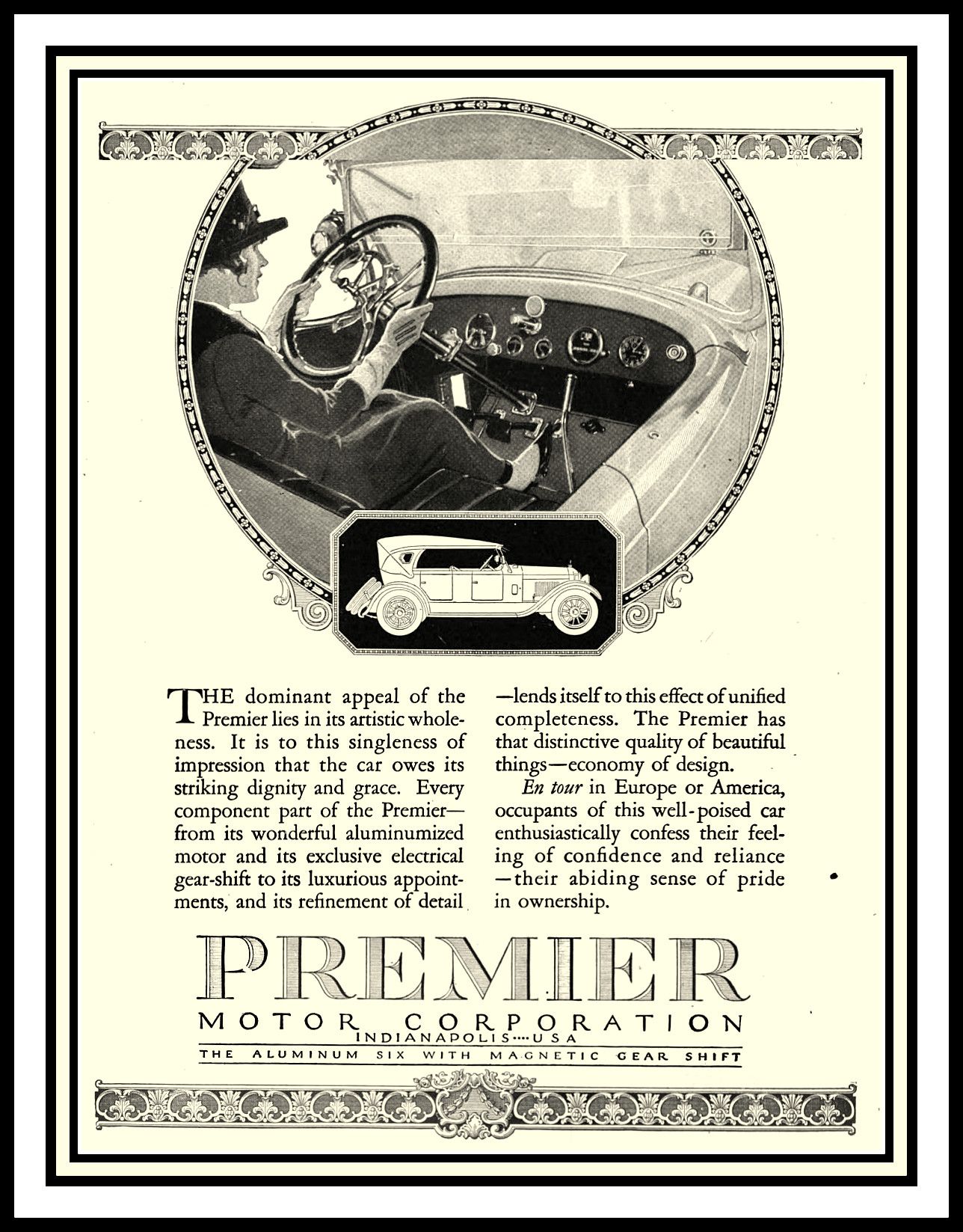
Premier Motor Corporation, 1920 Advertisement.
In an age of dramatic technological advancement, when it seemed an exciting new world of mechanical wonder was looming on the horizon, an automobile’s innovative features often became its claim to fame in advertisement and promotion. Here, too, the transformation of a company’s image from innovative to quirky happened quickly.
The Premier of 1918 was “The Aluminum Six with Magnetic Gear Shift.” Two years later, the company that had manufactured automobiles featuring overhead valves, sliding gear transmissions, and shaft drive in 1904 was in its death throes. The troublesome magnetic gearshift proved to be the company’s undoing.
On more than one occasion, visionary and innovative thinking leapt ahead of the technological capabilities of the time. The first automotive recall in the United States and the development of leaded gasoline stemmed from an engineering equivalent of getting the horse before the cart.
The air-cooled Chevrolet debacle of 1923 began with experimentation by Charles Kettering, the innovative genius behind the development of the electric starter that appeared on the 1912 Cadillac and transformed the entire industry, in 1918. It culminated with a rush to production fueled by a power struggle for control of General Motors.
Perhaps the most intriguing technological innovations from the industry’s formative years are those that were literally decades ahead of practical feasibility. Consider the Woods Dual Power of 1916, a hybrid that utilized a four-cylinder gasoline engine as an auxiliary to the Woods electric motor and featured many of the engineering principles found on the Prius.
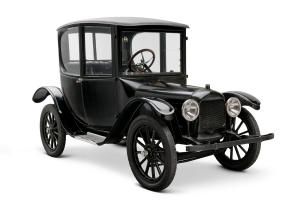
1916 Woods Dual-Power Hybrid Coupe. From the Collections of The Henry Ford. Gift of Adin P. Rawnsley
The infancy of the automobile is littered with the wreckage of genius that crashed upon the rocky shores of high-speed advancement, warp-speed technological advancement, and the changing needs of a fickle consumer. Consider the fact that the first automotive endeavors of Studebaker, a company that was the world’s largest producer of wheeled vehicles in the 1870s, were electric-powered vehicles designed by Thomas Edison. Consider the fact that the patented VST (variable speed transmission) devised by Milton Reeves is the grandfather of the transmission in the Dodge Caliber.
To be a visionary or eccentric requires independent thinking. From that perspective, independent thinking reigned supreme during the formative years of the American automobile industry.
©Jim Hinckley, March 2013, updated May 2025.

Author Jim Hinckley
About the Author: Jim Hinckley is an award-winning author and photographer who is an official contributor to Legends Of America through a partnership developed in October 2012. He is a former Associate Editor of Cars and Parts Magazine and the author of multiple books, including several on Route 66. You can follow him on Jim Hinckley’s America.
Also See:
Legends of the American Automobile
Jim Hinckley – Author & Legends of America Contributor