
By Albert Bolles, 1879
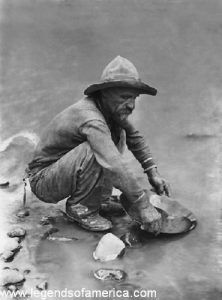
Old Prospector.
Although some specimens of gold were collected in North Carolina and Virginia before the American Revolution, no excitement about the subject arose until the discovery in California in 1848. Before then, the gold miner had pursued his occupation quietly and without ever dreaming of enormous riches suddenly acquired, but all was changed with the discovery on the Pacific Coast. Gold had been found in California before this time; for Hakluyt, in his account of the voyage of Sir Francis Drake’s expedition along the Pacific Coast in 1579, said, “There is no part of the earth to be taken up wherein there is not a reasonable quantity of gold and silver.”
Although this statement was highly overdrawn, it probably contained a basis of truth, for the Mexicans found placer gold near the Colorado River at various intervals between 1775 and 1828. Still, these discoveries were regarded as unimportant, and even so, as late as 1835, when Forbes wrote his History of California, he said, “No minerals of any particular importance have yet been found in Upper California, nor any ores of metals.” Three years later, the placers of San Francisco, 45 miles northwest of Los Angeles, were discovered. The deposit of gold was neither extensive nor rich, but it was worked steadily for 20 years.
In 1841, the exploring expedition of Commodore Wilkes visited the coast, and its mineralogist, James D. Dana, made a trip overland from the Columbia River through Willamette and Sacramento Valleys to San Francisco Bay. The following year, he published a work on mineralogy, which mentioned the discovery of gold in Sacramento Valley and auriferous rocks in Southern Oregon. Dana did not regard his discovery as of any practical value, and no one heeded his words if he said anything about it in California. Nevertheless, many people believed the country was rich in minerals. On May 4, 1841, Thomas O. Larkin, at that time United States consul in Monterey, wrote in an official letter to James Buchanan, who was then Secretary of State, saying: “There is no doubt, but that gold, silver, quicksilver, copper, lead, sulfur, and coal mines are to be found all over California; and it is equally doubtful whether, under their present owners, they will ever be worked.”
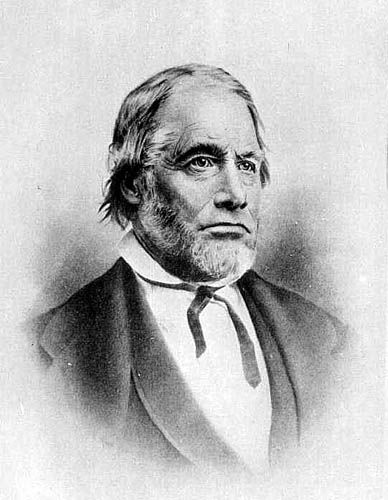
James Marshall.
Seven years later, on January 19, 1848, James W. Marshall, while engaged in digging a race for a sawmill at Coloma, California, about 35 miles eastward from Sutter’s Fort, found some pieces of yellow metal in the mill race, which he and the half-dozen men working with him imagined were gold. Feeling confident that he had discovered great importance, he went to the mill race every morning to look for gold. As his specimens accumulated, his associates began to think there might be something in his gold mine. About the middle of February, one of the men employed at the mill went to San Francisco to determine if this metal was precious and was introduced to Isaac Humphrey, who had washed for gold in Georgia. The experienced miner saw at a glance that the real stuff was before him and, after a few inquiries, was satisfied with the richness of the deposits and made immediate preparations to go to the mill.
Arriving at Coloma on March 7, Humphrey found work at the mill going on as though no gold existed in the neighborhood. The next day, he took a pan and spade and washed some of the dirt from the bottom of the mill race in places where Marshall had found his specimens for gold. In a few hours, he declared the mines far more prosperous than any he had seen or heard of in Georgia.
He now made a rocker and went to work earnestly washing for gold, and every day, he found an ounce or more of metal. The men at the mill made rockers for themselves, and all were soon busy searching for the shining stuff.
Everything else was abandoned, yet the rumor of the discovery spread slowly. In the middle of March, Pearson B. Reading, the owner of a large ranch at the head of the Sacramento Valley, happened to visit other Sutter’s Fort, and, hearing of the mining at Coloma, he went there to see it. He said that if the similarity of formation could be regarded as proof, there must be gold mines near his ranch, so after observing the method of washing, he went away and, in a few weeks, was at work on the bars of Clear Creek, nearly 200 .miles in a northwesterly direction from Coloma.
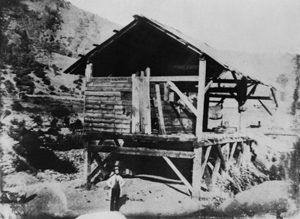
James Marshall at Sutter’s Sawmill, Coloma, California, 1851.
A few days after Reading left, John Bidwell, formerly a California congressional representative, came to Coloma, and the result of his visit was the organization of a party of Indians belonging to his ranch to wash for gold on the bars of Feather River, 75 miles from Coloma. Thus, the mines were opened at several distant points.
The following was the first printed notice, in a California newspaper published in San Francisco, of the discovery: “In the newly-made raceway of the sawmill erected by Captain John Sutter on the American Fork, gold has been found in considerable quantities. One discovery person brought $30 to New Helvetia and gathered them there quickly.”
On May 20, the same paper, announcing that its publication would be suspended, said, “The whole country, from San Francisco to Los Angeles, and from the seashore to the base of Sierra Nevada, resounds with the sordid cry of ‘Gold, gold, gold!’ while the field is left half planted, the house half-built, and everything neglected but the manufacture of picks and shovels, and the means of transportation to the spot where one man obtained a $128 worth of the real stuff in one day’s washing; and the average for all concerned is $20 per day.”
Towns and farms were deserted or left to the care of women and children. In contrast, rancheros, wood-choppers, mechanics, vaqueros, and soldiers and sailors who had deserted or obtained leave of absence devoted all their energies to washing the auriferous gravel of the Sacramento River. Never satisfied, however great their profits were, they continually looked for new places that might yield twice as much as they had made before. Thus, the area of their labors gradually extended, and, at the end of 1848, miners were at work in every large stream on the western slope of the Sierra Nevada, from the Feather River to the Tuolumne River, a distance of 150 miles, and also at Reading’s diggings in the northwestern corner of the Sacramento Valley.
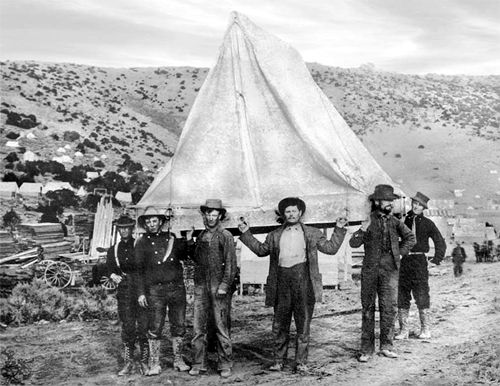
Miners were always quick to “pick up” their homes and move to the next big mining strike.
The news of the gold discovery was received with disbelief and ridicule in the Atlantic States and foreign countries. Still, soon, the receipts of the precious metal in large quantities and the enthusiastic letters of army officers and men whose words were unquestioned changed the current of belief and created tremendous excitement.
Oregon, the Hawaiian Islands, and Sonora sent their thousands to share in the auriferous harvest of the first year. In the following spring, all the adventurous young Americans east of the Rocky Mountains wanted to go to the new Eldorado, where, as they imagined, everybody was rich. Gold could be dug by the shovelful from the bed of every stream.
The year 1850, two years after Marshall’s discovery, was marked by many “rushes” or sudden migrations in search of imaginary rich diggings. The miners, although generally men of rare intelligence, compared ideas with the laborers in other countries, had vague ideas of the geological distribution of gold and the incredible amounts dug out by them (sometimes a single miner extracting thousands of dollars per day) excited their imagination so highly as to prevent the formation of sound judgment, even if they had possessed the requisite information upon which to act. Many believed that there must be some volcanic source from which the gold had been thrown up and scattered over the hills, and they thought that if they could only find that place, they would have nothing to do except shovel up the precious metal and load their mules with it. More than once, long trains of pack animals were sent out with the confident expectation of getting loads of gold within a few days.
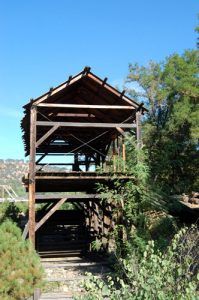
Sutter’s Mill in Coloma, California, by Kathy Alexander.
No story was too extravagant to command belief. Men who had never earned more than a dollar a day before coming to California were dissatisfied when clearing $20 and were always ready to start on some expedition searching distant diggings expected to yield more abundantly. Decades later, the miners would have better ideas of the auriferous deposits and no longer count upon digging the pure gold by the shovelful. Yet, ever since the discovery of the mines, they were always prepared for emigration to any new field of excitement.
Of course, the chief want of the placer miner was an abundant and convenient supply of water; the first noteworthy attempt to convey the needful element in an artificial channel was made at Coyote Hill in Nevada County, California, in March 1850. This ditch was about two miles long and, proving a decided success, was imitated in many other places until, in eight years, 6,000 miles of mining canals had been made, supplying all the principal placer districts with water and furnishing the means for obtaining the more significant portion of the gold yield of the State. Many of the ditches were marvels of engineering skills.
The problem was getting the most water at the greatest altitude above the auriferous ground and the least immediate expense, as money was worth 3-10% per month interest. As the paydirt might be exhausted within a couple of years, and as the anticipated profits would be sufficient quickly to pay for a new ditch, durability was a point of minor importance.
There was no imperial treasury to supply the funds for a durable aqueduct in every township, nor could the impatient miners wait a decade to complete gigantic structures in stone and mortar. The high value of their time and the scarcity of their money made it necessary to adopt the cheapest and most expeditious expedients for obtaining water. Where the surface of the ground furnished the proper grade, a ditch was dug in the earth; and, where it did not, flumes were built of wood, sustained in the air by a framework that sometimes rose to a height of 300 feet in crossing deep ravines, and extending for miles at an elevation of 100-200 feet.
All the devices known to mechanics for conveying water from hilltop to hilltop were adopted. Aqueducts of wood and iron pipes were suspended upon wire cables or sustained on wood bridges, and inverted siphons carried water up the sides of one hill with heavier pressure from the higher side of another.
The ditches were usually the property of companies, of which there were 400 in the State at one time, owning a total length of 6,000 miles of canals and flumes. The largest of these, the Eureka, in Nevada County, had 205 miles of ditches constructed for $900,000, and their receipts from the sale of water were $6,000 per day. Unfortunately, these mining canals, though more numerous, more extensive, and bolder in design than the aqueducts of Rome, were less durable. Most were abandoned and allowed to go to ruin so that scarcely a trace of their existence remains, save in the heaps of gravel from which the clay and loam were washed in search of gold.
As the placers in many districts were gradually exhausted, the demand for water and the profits of the ditch companies decreased, and the more expensive flumes, when blown down by severe storms, carried away by floods, or destroyed by the decay of the wood, were not repaired.
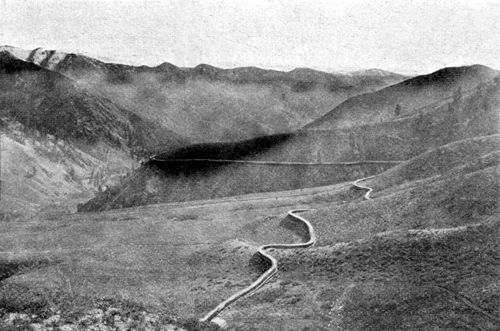
Ten-mile long flume, Twin Springs, Idaho, 1898.
The construction of hundreds of ditches within three or four years after the successful experiment at Coyote Hill created a fresh impulse to placer mining and significantly modified its character. Though of the rudest description, new inventions were multiplied to facilitate the gathering of the yellow metal. Among others was the introduction of an implement previously used in Georgia, called by the short and unclassic name of ” tom.” This was a great improvement upon the rocker, yet it was soon superseded by a still more remarkable, — the sluice, a broad trough from 100-1000 feet long, with transverse cleats at the lower end to catch the gold. With a descent of one foot in twenty, the water rushes through it like a torrent, bearing down large stones and tearing the lumps of clay to pieces. The miners, of whom a dozen may work at one sluice, have little to do save to throw in the dirt and take out the gold.
Occasionally, throwing out some stones or shoveling the dirt may be necessary to prevent the sluice from choking, but these attentions cost little time. The sluice is the best device previously used for washing gold and is supposed to be unsurpassable. It has been used more extensively in California than elsewhere, although American miners have introduced it into Australia, New Zealand, British Columbia, Transylvania, and many other countries.
Though an original invention here, the sluice had been previously used in Brazil, but it was never brought too much excellence there nor used extensively. No such implement was known in 1849 in the gold mining industry.
The shovel could not bring the earth to the sluice fast enough, and the wages of a dozen workmen must be saved, if possible. So, in 1852, Edward E. Mattison, a native of Connecticut, invented the process of hydraulic mining, in which a stream of water was directed under heavy pressure against a bank or hillside containing placer gold, and the earth was torn down by the fluid and carried into the sluice to be washed. Thus, the expense of shoveling was entirely reduced.
The man with the rocker might wash one cubic yard of the earth daily; with the tom, he might average twice that quantity; with the sluice, four yards; and with the hydraulic and sluice together 50 or even 100 yards. The difference was immense. The force of a stream of water rushing through a two-inch pipe, under a pressure of 200 feet perpendicular, is tremendous, and the everlasting hills themselves crumble down before it as if they were. Still, piles of clouds blown away by a breath of wind or dissipated by a glance of the sun.
And yet, even this terrific power has not sufficed. When the hills have been dried by months of constant heat and drought, the clay becomes so hard that the hydraulic stream, with all its momentum, does not steadily dissolve it. Often, the water runs off clearly as ever through the sluice and consequently is wasted.
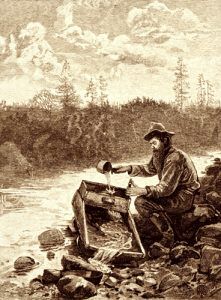
The Cradle, by Century Illustrated, Henry Sandham, 1883.
The sluice could wash more dirt than the hydraulic stream furnished when the clay was hard and dry, and, to prevent this loss, the miner would often cut a tunnel into the heart of his claim and blast the clay loose with powder, so that it would yield more readily to the action of water. Some of these operations used two tons of powder at a single blast.
Laborers were hired to introduce the sluice, the ditch, and the hydraulic process. The pan and the rocker required every man to be his own master, but these new processes led to other modes of employment.
Rocker claims were abundant in 1849, but there were not enough good sluice claims to supply one-third of the miners three years later. The erection of a long sluice, the cutting of drains (often necessary to carry off the tailings), and the purchase of water from the ditch company required capital. The manner of clearing up rendered it possible for the owner of a sluice to prevent his servants from stealing any considerable portion of his gold before it came to his possession. Thus, hiring miners for wages became common in the placer diggings.
Since the discovery of the original home of gold, it was extracted more scientifically than placer mining.
There are other modes of obtaining gold, which almost became obsolete. The arrastra, for instance, was used in the early days to pulverize the ore. It was a Mexican contrivance, rude but effective. Winnowing, or “dry-washing,” was also practiced by the Mexicans and continued to be used in lower California, where the ore was found too far away from a sufficient water supply to make any other practice possible. The wind bears away the dust and light particles of the earth and leaves the gold dust, which is heavier.
During geological surveys, gold was found in many places but nowhere in quantities as large as in California. It was found in the White Mountains of New Hampshire, Vermont, New York, New Jersey, and Pennsylvania, and in still larger quantities, in the remaining Southern seaboard States, as far as Alabama.
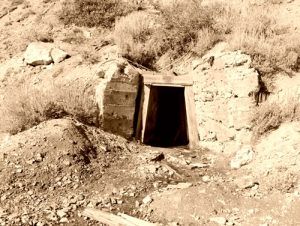
Adit at the Lucky Tiger Mine, Humboldt County, Nevada.
Gold mining contains more gambling elements than any other regular industry, which is one reason why it has always fascinated many. But quartz mining is robbed essentially of this uncertain element, for the business, if properly conducted, yields more regular profits than any other mode of gathering the precious metal.
By Albert Bolles, 1879, compiled and edited by Kathy Alexander/Legends of America, updated January 2025.
Also See:
Reed Gold Mine, North Carolina – First Gold Discovery
Mining on the American Frontier
Source: Bolles, Albert S.; Industrial History of the United States, Volume IV, Henry Bill Publishing Company, Norwich, CT, 1879.