
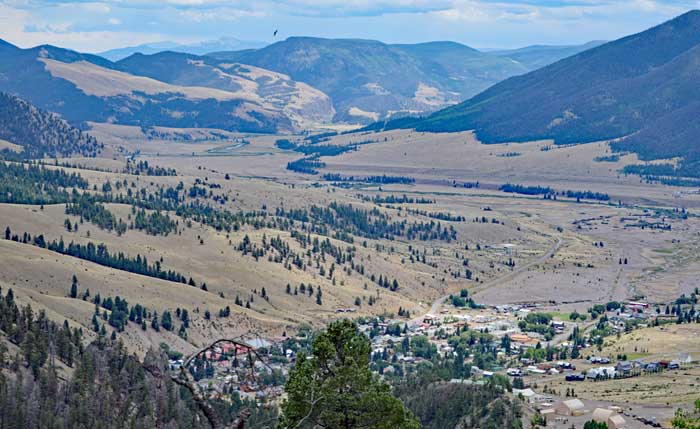
A view from Bachelor Loop and the Bulldog interpretive sign of Creede, Colorado. Photo by Dave Alexander.
For an adventure into old-west mining, scenic views, historic ruins, and more, Creede, Colorado, and Bachelor Loop will not disappoint.
There’s Silver in Them Hills! Or, at least, there was when Nicholas C. Creede discovered it here in 1889. But there was settlement in this area long before Creede found his rich vein of Silver on Willow Creek. The Upper Rio Grande Valley had long played a significant role in the lives of indigenous peoples, including the Ute tribe, who traversed the San Juan Mountains according to the seasons, moving to the valleys in winter and the high country in summer.
Another attraction for the Natives of Southwest Colorado was the hot springs at what is now known as Wagon Wheel Gap, less than ten miles downriver from where Creede would be established. It was there that settlers began farming as early as 1840, curtailing Native migrations and eventually taking over the land as troops from Fort Garland forced them onto reservations. By the 1870s, stage stations connecting mining camps over the Divide with the East further increased settlement.
Tourism was also on the grow. Books about the American West helped lure Easterners and European immigrants to the region. By 1883, the Denver & Rio Grande Railroad was transporting tourists to Wagon Wheel Gap with the opening of a depot. The hot springs soon became a popular destination for those wanting to take in the ‘healing waters.’
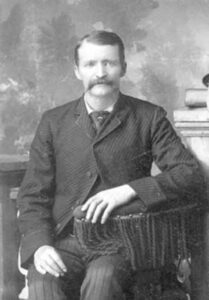
Nicholas ‘Nic’ C. Creede.
Then, in 1889, Nicholas C. Creede, a former soldier and scout who had been drifting up and down the Rockies in search of striking it rich, found his fortune in Willow Creek Canyon. It wasn’t his first success, as Creede had already discovered rich mineral veins, including the Monarch in Chaffee County in 1878 and the Bonanza. Lacking the knowledge to develop the mines and the capital, Creede sold both and used the money to tour mining districts and expand his knowledge. His discovery of the Holy Moses, a high-grade silver vein on the Rio Grande tributary, in 1889, sparked a great rush. By 1891, the population of the area’s mining camps had swelled from 600 to over 10,000.
It was near Jimtown camp in June of 1891 that Creede caught the attention of David Moffat, one of Denver’s most important financiers and industrialists of the late 19th Century. Creede had discovered his biggest strike to date with the Holy Moses mine, which convinced Moffat and his consortium to lease the mine from Creede and enter into an agreement with him to fund his prospecting, paying him a one-third share of all future finds, along with $100 a month. This benefited Creede greatly, who soon after discovered a rich Amethyst vein that would lead to several mines, including the Bachelor, Annie Rooney, Sunnyside, and the Commodore. It is estimated that the Amethyst vein generated up to $1,000 a day for Creede in 1892.
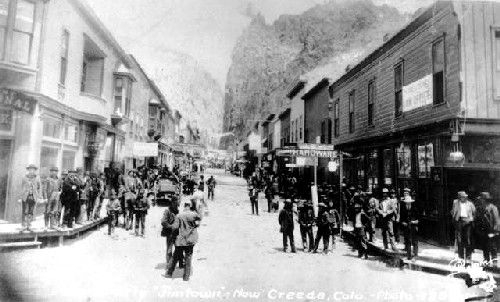
Creede, Colorado, May 23, 1892.
The original townsite that would become Creede was located on East Willow Creek, just above its junction with West Willow Creek. Below the townsite were Stringtown, Jimtown, and Amethyst. After the discovery of the Holy Moses, the entire area from East Willow to Amethyst was renamed Creede in honor of Nicholas. Railroad tycoon William Palmer extended the line from Wagon Wheel Gap into Willow Creek Canyon just above Creede in 1891, eventually leading to two trains arriving and departing daily, shipping over a million dollars in Silver down-valley by 1892.
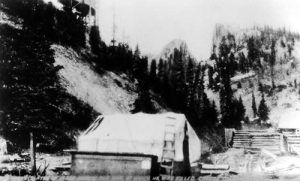
Bob Ford’s Tent Saloon in Creede, Colorado, 1892.
During this boom, the region also attracted numerous gambling houses, as the State Capital of Denver was experiencing a reform movement against drinking and gambling. Infamous confidence man Soapy Smith would become the uncrowned king of Creede’s criminal element. Other well-known names attracted to the town include Bat Masterson, William Sidney “Cap” Light, the first deputy sheriff and Smith’s brother-in-law, and Robert Ford, the man who shot and killed Jesse James a decade previously in Missouri.
Ford opened Ford’s Exchange Dance Hall on May 29, 1892, but disaster would strike the mining town just days later when fire destroyed most of the business district, along with Ford’s dance hall. He wasted no time and quickly put up a makeshift tent saloon just a few days later. He would lose his life the very next day when Edward O’Kelley walked into the tent with a sawed-off shotgun and killed him. Some historians speculate that Soapy Smith was involved, but this has never been proven. Ford was buried in Creede, but his body was later exhumed and reburied in his hometown of Richmond, Missouri. There is still a marker at his original grave in Creede.
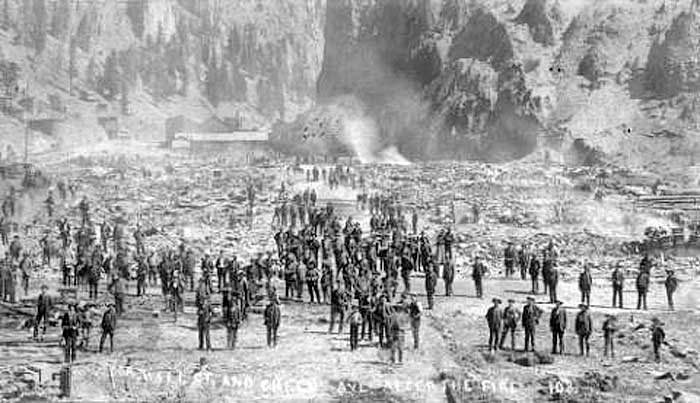
Men stand at the corner of Wall Street & Creede Ave after the June 1892 fire. Photo courtesy Colorado Museums.
Also, just days after the fire, Creede was officially incorporated on June 13, 1892. At the same time, politics at the state capitol were cooling to the anti-gambling movement, and Denver businessmen began relocating from Creede back to their original operations. The mining boom lasted until the following year, when the Silver Panic of 1893 shuttered most of the mines. But unlike some boom towns, Creede survived the economic downturn, as it increasingly relied on lead and zinc mining. Prospectors and families began moving from nearby abandoned mining camps to Creede, which by then had installed its own electric system.
Tensions escalated between the town and the nearby Wason Ranch, culminating in the incorporation of Mineral County. M.V.B. Wason believed his ranch was best suited as the county seat, given its location at the confluence of roads and waterways, as well as its safety from flash floods, which Creede had already experienced. The state agreed and named Wason the County Seat on March 27, 1893. Citizens in Creede disagreed, and Mineral County voters chose Creede as the seat that November. Wason attempted to delay the move on technical grounds, so residents of Creede raided Wason, taking all the town’s records, docket books, and other essential materials.
Mining experienced a slight resurgence in the early 1900s, and despite the market’s fluctuations, Creede continued to be supported primarily by hard rock mining. Total production through 1966 included 58 million troy ounces of silver, 2 million metric tons of copper, 150,000 ounces of gold, 112,000 metric tons of lead, and 34 metric tons of zinc. Mining continued until 1985, when the last mine, Homestake, closed permanently.
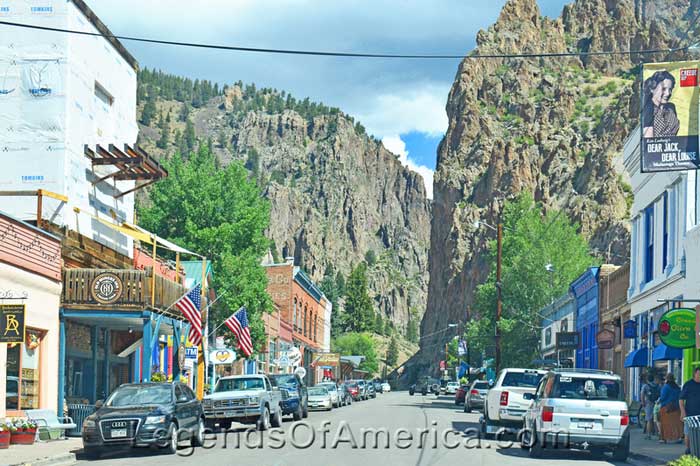
Looking down Main Street toward Bachelor Loop in Creede, Colorado. Photo by Kathy Alexander.
Today, Creede has gone back to its tourism roots. City and County leaders began leading efforts to preserve historic buildings and promote the area’s mining history and scenic views. In 1976, the Creede Historical Society was established, and during the 1980s, the town transformed into a vibrant arts community, boasting galleries, theaters, and a range of cultural events.
In 1992, the Rio Grande Headwaters Land Trust was established to protect and conserve the region’s land, water, and wildlife resources. With its location by the headwaters of the fourth-longest river in North America, Creede and Mineral County feature rafting and kayaking at various difficulty levels to suit everyone. The Trout fishing is also excellent here, with the Rio Grande and its tributary streams providing opportunities for fly fishermen. Hiking is also very popular in the area.
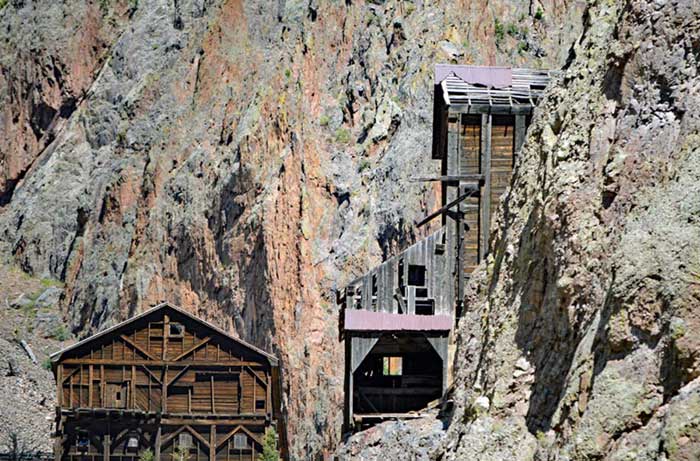
On Bachelor Loop outside of Creede, Colorado. Photo by Dave Alexander.
For history buffs, a journey on the Bachelor Loop Historic Driving Tour tops off your Creede Adventure. Seventeen miles through the historic mining district above Creede, you will experience mining remnants and abandoned camps, tour the Last Chance Mine, and take in the Creede Underground Mining Museum & Community Center adjacent to the loop at the north end of town.
The loop’s route includes 14 interpretive pullouts telling the history of the mining operations and abandoned camps, including Bachelor. The eastern part of the loop is designated for four-wheel drive vehicles, as it traverses steep terrain. However, the Western part of the loop is much easier, and traveling this way allows you to bypass the rough parts by going down the mountains if you can’t make the steep climbs.
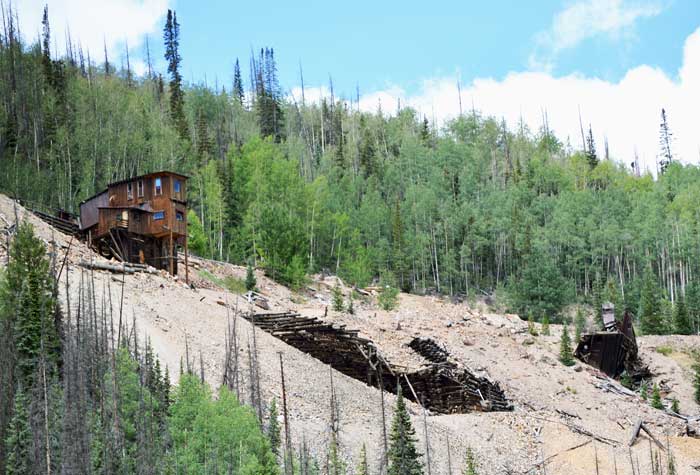
A view from the lower tier of the Last Chance Mine on Bachelor Loop. Photo by Dave Alexander.
You’ll find the Last Chance Mine & Museum toward the north end of the loop, not far north of Bachelor on the west side of the route. The mine would be a pile of ruins if not for the efforts of Jack Morris, who, over the past couple of decades, has rebuilt some of the mining buildings, reopened the shaft for tours, and established a couple of museums on the site. Well worth a stop to talk to Jack and take in the history. He is featured in a PBS documentary on Creed, discussing how the Last Chance Mine came to be, which can be viewed here.
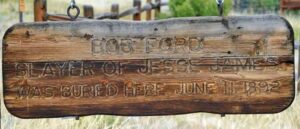
Sign where Bob Ford was initially buried in Creede, Colorado. Photo by Dave Alexander.
In addition to the 14 interpretive mining pullouts, stops 15 & 16 take you to Creede Cemetery and Bob Ford’s original grave site just above Creede.
For more information, visit Creede & Mineral County.
©Dave Alexander/Legends of America, updated August 2025.
Also See:
Alpine Loop National Backcountry Byway, Colorado
Colorado, the Centennial State
Denver & Rio Grande Western Railroad
Mining and Manufacturing in the West
Sources:
Creede & Mineral County, Colorado
City of Creede
U.S. Forest Service
Wikipedia