
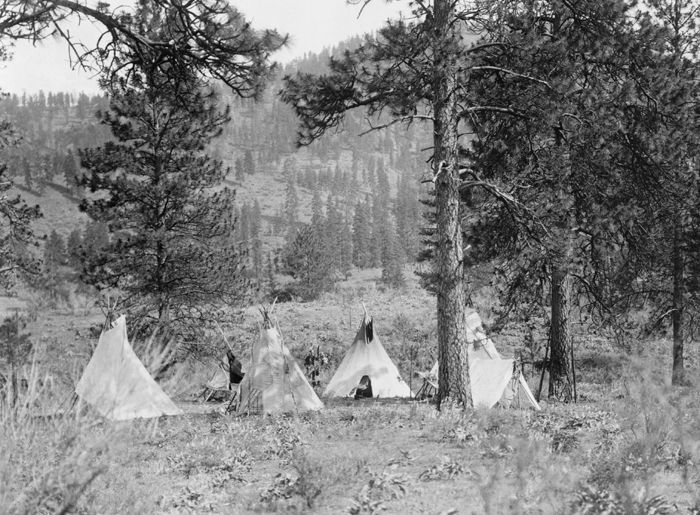
Spokane camp by Edward S. Curtis, about 1910.
The Salishan people share a group of languages with the Indians of the Pacific Northwest, including Washington, Oregon, Idaho, Montana, and British Columbia, Canada. The language group is comprised of 23 different dialects spoken by various tribes. Although distinct from one another, the Salishan language is similar to the Chimakuan and Wakashan languages. Salish is the largest language family in the Pacific Northwest.
Two widely separated branches of Salishan languages developed — Coastal and Interior. All of the Salishan languages are considered critically endangered, some extremely so, with only three or four speakers left. The Pentlatch, Tillamook, Twana, and Nooksack are no longer spoken. Of those that remain, older adults speak the Salishan languages almost exclusively. However, efforts are being made to revive the languages as they are now taught in several schools and at the Salish Kootenai College in Montana, where students can train to teach the language.
According to his own statements, Juan de Fuca was probably the first European to visit the Salishan people in 1592. However, there is some evidence today that Sir Francis Drake’s vessels made it to the area in 1579. This evidence includes English swords, coins, and other paraphernalia found in the area.
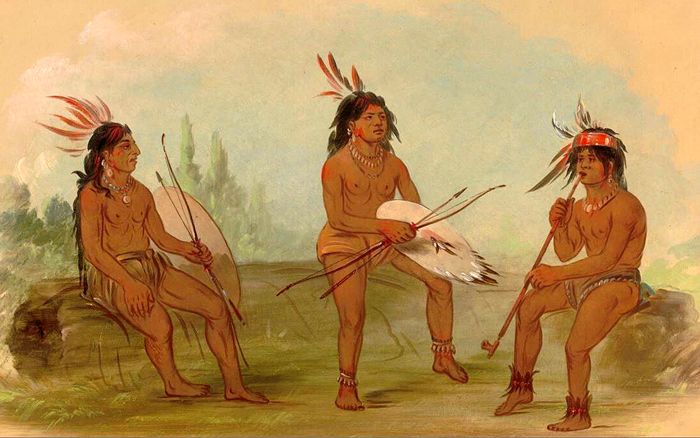
Chinook Men by George Catlin.
Afterward, several Spanish navigators passed along their coasts, followed by British and American vessels that came to trade. The first detailed information regarding the Salishan tribes was obtained, however, from the account of the expedition of Lewis and Clark (1804-06).
Fort Astoria, established in 1811 at the mouth of the Columbia River in Oregon, extended knowledge of the tribes. From that time until 1846, most of the region, known as the Oregon Territory, was a subject of dispute between Great Britain and the United States. On the Canadian side, employees of the Hudson’s Bay Company were among the first to enter the country.
Physically and culturally, the coast and interior Salish belong to different groups, the former being affiliated to some extent with the other coast people to the north and the interior Salish resembling interior stocks in their own neighborhood. Ways of living and different cultural practices were also in use from region to region.

Salish Warrior by Edward Boos, 1907.
The Salishan includes numerous tribes, including the Clatsop, Chinook, Klickitat, Molala, Kalapuya, Tillamook, Alsea, Umpqua, Coos, Coquelle, Tututni, Salish, Chetco, Tolowa, Takelma, Galice/Applegate, and Shasta.
Compiled by Kathy Alexander/Legends of America, updated May 2024. See Sources.
Also See:
Indians and Emigrants on the Overland Trails
Native Americans – First Owners of America