
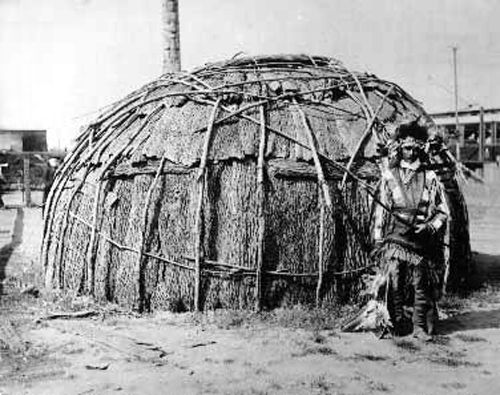
Kickapoo Wikiup.
Before contact with Europeans, the Kickapoo lived in northwest Ohio and southern Michigan between Lake Erie and Lake Michigan. By common tradition, the Kickapoo and Shawnee believe they were once a single tribe but separated after an argument over a bear’s paw. When the white man pushed west, the Kickapoo migrated to Wisconsin, then Illinois. By treaty, they were relocated to southern Missouri, but less than half stayed, wandering south and west. Fiercely independent, many Kickapoo people fled to Mexico rather than surrender to the Americans. Approximately half of those who went to Mexico returned to the United States and were sent to Indian Territory in Oklahoma.
Kickapoo comes from the word “Kiwigapawa,” which means “he stands about” or “he moves about.” The tribe of the central Algonquian group formed a division with the Sac and Fox, with whom they had close ethnic and linguistic connections. The Kickapoo first appeared in written history about 1667-70 when Allouez found them near the Fox and Wisconsin Rivers portage. The Kickapoo were associated with other more powerful tribes occupying the country watered by the Ohio, Wabash, and Miami Rivers, in which they participated in a treaty made at Greenville, Ohio, in 1795 by General Wayne, and in those of 1803, at Fort Wayne and Vincennes, Indiana. By these and succeeding treaties, the tribe ceded all their lands on the Wabash, White, and Vermilion Rivers.
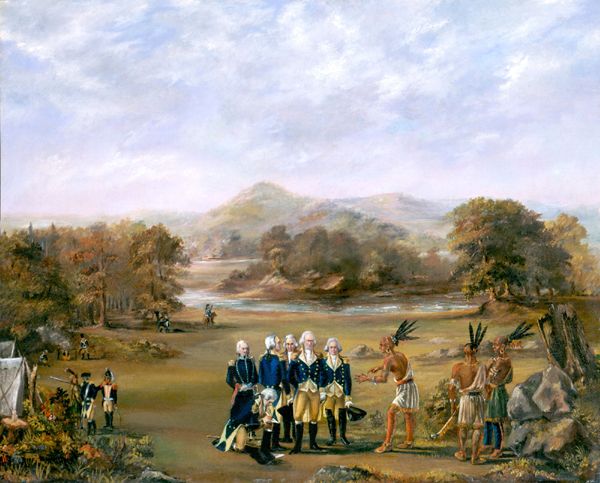
Treaty of Greenville, Ohio.
They also ceded lands in the valley of the Illinois River, of which “the said Kickapoo tribe claim a large portion by descent from their ancestors, and the balance by conquest from the Illinois nation, and uninterrupted possession for more than half a century.”
Considering these cessions, they were given a tract of land on and south of the Osage River in Missouri. The tribe lived on the Wabash River when this treaty was made and moved to Missouri the following year.
On October 24, 1832, the Kickapoo ceded their country on the Osage River in Missouri. On November 26 of the same year, they were granted a reservation north of the Delaware tribe in Kansas and were also to receive an annual subsidy.
However, on May 18, 1854, another treaty ceded their Kansas land to the United States, “saving and reserving in the western part thereof 150,000 acres for a future and permanent home” for the tribe. By the terms of the treaty, the specified sum of $20,000 was to be paid to the tribe, and they were to support themselves thereafter.
June 28, 1862, a treaty was made, setting apart a portion of the reserve to be divided and held in severalty by members of the tribe, the remainder to be sold, the Atchison & Pike’s Peak Railroad Company having the privilege of buying the lands at $1.25 per acre. The company bought 123,832 acres at that price, lying principally in Brown County, Kansas. The lands were advertised for sale in 1866. The tribe members who chose to move to the Indian Territory, numbering about 600, were allotted a portion of the Sac and Fox Reservation.
The Kickapoo’s first location in Kansas was on the southeast corner of their reservation, near Fort Leavenworth. They were more industrious and generally more correct than many of the tribes to the north.
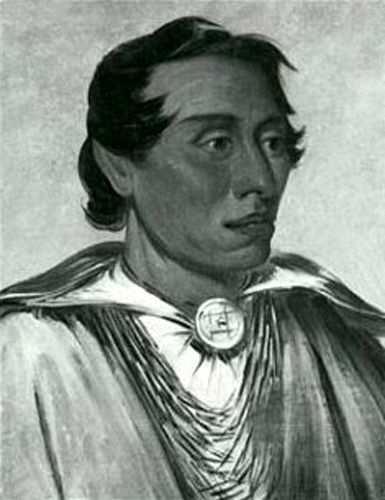
Kennekuk, Kickapoo Prophet.
The more rapid improvement of this tribe was in large measure owing to the influence of Kennekuk, a Kickapoo Prophet. He moved to the Indian Territory with the tribe and founded a religious sect among them, teaching and practicing the doctrines of sobriety, industry, and honesty. The Prophet numbered a large proportion of the tribe among his adherents.
Today, there are three recognized Kickapoo tribes in the United States: the Kickapoo Tribe of Indians of the Kickapoo Reservation in Kansas, the Kickapoo Tribe of Oklahoma, and the Kickapoo Traditional Tribe of Texas. Additionally, there is another band in the Mexican state of Coahuila and a large group in Arizona. Today, there are about 3,000 Kickapoo Tribal Members.
Compiled and edited by Kathy Alexander/Legends of America, updated March 2025.
Also See:
List of Notable Native Americans
Native Americans – The First Owners of America
Native American Heroes and Legends
See Sources.