
By Charles M. Skinner in 1896
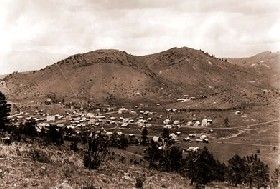
Rosita, Colorado.
A mass of rock chokes the canyon of Oak Creek, shaped like a keystone and wedged into the jaws of the defile. An elderly Ute tells this story of it. Acantow, one of the chiefs of his tribe, usually placed his lodge beside the spring that bubbled from a thicket of wild roses in the place where Rosita, Colorado, stands today. He left his wife–Manetabee (Rosebud) — in the lodge while he went across the mountains to attend a council and was gone four sleeps. On his return, he found neither wife nor lodge, but footprints and hoof prints on the ground showed to his keen eye that the Arapaho had been there.
Getting on their trail, he rode over it furiously and reached Oak Canyon at night, along which he traveled until he saw the gleam of a small fire ahead.
A squall was coming up, and the noise of it might have enabled him to gallop fairly into the group that he saw huddled about the glow, but it is not like an Indian to do that, and, tying his horse, he crawled forward.
There were fifteen of the Arapaho, and they were gambling to decide the ownership of Manetabee, who sat bound beneath a willow near them. So engrossed were the Indians in the contest that the snake-like approach of Acantow was unnoticed until he had cut the thongs that bound Manetabee’s wrists and ankles — she did not cry out, for she had expected rescue — and both had imperceptibly slid away from them. Then, with a yell, one of the gamblers pointed to the receding forms and straightway, the 15 made an onset.
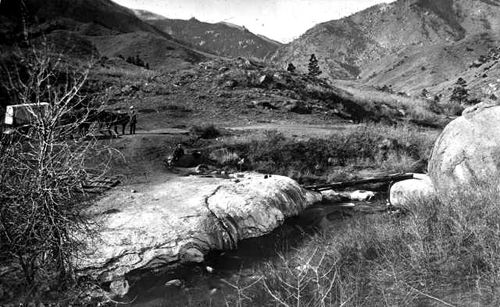
Manitou Spring, 1870
Swinging his wife lightly to his shoulders, Acantow set off at a run. He had almost reached his horse when his foot caught in a root, and he fell headlong. The pursuers were almost upon him when the storm burst in a fury.
A flood of fire rushed from the clouds and struck the earth with an appalling roar. Trees were snapped, rocks were splintered, and a whirlwind passed. Acantow was nearly insensible for a time — then he felt the touch of the Rosebud’s hand on his cheek, and together they arose and looked about them. A massive block of river granite lay in the canon, dripping blood. Their enemies were not to be seen.
“The trail is gone,” said Acantow. “Manitou has broken it, that the Arapaho may never cross it more. He would not allow them to take you. Let us thank the Manitou.” So they went back to where the spring burst amid the rose bushes.
By Charles M. Skinner in 1896, compiled & edited by Kathy Alexander/Legends of America, updated March 2025.
Also See:
Legends, Ghosts, Myths & Mysteries
Native American Legends & Tales
About the Author: Charles M. Skinner (1852-1907) authored the complete nine-volume set of Myths and Legends of Our Own Land in 1896. This tale is excerpted from these excellent works now in the public domain.