
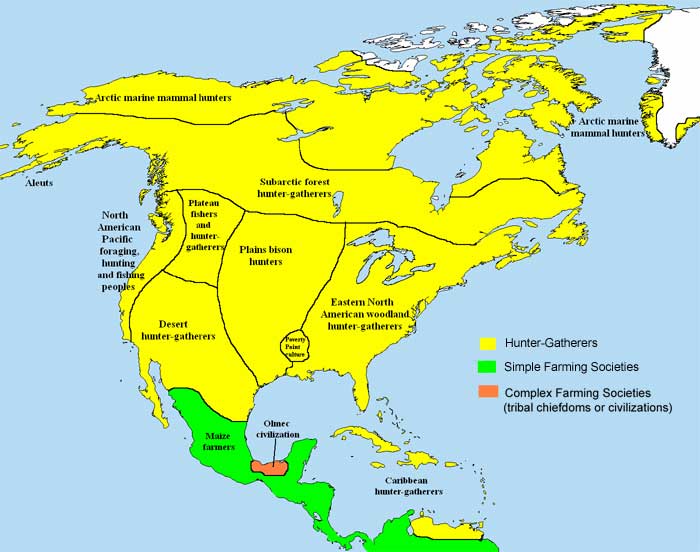
Pre-Columbian Map of North America
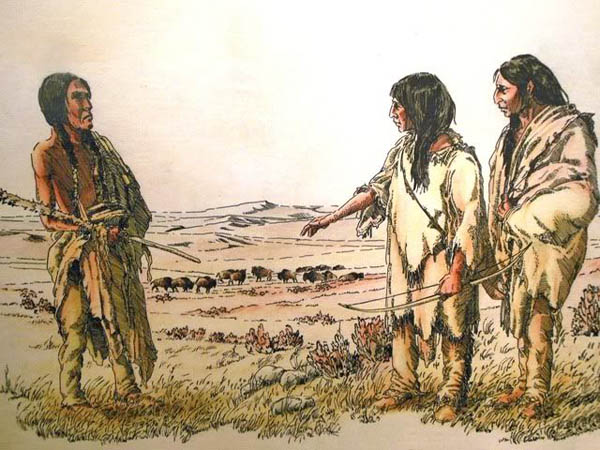
Native Americans and Buffalo.
Eras:
Paleo Indian (Lithic stage) 16,000 BC to 8000 BC
Clovis Culture – 13,500 BC to 11,000 BC
Folsom Culture – 9000 BC to 8000 BC
Archaic Period – 8000 BC to 3000 BC
Dalton Period – 8500-7900 BC
Woodland Period – 3,000 BC to 1000 AD
Early Woodland Period – 1000 BC to 200 BC
Adena Culture – 1000 BC to 1 AD
Hopewell Culture – 100 BC – 500 AD
Middle Woodland Period – 200 BC to 500 AD
Late Woodland Period – 500 to 1000 AD
Post-Archic Period – 1000 BC – present
Mogollon – 150 AD to about 1450 AD
Mississippian 1000 to 1520 AD
Exploratory Period – 1520 to 1670 AD
Historic Period – 1670 AD to present
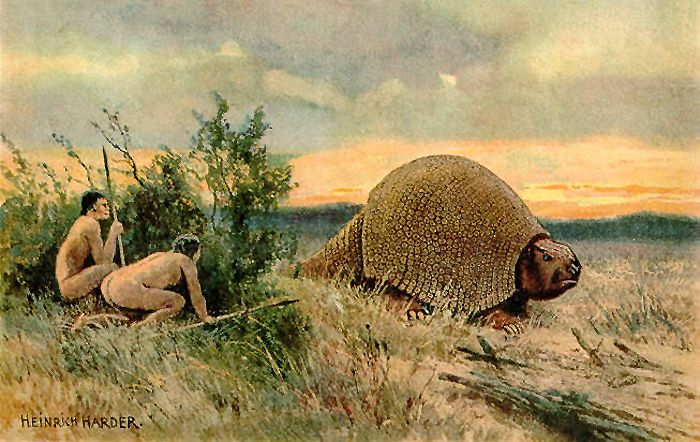
Paleo Indians by Heinrich Harder, 1919.
North American archaeology divides the history of pre-Columbian North America into several distinct periods, spanning from the earliest known human habitation to the early European exploration of the New World.
While the phrase “pre-Columbian” literally refers to the time preceding Christopher Columbus’s voyages of 1492, in practice, it is also used to denote the entire history of indigenous American cultures until those cultures were extinguished, diminished, or extensively altered by Europeans, even when this occurred long after Columbus. This era is also referred to as precontact, pre-colonial, or prehistoric America.
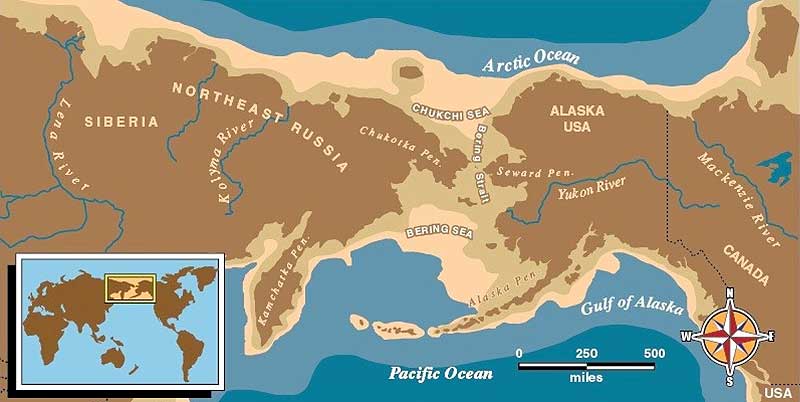
Bering Land Bridge courtesy National Park Service.
The Americas are thought to have been first inhabited by Asian nomads who crossed the Bering Land Bridge, now the Bering Strait. At the end of the last Ice Age, the land bridge was exposed due to low sea levels. The exact date when the first group of people migrated into the Americas is subject to much debate. However, genetic findings suggest that people migrated from southern Siberia and crossed to America about 18,000 years ago. Further archaeological evidence indicates that by approximately 15,000 years ago, humans had migrated south of the Canadian ice sheets. People spread to all parts of the continent throughout the next millennia, but it would be several thousand years before the first complex civilizations arose. These people are referred to as living in the Paleo-Indian period. Several cultures and traditions have been identified within this time frame, including the Clovis Culture, Folsom Tradition, and Dalton Tradition.

Paleo-Indian People.
These early inhabitants of the Americas were hunter-gatherers, and even after the emergence of advanced civilizations, hunter-gatherer societies continued to inhabit most of the continent’s area until the 18th century.
Artifacts found in North and South America have been dated to approximately 14,000 years ago, and humans are believed to have reached Cape Horn, the southernmost tip of South America, by this time.
As time went on, many Native American groups began an agricultural way of life, dating back to perhaps about 7000 BC, and numerous pre-Columbian societies became sedentary, such as the Pueblo peoples, Mandan, Hidatsa, and others, and some established large settlements, even cities, such as Cahokia, in what is now Illinois. Some groups also built civic and monumental architecture, major earthworks, and complex societal hierarchies.
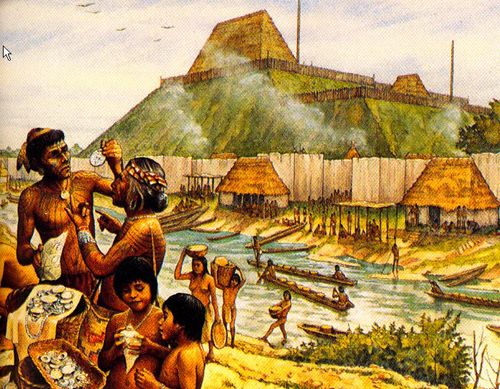
Cahokia People
Many of these civilizations had long ceased to function by the time of the first permanent European arrivals in the late 15th and early 16th centuries, and are known only through archaeological evidence and native oral histories. Other civilizations were contemporary with the colonial period and were described in European historical accounts.
Before the development of archaeology in the 19th century, historians of the pre-Columbian period primarily relied on the records of European conquerors and the accounts of early European travelers to interpret the past.
It was not until the 19th century that archaeology and scientific methodologies began to be applied. Because the first Native Americans kept no written records, historians analyzing this period must rely on artifacts and search for clues to understand the lifestyles of these earliest Americans better. Historians often divide history into two segments: prehistory and history. Prehistory is defined as the period before the existence of written documents.
Although not all experts agree on the exact dates for each period, classifying prehistoric life into distinct ages helps historians emphasize the features shared by cultures during given periods.
©Kathy Alexander/Legends of America, updated August 2025.