
By William Worthington Fowler in 1877
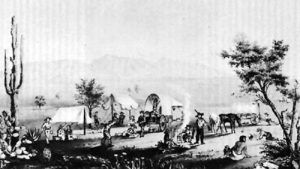
Wagon Train.
The first stage in pioneer life is nomadic: a half-score of men, women, and children faring day after day, living in the open air, encamping at night beside a spring or brook, under the canopy of the forest; it is only when they reach their place of destination that the germ of a community fixes itself to the soil and rises obediently to those laws of social and civil order.
The experiences of camp life form the initial steps to the backwoods education that a woman must at length acquire to fit her for the duties and trials of all remote settlements. Riding, driving, or tramping on, now through stately groves, now over prairies which lose themselves in the horizon, now fording shallow streams, or poling themselves on rafts across rivers, skirting morasses or wallowing through them, and climbing mountains, as they breathe the fresh woodland air and catch glimpses of a thousand novel scenes and encounter the dangers or endure the hardships of this first stage in their pilgrimage, they learn those first hard lessons which stand them in such good stead when they have settled in their permanent abodes in the heart of the wilderness which it is the work of the pioneer to subdue.
There is an air of romance and wild enjoyment to the casual observer in this journey through that magnificent land. Many things there doubtless are to give zest and enjoyment to the long march of the pioneer and his family. The country they pass deserves the title of “the Garden of God.” The trees of the forest are like stately columns in some verdurous temple; the sun shines down from an Italian sky upon lakes set like jewels flashing in the beams of light, and the turf is filled with exaggerated velvet, through whose green the purple and scarlet gleams of fruit and flowers appear. Everything speaks to the eye of the splendor, richness, and joy of wild nature. The traits of man in this scene are favorite themes for the painter’s art. The fire burning under the spreading oak or chestnut, the horses, or oxen, or mules picketed in the vistas, Indian wigwams, and women with children watching curiously the pioneer household sitting by their fire and eating their evening meal; this is the picture framed by the imagination of a poet or artist; but this is but a simple sketch, — a mere glimpse of one of them any thousand phases of the long and weary journey. The reality is quite another thing.
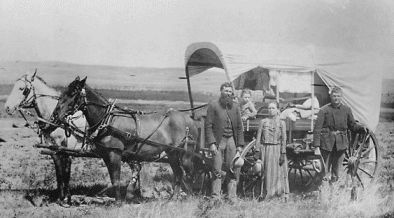
Frontier Homesteaders.
The arrival of the household at their chosen seat marks the second stage in backwoods life, which calls for all the powers of mind and body, tasks the hands, exercises ingenuity, summons vigilance, and awakens every latent energy. The woman steps at once into a new sphere of action and, hand in hand, shoulder to shoulder, with her stronger but not more resolute companion, enters that career that looks to the formation of communities and states. The household constitutes the primal atom, the aggregation of which makes the village, town, or city; the state itself rests upon the household finally, and the household is what the faithful mother makes it.
The toilsome march at length ended, we see the great wagon, with its load of household utensils and farming implements, bedsteads walling up the sides, a wash-tub turned up to serve as a seat for the driver, a broom and hoe handle sticking out behind with the handles of a plow, pots, and kettles dangling below, bundles of beds and bedding enthroning children of all the smaller sizes, stopping at last ” for good,” and the whole procession of men, women, and boys, cattle, horses, and hogs, resting after their mighty tramp.
Shelter and food are the first wants of the settler; the log cabin rises to supply the one; the ax, the plow, the spade, and the hoe prepare the other. The women often joined in felling trees and trimming logs to be used in erecting the cabins. Those who have never witnessed the erection of log cabins would be surprised to behold the simplicity of their mechanism and the rapidity with which they are put together. The ax and the drill are often the only tools used in their construction, but the drawing knife, the broad ax, and the crosscut saw are usually added.
The architecture of the body of the house is sufficiently apparent. Still, it is curious to notice the ingenuity with which the wooden fireplace and chimney are protected from the action of the fire by a lining of clay, to see a smooth floor formed from the plain surface of hewed logs. A door made of boards split from the log, hastily smoothed with the drawing knife, united firmly with wooden pins, hung upon wooden hinges, and fastened with a latch. Not a nail nor any particle of metal enters into the composition of the building — all is wood from top to bottom, and the woodsman does all without the aid of any mechanic. These primitive dwellings are not as wretched as their name and rude workmanship would seem to imply. They still frequently constitute the farmers’ dwelling in new settlements; they are often roomy, tight, and comfortable. If one cabin is not sufficient, another and another is added until the whole family is accommodated, and thus, the homestead of a respectable farmer often resembles a tiny village.
The skill of the backwoodsman in the use of the ax is also remarkable, yet it ceases to be so regarded when we reflect on the variety of uses to which this implement is applied and that it enters into almost all the occupations of the pioneer, in clearing land, building houses, making fences, providing fuel; the ax is used in tilling his fields; the farmer is continually obliged to cut away the trees that have fallen in his enclosure, and the roots that impede his plow; the ax clears the path of the surveyor and his lines and corners marked by this instrument; roads are opened and bridges made by the ax, the first courthouses, and jails are fashioned of logs with the same tool. In labor or hunting, the ax is the backwoodsman’s companion in traveling by land or water.
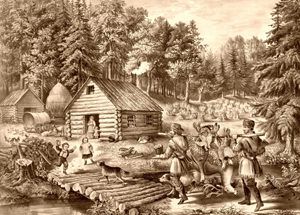
Pioneer home, by Currier & Ives, 1867.
Most of these cabins were fortresses and could be defended by a family for several days. A clay covering sometimes supplemented the thickness of the walls and numerous loop-poles upon the roof to resist the fiery arrows of the Indians. Sometimes, places of concealment were provided for the women and children beneath the floor, with a closely fitting trap door leading to it. Mrs. Graves, a widow who lost her husband in Braddock’s retreat, provided such a place of refuge. In a large pit beneath the floor of the cabin every night, she laid her children to sleep upon a bed of straw, and there, replacing one of the floor logs, she passed the weary hours in darkness, seated by the window which commanded a view of the clearing through which the Indians would have to approach. When her youngest child required nursing, she would lift the floor log and sit on the edge of the opening until it was lulled to sleep and then deposit the nursling again in its secret bed.
Once, while sitting without a light, knitting before the window, she saw three Indians approaching stealthily. Retreating to the hiding place beneath the floor, she heard them enter the cabin and, having struck a light, help themselves to the eatables they found in the pantry. After remaining for an hour in the house and appropriating such articles as Indians’ most valuable items, such as knives, axes, etc., they departed.
More elaborate fortresses were often necessary, and for purposes of mutual defense in a country that swarmed with Indians, the settlers banded together and erected stations, forts, and blockhouses. A station may be described as a series of cabins built on the sides of a parallelogram and united with palisades to present on the outside a continuous wall with only one or two doors, the cabin doors opening on the inside into a common square.
A fort was a stockade enclosure embracing cabins, etc., to accommodate several families. One side was formed by a range of cabins separated by divisions or partitions of logs; the walls on the outside were ten or twelve feet high, with roofs sloping inward. Some of these cabins were provided with puncheon floors, i.e., floors made of logs split in half and smoothed, but most of the floors were earthen. At the angles of these forts were built the blockhouses, which projected about two feet beyond the outer walls of the cabins and stockade; these upper stories were about 18 feet, or two inches every way larger than the under one, leaving an opening at the commencement of the second story, to prevent the enemy from making a lodgment under the walls.
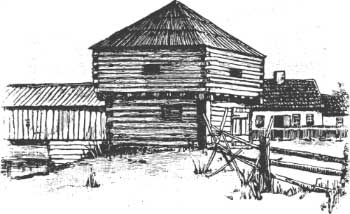
Blockhouse.
These blockhouses were devised in the early days of the first settlements made in our country and furnished rallying points for the settlers when attacked by the Indians. They were enlarged and improved on the Western frontier to meet the military difficulties arising in a country that swarmed with Indians. In some forts, instead of block houses, the angles were furnished with bastions; a sizeable folding gate, made of thick slabs nearest the spring, closed the forts; the stockade, bastion, cabin, and block-house walls were furnished with port holes at proper heights and distances. The whole of the outside was made completely bullet-proof; the families belonging to these forts were so attached to their cabins on their farms that they seldom moved into the forts in the spring until compelled by some alarm, i.e., when some murder announced that Indians were in the settlement.
We have described thus in detail the fortified posts established along the frontier to show that the life of the pioneer woman, from the earliest times, was, and now is, to a large extent, a military one. She was forced to learn a soldier’s habits and virtues. Eternal vigilance was the price of safety, and during the absence of the male members of the household, which was frequent and sometimes protracted, the women were on guard duty and acted as the sentinels of their home fortresses. Watchful against stratagem as against violent attack, they passed many a night alone in their isolated cabins, averting danger with all a woman’s fertility of resource and meeting it with all the courage of a man.
On one occasion, a party of Indians approached a solitary log house intending to murder the inmates. With their usual caution, one of their number was sent forward to reconnoiter, who, discovering the only persons within to be a woman, two or three children, and a black man, rushed in by himself and seized the man. The woman caught up the ax and, with a single blow, laid the savage warrior dead at her feet while the children closed the door and, with ready sagacity, employed themselves fastening it. The rest of the Indians came up and attempted to force an entrance. Still, the black and the children kept the door closed, and the brave mother, having no effective weapon, picked up a gun barrel that had neither stock nor lock and pointed it at the Indians through the apertures between the logs. The Indians, deceived by the appearance of a gun and daunted by the death of their companion, retired.
The station, the fort, and the blockhouse were the isolated settlers’ only refuges when the Indians became bolder in their attacks.
When the report of the four-pounder, the fort bell, or a volley of musketry sounded the alarm, the women and children hurried to the fortification. Sometimes, while threading the forest mazes, the hapless mother and her children would fall into an ambush. Springing from their cover, the prowling Indians would ply their tomahawks and scalping knives amid the shrieks of their helpless victims or bear them away into a captivity more cruel than death.
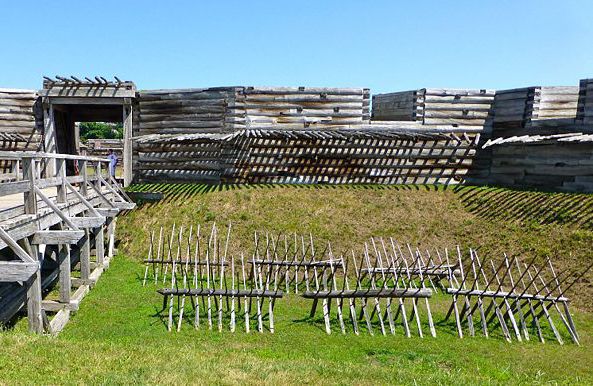
Fort Stanwix, New York, courtesy of fort wiki.
One summer’s afternoon, while Mrs. Folsom, with her babe in her arms, was hasting to Fort Stanwix in the Black River Country of New York, after hearing the alarm, she caught sight of a huge Indian lying behind a log with his rifle leveled directly at her. She quickly sprang to one side and ran through the woods in a course at right angles with the point of danger, expecting every moment to be pierced with a rifle ball. Casting a horror-stricken glance over her shoulder as she ran, she saw her husband hastening on after her but directly under the Indian’s rifle. Shrieking loudly, she pointed to the savage just in time to warn her husband, who stepped behind a tree as the report of the rifle rang through the forest. In an instant, he drew a bead upon the lurking foe, who fell with a bullet through his brain.
Before the family could reach the fort, a legion of Indians, roused by the rifles’ report, was on their trail. The mother and child fled swiftly towards their place of refuge, which they succeeded in reaching without harm, but the brave father, while trying to keep the Indians at bay, was shot and scalped almost under the walls of the fort.
Another of these border heroines, Ann Bush, was more unfortunate than Mrs. Folsom. While she and her husband were fleeing for safety to one of the stations on the Virginia border, they were overtaken and captured by the Indians, who shot and scalped her husband. Although she soon escaped from captivity, less than twelve months later, while again attempting to find refuge in the same station, she was captured a second time with an infant in her arms. After traveling a few hours, the Indians bent down young hickory, sharpened it, seized the child, scalped it, and spat it upon the tree; they then scalped and tomahawked the mother and left her for dead. She lay insensible for many hours, but it was the will of Providence that she should survive the shock. When she recovered her senses, she bandaged her head with her apron and, wonderful to tell, in two days, staggered back to the settlement with the dead body of her infant.
The transitions of frontier life were often startling and sad. Frequent vicissitudes ranged from a wedding to a funeral, from a merrymaking to a massacre. One of these shiftings of the scene is described by an actor and eye-witness as follows:
“Father had gone away the day before, and mother and the children were alone. At about nine o’clock at night, we saw two Indians approaching. Mother immediately threw a bucket of water on the fire to prevent them from seeing us, made us lie on the floor, bolted and barred the door, and posted herself there with an ax and rifle. We never knew why they desisted from an attack or how father escaped. In two or three days, we all set out for Clinch Mountain to the wedding of Happy Kincaid, a clever young fellow from Holston, and Sally McClure, a fine girl of 17 who was modest and pretty yet fearless. We knew the Shawnees were about; that our fort and household effects must be left unguarded and might be destroyed; that we incurred the risk of a fight or an ambuscade, a capture, and even death on the route, but in those days, and in that wild country, folks did not calculate consequences closely, and the temptation to recreation, a wedding, a feast, and dance till daylight and often for several days together, was not to be resisted. Off we went. Instead of the bridal party, the well-spread table, the ringing laughter, and the sounding feet of buxom dancers, we found a pile of ashes and six or seven ghastly corpses tomahawked and scalped.” Mrs. McClure, her infant, and three other children, including Sally, the intended bride, had been carried off by the Indians. They soon tore the poor infant from the mother’s arms and killed and scalped it so that she might travel faster. While they were scalping this child, Peggy McClure, a girl twelve years old, perceived a sinkhole immediately at her feet and dropped silently into it. It communicated with a ravine, down which she ran and brought the news to the settlement. The same night, Sally, who had been tied and forced to lie down between two warriors, contrived to loosen her thongs and make her escape. She struck for the canebrake, then for the river, and to conceal her trail, resolved to descend it. It was deep wading, and the current was so rapid she had to fill her petticoat with gravel to steady herself. Soon, however, she recovered confidence, returned to shore, and finally reached the still-smoking homestead about dark the following evening. A few neighbors well-armed had just buried the dead; the last prayer had been said when the orphan girl stood before them.”
Yielding to the entreaties of her lover, who was present, and to the advice and persuasion of her friends, the weeping girl consented to an immediate marriage, and beside the grave of the household and near the ruins of the cabin, they were accordingly made one.
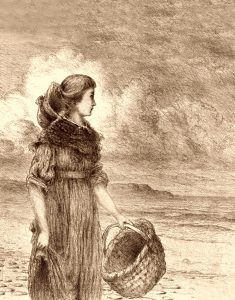
Prairie Girl.
These perilous adventures were episodes we should remember in a life of extraordinary labor and hardship. The luxuries and comforts of older communities were unknown to the settlers on the borderline, either in New England two centuries ago or in the West many years later. Plain in every way was the life of the borderer — plain in dress, manners, equipage, houses. The cabins were furnished in the most primitive style. Blocks or stumps of trees served for chairs and tables. Bedsteads were made by laying rows of saplings across two logs, forming a spring bed for the women and children, while the men lay on the floor with their feet to the fire and a log under their heads for a pillow.
The furniture of the cabin in the West, for several years after the settlement of the country, consisted of a few pewter dishes, plates, and spoons but mostly of wooden bowls, trenchers, and noggins; if these last were scarce, gourds and hard-shell squashes made up the deficiency; the iron pots, knives, and forks were brought from the East, with the salt and iron on packhorses. The articles on furniture corresponded very well with the articles on diet. “Hog and hominy” was a dish of proverbial celebrity; Johnnycake or pone was, at the outset of the settlement, the only form of bread in use for breakfast or dinner; at supper, milk and mush was the standard dish, when milk was scarce, the hominy supplied its place, and mush was frequently eaten with sweetened water, molasses, bear’s oil, or the gravy of fried meat.
Delft, china, or silver were unknown in the display of furniture. Many of the backwoods people considered the introduction of Delftware as a wasteful innovation. It was too easily broken, and the plates dulled their scalping and clasp knives.
The costumes of the women of the frontier were suited to the plainness of the habitations where they lived and the furniture they used. Homespun, linsey-woolsey, and buckskin were the primitive materials from which their everyday dresses were made, and only on occasions of social festivity were they seen in braver robes. Rings, broaches, buckles, and ruffles were heir-looms from parents or grandparents.
But this plainness of living and attire was preparation for, and almost necessary antecedent of hardihood, endurance, courage, and patience, qualities which made themselves manifest in the heroic acting of these women of the border. With such a state of society, we can readily associate assiduous labor, a battle with danger in its myriad shapes, a subjugation of the hostile forces of nature, and the development of a strange and peculiar civilization.
Here, we see a woman in her true glory. We see her as a wife partaking of the cares and guiding the labors of her husband and by domestic diligence spreading cheerfulness all around for his sake, sharing the decent refinements of civilization without being injured by them, placing all her joy, all her happiness in the merited approbation of the man she loves; as a mother, we find her affectionate, the ardent instructress of the children she has reared from infancy and trained up to thought and the practice of virtue, meditation, and benevolence and to become strong and practical men and women.
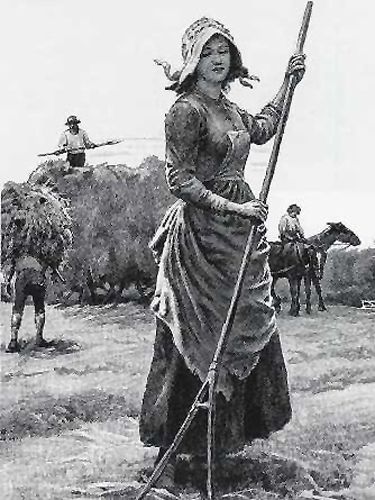
Pioneer Woman.
Could happiness or comfort exist in such dwellings and a state of society. To those accustomed to modern refinement, the truth appears to be like a fable. The lowly occupants of log cabins were often among the most happy of mankind. Exercise and excitement gave them health; they were practically equal; common danger made them mutually dependent; brilliant hopes of future wealth and distinction led them on, and as there was ample room for all, and as each newcomer increased individual and general security, there was little room for that envy, jealousy, and hatred which constitutes a large portion of human misery in older societies. Never were the story, the joke, the song, and the laugh better enjoyed than upon the hewed blocks or puncheon stools around the roaring log fire of the early western settler. The lyre of Apollo was not hailed with more delight in primitive Greece than the advent of the first fiddler among the wilderness dwellers. The polished daughters of the East never enjoyed themselves half so well moving to the music of a full band upon the elastic floor of their ornamented ball-room, as did the daughters of the western emigrants keeping time to the self-taught fiddler on the bare earth or puncheon floor of the primitive log cabin: the smile of the polished beauty is the wave of the lake where the breeze plays gently over it, and her movement the gentle stream which drains it, but the laugh of the log cabin is the gush of nature’s fountain and its movement the leaping water.
Amid the multifarious toils of pioneer life, a woman has often proved that she is the last to forget the stranger within the gates. She welcomes the coming as she speeds up the parting guest. Suppose travelers caught in a rainstorm reach at last one of these western homes. A roof, a stick chimney, drenched cattle crowding in beneath a strawy barrack, and some forlorn fowls huddling under a cart. The log house is small, though its neat corn crib and chicken coop of slender poles bespeak a careful farmer. No gate is seen, but great bars are let down or climbed over, and the cabin has only a back door.
Within, everything ministers to the useful; nothing to the beautiful. Flitches of bacon, dried beef, and ham depend on the ceiling; pots and kettles are ranged in a row in the recess on one side of the fireplace; and above these necessary utensils are plates and heavy earthen nappies. The ax and gun stand together in one corner. The good woman of the house is thin as a shadow and pinched and wrinkled with hard labor. Little boys and girls are playing on the floor like kittens.
A free and hospitable welcome is given to the travelers; their wet garments are ranged for drying on those slender poles usually seen above the ample fireplace of a log cabin in the West, placed there for drying sometimes the week’s wash when the weather is rainy, sometimes whole rows of slender circlets of pumpkins for next spring’s pies, or festoons of sliced apples.
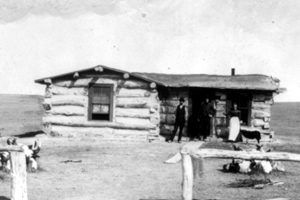
Prairie Homestead.
The good woman, after busying herself in those little offices that reveal a desire to make guests welcome, puts an old cloak on her head and flies out to place tubs, pails, pans, and jars under the pouring eaves, intimating that as soap was scarce, she “must try and catch rainwater anyhow.”
The ” old man” has the shakes, so the woman has all to do: throw more wood on the fire and fan it with her apron; cut rashers of bacon; run out to the hen coop and bring in new-laid eggs; mix a johnnycake and set it in a pan upon the embers.
While the supper is cooking, the rain subsides to a sprinkle, and the travelers look at the surroundings of this pioneer household.
The cabin stands in a prairie, skirted by a forest. A stream gurgles by. The prairie is broken, with corn and potato patches emerging from the rich black mold. Pig pens, a barn, corn houses, a half-dozen sheep in an enclosure, cows and calves and oxen in a corral, a garden patch, hen coops, and stumps of what were once mighty trees tell the story of the farmer’s labors. With all its appurtenances and surroundings, the cabin shows how much the good woman has contributed to making it the abode of rustic plenty provided by this pioneer couple’s unaided toil.
They had come from the East ten years before, and their cabin was the initial point from which numerous settlements grew. Other cabins sent up their smoke in the prairie around them. A schoolhouse and church had been built, a sawmill was at work on the stream nearby, and surveyors for a railroad had just laid out a route for the iron horse.
Two little boys come in now, skipping from school, and at the same time, the good woman, who is all patience and civility, announces supper. Sage tea, Johnny cake, fried eggs, and bacon are seasoned with sundry invitations from the hostess to partake freely, and then the travelers are in a mood for rest.
The sleeping arrangements are somewhat perplexing. There is one large bed and a trundle bed; the former is given up to the travelers, and the trundle bed suffices for the little ones. The hostess prepares a cotton sheet partition for the benefit of those who choose to undress and then begins to prepare herself for the rest she sorely needs. She and her good man repose upon the floor, with buffalo robes for pillows and their feet to the fire.
The hospitality of the frontier woman is bounded only by their means of affording it. Come when you may; they welcome you, give you their best while you remain, and regret your departure with simple and genuine sincerity. If you are sick, all that sympathy and care can devise is done for you, and all this is from the heart.
Homestead life and women’s influence are modified to some extent by the different races that contributed their quotas to the pioneer army. The early French settlements in our western States furnish a picture somewhat different from those of the emigrants of English blood: a patriarchal state of society, self-satisfied and kindly, with bright superficial features, but lacking the earnest purpose and restless, aggressive energy of the Anglo-American, whose very amusements and festivals partook of a helpful character.
Those French pioneer women made thrifty and industrious housewives. They entered, with all the joy and enthusiasm of their race, into all the merry-makings and social enjoyments peculiar to those neighborhoods. The blooming damsels wound fancy-colored handkerchiefs around their foreheads on festive occasions, streaming with gay ribbons or plumed with flowers. The matrons wore short jackets or petticoats. The foot was left uncovered and free, but on holidays, it was adorned with the light moccasin, brilliant with porcupine quills, shells, beads, and lace.
A faithful picture of life in these French settlements possesses an indescribable charm, such as that conveyed by the perusal of Longfellow’s Acadian Romance of “Evangeline,” when we see the French maiden, wife, and widow in a border settlement.

French Settlement.
Different types of homestead life are, of course, to be looked for in different sections. On the ocean’s beach, on the shores of the inland seas, on the banks of great rivers, in the heart of the forest, on the rugged hills of New England, on southern Savannas, on western prairies, or among the mountains beyond, the region, the scenery, the climate, the social laws may be diverse, yet homestead-life on the frontier widely varying as it does in its form and outward surroundings, is in its spirit everywhere essentially the same. The sky that bends overall and the sun that sheds its light for all are symbols of the oneness of the animating principle in the home where a woman is a bright and potent genius.
We have spoken of the western form of homestead life because the frontier line of today lies in the Occident. But in each stage of the movement that carried our people onward in their destined course from ocean to ocean, the wife and the mother were centers from which emanated a force to propel forward and to fix firmly in the chosen abode those organisms of society which forms the molecular atoms out of which, “by the laws of our being, is built the compact structure of civilization.
In approximating some estimate of women’s peculiar influence in lonely and far-off Western homes, we must not fail to consider the humanizing and refining power she exerts to soften the rugged features of frontier life. Different classes of women all worked in their way towards this end.

A woman at a log cabin.
“The young married people, who form a considerable part of the pioneer element in our country, are simple in their habits, moderate in their aspirations, and hoard a little old-fashioned romance — unconsciously enough — in the secret nooks of their rustic hearts. They find no fault with their bare loggers; with a shelter and a handful of furniture, they have enough.” If there is the wherewithal to spread a warm supper for the “old man” when he comes in from work, the young wife forgets the long, solitary, wordless day. She asks for no greater happiness than preparing it with the help of such materials and utensils as would be looked at with utter contempt in the comfortable kitchens of the East.
They have youth, hope, health, occupation, and amusement, and when you have added ” meat, clothes, and fire,” what more has England’s queen?”
We should, however, remember that there is another large class of women who, for various reasons, have left comfortable homes in older communities and risked their happiness and all that they have in enterprises of pioneer life in the far West. What wonder that they should sadly miss the thousand old familiar means and appliances! Some utensils or implements necessary for their farming want to be replaced or have been lost or broken. Some comfort or luxury she has been using since childhood is lacking and cannot be furnished. The various materials upon which household art can be employed are reduced to the few essentials. These difficulties are felt more by the woman than by the man. To quote the words of a writer who was herself a pioneer housewife in the West:
“The husband goes to his work with the same ax or hoe which fitted his hand in his old woods and fields; he tills the same soil or perhaps a far richer and more hopeful one; he gazes on the same book of nature which he has read from his infancy and sees only a fresher and more glowing page, and he returns home with the sun, strong in heart and full of self-congratulation on the favorable change in his lot. Perhaps he finds the home bird drooping and disconsolate. She has found a thousand difficulties that her rougher mate can scarcely be taught to feel as evils. She has been looking in vain for any of the cherished features of her old fireside. What cares if the time-honored cupboard is meagerly represented by a few oak boards lying on pegs. His tea equipage shines as it was wont; the biscuits can hardly stay on the brightly glistening plates. His bread never was better baked. What does he want with the great old-fashioned rocking chair? When he is tired, he goes to bed, for he is never tired till bedtime. The sacrifices in moving West have been made most largely by women.”
This scarcity of many things once made her life easy and comfortable, but it threw her back upon her own resources. Here, again, is a woman’s strength. Fertile in expedients, apt in devices, an artisan to construct, and an artist to embellish, she supplies what is lacking in her new home. She has a miraculous faculty for creating much out of little and transforming the course into the beautiful. Barrels are converted into easy chairs and washstands; spring beds are manufactured with rows of slender, elastic saplings; a box covered with muslin stuffed with hay serves as a lounge. With considerable personal exertion, she also enlarges the circle of luxuries while adding useful and necessary articles to the list. An hour or two of extra work now and then enables her to hoard enough to buy a new looking-glass and make small additions to the showy part of the household from time to time.
After transforming the rude cabin into a cozy habitation, she turns her attention to the outside surroundings. Woodbine and wild cucumber are trailed over the doors and windows; little beds of sweet-williams and marigolds line the path to the clearing’s edge or across the prairie grass to the well, and an apple or pear tree is put in here and there. In all these works, either of use or embellishment, she is at least the moving spirit if not done by her own hand. Thus, over the rugged and homely features of her lot, she throws something of the magic of that ideal of which the poet sings:
“Nymph of our soul and brightener of our being:
She makes the common waters musical —
Binds the rude night-winds in a silver thrall,
Bids Hybla’s thyme and Tempe’s violet dwell
Round the green marge of her moon-haunted cell.”
The thousand nameless household offices a woman performs make the home: the home molds the children’s character and makes the husband what he is. Who can deny the vast debt of gratitude due to the present generation of Americans to these offices of a woman in refining and ameliorating the rude tone of frontier life? It may well be said that the pioneer women of America have made the wilderness bud and blossom like the rose. Under their hands, even nature, no longer a wild, wayward mother, turns a more benign face upon her children. A land bright with flowers and bursting with fruitage testifies to the labors and influence of those who embellish the homestead and make it attractive to their husbands and children.

Homesteader George O. Waters, Dry Valley, near Comstock, Nebraska, by Solomon D. Butcher, 1887.
A traveler on the vast prairies of Kansas and Nebraska will often see cabins remote from the great thoroughfares embowered in vines and shrubbery and bright with beds of flowers. Entering, he will discern the rugged features of frontier life softened in a hundred ways by a woman’s hand. The steel is just as hard and more serviceable after it is polished, and the oak wood is as strong and durable when it is trimmed and smoothed. The children of the frontier are as hardy and as manly through the gentle voice of the woman who schools their rugged ways, and her kind hand leads them through the paths of refinement and molds them in the school of humanity.
By William Worthington Fowler, 1877. Compiled and edited by Kathy Alexander/Legends of America, updated May 2024.
About the Author: William Worthington Fowler was a diverse man with several careers, including lawyer, stockbroker, politician, and author. This article was the prelude to his book Woman On The American Frontier: A Valuable And Authentic History, initially published in 1877. The text here is not verbatim as it has been edited for punctuation, spelling, and ease of the modern reader.
Also See: