
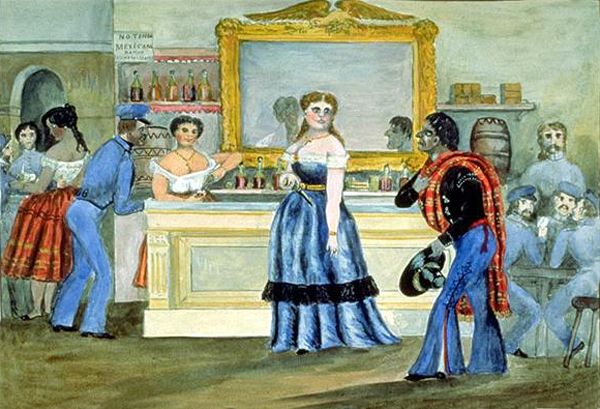
Depiction of Sarah Borginnes, also known as “The Great Western” or the “Heroine of Fort Brown, as the landlady of one of several hotels/restaurants she operated in Northern Mexico during Zachary Taylor’s campaign during the Mexican-American War. Painting by Samuel E. Chamberlain, circa 1846.
“She could whip any man, fair fight or foul, could shoot a pistol better than anyone in the region, and at blackjack could outplay (or out cheat) the slickest professional gambler.” — John Salmon Ford, Texas Ranger
Sarah A. Bowman, who earned the nickname the “Great Western,” was a Madam, cook, businesswoman, nurse, wife, and mother who made her way around the American West, primarily following soldier camps. She was married several times and also went by the last names of Boginnis, Bourdette, Bourget, Bourjette, Borginnis, Davis, Bowman, and possibly Foyle.
She was born Sarah Knight in 1812 or 1813, probably in Clay County, Missouri, although some sources say Tennessee. Raised on the American frontier, she received no formal education and is believed to have been illiterate, as evidenced by her use of an X on business and census forms.
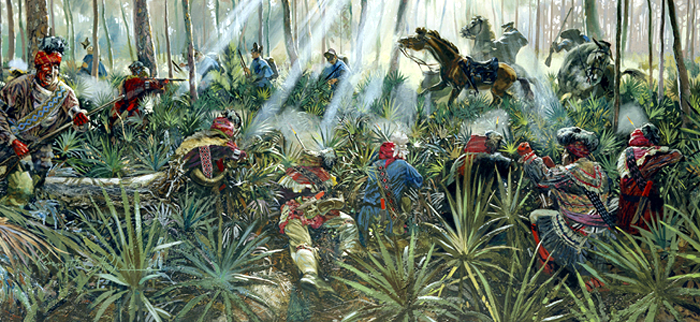
Seminole Wars.
Some records indicate that she married a man named James McLin in Clay County, Missouri, in March 1841. It was then that she began her career as a camp follower when he was assigned to fight during the Seminole War in Florida. At that time, Army rules stated women married to soldiers could follow the troops. They helped with meals, washed clothes, and tended to the sick and wounded. During this war, she was reportedly a favorite of General Zachary Taylor.
Physically, Bowman was a huge woman, standing six feet tall and reportedly weighing about 200 pounds. She was described as “a huge, well-proportioned, strong woman, of strong nerves, and great physical power.” Despite her considerable size, she was said to have been very attractive, with an hourglass figure and a great deal of grace. She had long dark red hair that matched her temperament, and her eyes were grey-blue. She was nicknamed the Great Western, after a British trans-Atlantic steamer, the largest ship of its day.
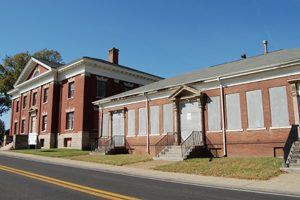
Buildings at Jefferson Barracks, St. Louis, Missouri by Kathy Alexander.
Whatever happened to her first husband is unknown, but by 1845, she had married a second time to a soldier named Borginnis, who had enlisted at Jefferson Barracks, Missouri. The first documented record of her occurred the same year she signed on as a laundress at Jefferson Barracks. The position included food, shelter, and the opportunity to earn a salary three times that of an Army private. She followed the troops as they made their way to Corpus Christi, Texas, before the start of the Mexican-American War. By the time they arrived, she had also taken on the responsibilities of cook, nurse, and laundry.
The army remained encamped along the Nueces River until March 1846, when it received orders to advance to the Rio Grande. Though her husband was ill, she left him behind, purchased a wagon and mule team, and followed the army.
The first encounter between American and Mexican forces came on March 21, 1846, during the crossing of Arroyo Colorado. As the Americans approached the steep embankment, bugles rang out on the other bank, accompanied by the warning, “Cross this stream, and you will be shot!” Further, the Mexicans taunted and called into question the ancestry of the Texans. Sarah was enraged and rode to the front and told General William Jenkins Worth, “If the general would give me a strong pair of tongs (slang for men’s trousers), I’d wade that river and whip every scoundrel that dared show himself.” Inspired by her bravado, the American troops made the crossing and routed the Mexicans.
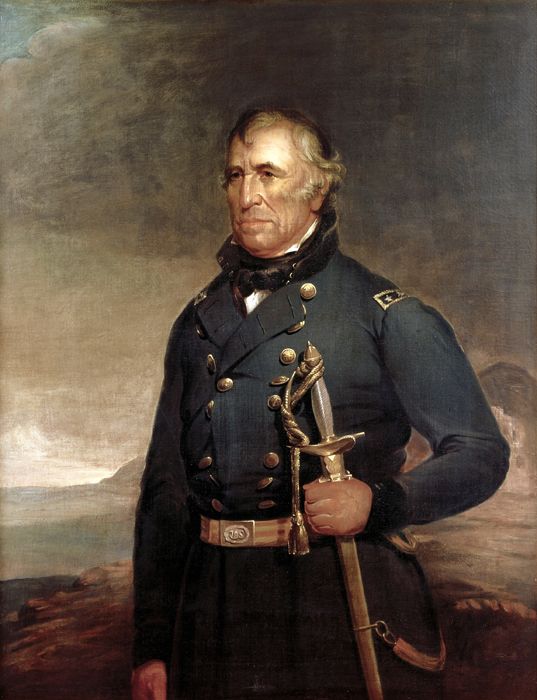
Zachary Taylor by Joseph Henry Bush in about 1848.
General Taylor then pushed his men to the Rio Grande, where he ordered his men to build Fort Texas across the Rio Grande from Matamoros, Mexico. It was manned by 500 men of the 7th Infantry, with Major Jacob Brown as the regiment commander. Sarah’s husband was here, and she operated an officer’s mess.
In the early morning of May 3, 1846, when General Taylor and many of the troops were away from the fort, it was attacked by the Mexicans. The women and the injured were immediately ordered to an underground magazine, but Sarah refused to go. Instead, she cooked and delivered food and coffee to the soldiers and nursed the wounded. She was twice shot at but continued her duties and then some. On the third day of the siege, the commanding officer, Major Jacob Brown, was struck down. The Mexicans then seized the opportunity to attack in force and sent some 5,000 men forward. Sarah then fought alongside the American soldiers, helping to load the cannon.
When the U.S. line began to weaken, she promised them that “Zack” would be back soon, and luckily, he was. When Taylor’s forces arrived, he and his men defeated the Mexicans in the Battle of Palo Alto on May 8, 1856. Afterward, the fort was renamed for the fallen Major Brown.
Following the siege, Sarah came to the attention of U.S. newspapers, which named her the “Heroine of Fort Brown.” Stories of her exploits were published as far away as Philadelphia, Pennsylvania, and New York City.
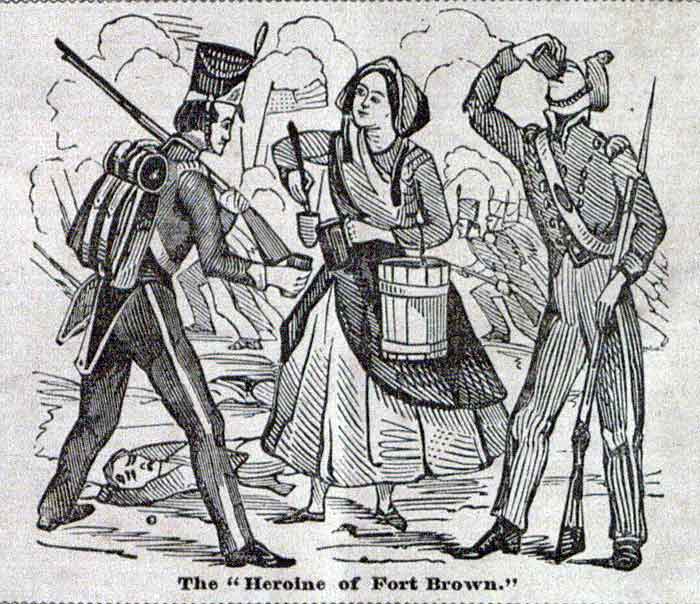
Depiction of Sara Bowman, Heroine of Fort Brown.
“The Heroine of Fort Brown He said that during the whole of the bombardment, the wife of one of the soldiers whose husband was ordered to Point Isabel remained in the Fort, and though the shot and shells were constantly flying on every side, she disdained to seek shelter in the bombproof but labored the whole time in cooking and taking care of the soldiers, without the least regard for her own safety. Her bravery was the admiration of all who were in the Fort.” — The New Orleans Delta newspaper
Afterward, Sarah briefly established a boarding house in Matamoros, Mexico, called the American House. In addition to food, lodging, and stables for soldiers’ horses, the establishment also served as a saloon and brothel. Becoming immensely popular, one soldier described it as “the headquarters for everyone.”
However, when General Taylor moved deeper into Mexico, she followed the troops and opened a hotel in Saltillo called the American House. There, she became involved with yet another man, who was also married. Captain George Lincoln was also tall and striking, well known for bravery during battle, and was said to have been the “love of her life.”
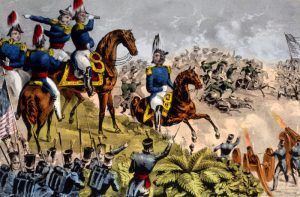
General Zachary Taylor at the Battle of Buena Vista, Mexico by Sarony & Major, 1847
When the Battle of Buena Vista began about seven miles south of Saltillo on February 22, 1847, Sarah was involved, once again preparing food and coffee for the soldiers, reloading weapons, and carrying the wounded off the field. At one point, she was working on a cannon when she was attacked by a Mexican soldier who struck her across the face with his saber. She retaliated by shooting him dead.
On February 23, the battle ended, and Sarah found her lover, Captain Lincoln, dead on the battlefield. Though broken-hearted, she buried him, bought his horse, and arranged for the animal and his effects to be returned to his family in New York.
After the battle, a retreating soldier ran into her restaurant, yelling that Taylor had been defeated. Sarah responded by punching the private and telling him, “You damned son of a bitch, there ain’t Mexicans enough in Mexico to whip old Taylor. You just spread that report, and I’ll beat you to death.”
Following her actions on the battlefield, Sarah was awarded a military pension by General Winfield Scott.
When the war ended in 1848, one detachment of troops was headed for California, and Sarah asked Colonel Washington if she could accompany them. By this time, her husband was gone — whether by death or abandonment is unknown. However, she was told that only wives were allowed to accompany the troops. In response, she mounted her horse and rode the line of the enlisted men, yelling, “Who wants a wife with $15,000 and the biggest leg in Mexico! Come, my beauties, don’t all speak at once — who is the lucky man?” Finally, a man named David Davis agreed to marry her, and she was mustered in as a laundress.
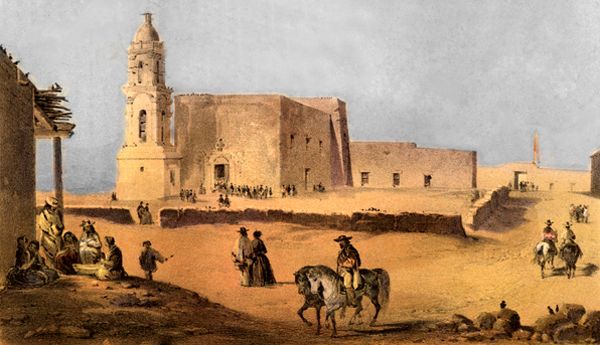
ElPaso, Texas, 1850s.
However, by the time the troops reached El Paso, Texas, she began to notice the increased traffic along the trail due to the California Gold Rush. Sensing money to be made, she decided to stay and became the first woman to open a business in El Paso, and was also the first recorded madam in the town. She opened a “hotel” that provided room, board, and “entertainment.” Though she was described as “the greatest whore in the West,” she continued using her medical skills to nurse anyone who needed help and adopted several orphaned children whom she raised. Those who stopped at her hotel praised her as a tender and compassionate woman. One traveler would describe her:
“A perfect Amazon… she wears a pistol about her waist and rides a mule over the plains with as much endurance as any of the stronger sex. It can’t be said that the conversation of this woman would be charming to a very fastidious person…”
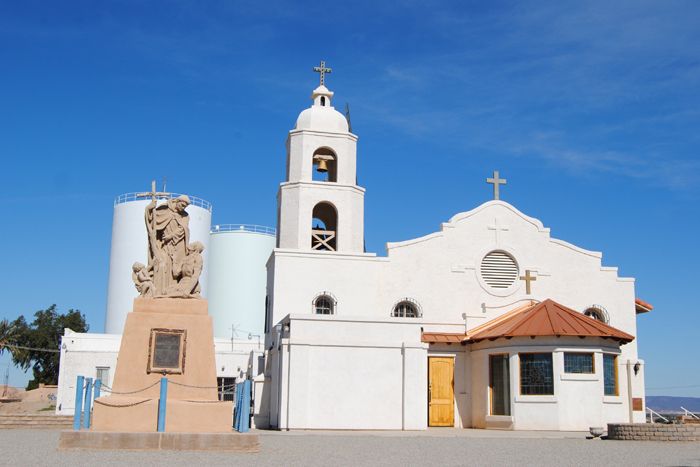
St. Thomas Church at Fort Yuma, Arizona by Kathy Alexander.
By early 1850, Sarah leased her hotel in El Paso and moved up the Rio Grande to Socorro, New Mexico. There, she and her adopted children lived with a man named Juan Duran. She met yet another soldier named Alfred J. Bowman, a dragoon in the U.S. Army, and married him. On November 30, 1852, Bowman was discharged from the army, and the family moved again to Fort Yuma, California. She opened a restaurant, becoming Yuma’s first business operator. She also cooked and did laundry for the officers of Fort Yuma while her husband prospected.
During this time, one of the fort’s soldiers noted:
“She has been with the Army for twenty years and was brought up here, where she keeps the officers’ mess. Among her other admirable qualities, she is a skilled `pimp.’ She used to be a splendid-looking woman and has done good service, but is too old for that now.”
In approximately 1856, Sarah was at Fort Buchanan, Arizona, where she established another hotel about ten miles from the fort. By 1861, she was back working at Fort Yuma. By the mid-1860s, Sarah and Albert Bowman were no longer married to each other.
On December 22, 1866, Sarah died from a spider bite. Following her death, she was breveted an honorary colonel and buried with military honors in the Fort Yuma cemetery on December 23, 1866. She was the first woman ever to receive such an honor.
In August 1890, following the decommissioning of Fort Yuma, 159 graves in the Yuma cemetery, including Sarah’s, were exhumed and reburied in the national cemetery at the Presidio in San Francisco, California.
Throughout her life, Sarah Bowman was married multiple times, often without a legal record or the blessing of a priest. She never had natural children. Despite being unable to read and write, she became bilingual in her later years, with a priest noting that she was the first American woman he had met who was fluent in Spanish.
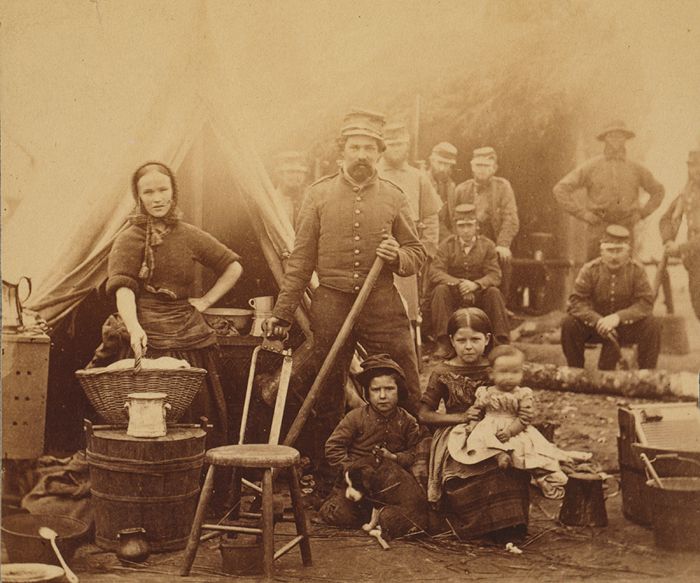
Camp Followers.
©Kathy Alexander/Legends of America, updated August 2025.
Also See:
Historic Women Photo Galleries
Sources: