

Battle Canyon, Scott County, Kansas.
The Battle of Punished Woman Fork, the last Indian battle in Kansas, occurred on September 27, 1878, in Scott County.
Also known as Battle Canyon, it occurred when Chief Dull Knife and Little Wolf of the Northern Cheyenne decided to lead their people from their reservation near Fort El Reno, Oklahoma, back to their former home in the north. The Cheyenne included 92 warriors, 120 women, and 141 children. As they came through Kansas, crossing the Arkansas River at the Cimarron Crossing, Lieutenant-Colonel William H. Lewis, commander at Fort Dodge, was dispatched to capture and return them.
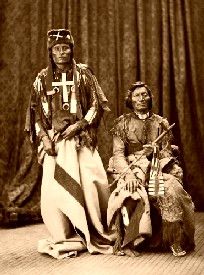
Cheyenne Chiefs Little Wolf and Dull Knife.
Hiding from the soldiers during the day, the Indians traveled by night to present-day Scott County, Kansas, where they took refuge in the Valley of Punished Woman’s Fork in late September 1878. For two days, they rested, re-supplied their food, and fortified their position in what is today known as Sanctuary Cave.
On the afternoon of September 27, Colonel Lewis and his troops caught up with them, advancing from the southwest. The women, children, and elderly hid in the cave while the warriors fought the advancing soldiers. Lieutenant-Colonel William H. Lewis was wounded in the thigh. That night, the Cheyenne escaped, crossing the Smoky Hill River and heading northwest.
The following day, Lewis was placed in a military ambulance, and the soldiers made their way to Fort Wallace, Kansas, about 40 miles to the northwest. Along the way, he died of his wounds, becoming the last Kansas military casualty of the Indian Wars.
After escaping from Battle Canyon, the tribe continued in what has become known as the Cheyenne Raid, making their way through Decatur and Rawlins Counties and committing several depredations.
The Cheyenne then made their way to Nebraska, split up with part of the group following Chief Dull Knife and the other with Little Wolf. Dull Knife’s group was captured close to Fort Robinson, Nebraska, while Little Wolf’s band remained in the sandhills of Nebraska for the winter and eventually made their way to Montana.

Battle Canyon Monument in Scott County, Kansas.
The battle site is about one mile southeast of Lake Scott State Park. The Scott County Historical Society owns the site, and a marker designates it. A monument has been placed over Sanctuary Cave.
See Scott County Historical Society/El Quartelejo Museum for additional information.
©Kathy Alexander/Legends of America, updated August 2025.
Also See:
Indian Wars, Battles & Massacres
Indian Wars of the Frontier West
See Sources.