
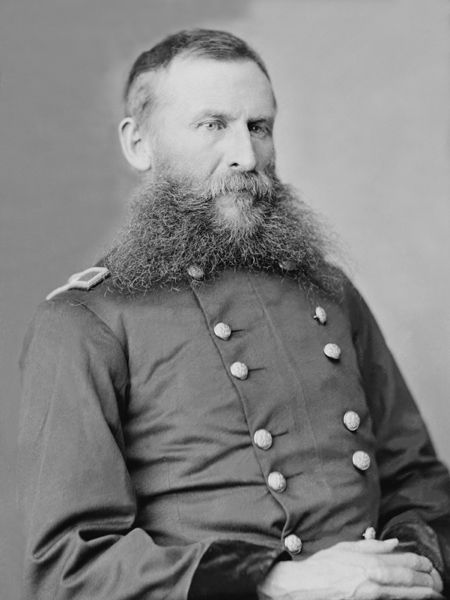
General George Crook was a career United States Army officer, most noted for his distinguished service during the Civil War and the Indian Wars.
He was assigned to the 4th U.S. infantry as a brevet second lieutenant, serving in California from 1852 to 1861. He served in Oregon and northern California, fighting against several Native American tribes. In 1856, he was promoted to first lieutenant, and the following year, he commanded the Pitt River Expedition. He was severely wounded by an Indian arrow in one of the several engagements. He established Fort Ter-Waw in what is now Klamath, California.
He was promoted to captain in 1860 and ordered East in 1861. At the beginning of the Civil War, he was made colonel of the 36th Ohio Volunteer Infantry.
On September 7, 1862, he was promoted to brigadier general and commanded a brigade of regiments from Ohio during the Battles of South Mountain and Antietam during the Maryland Campaign. Following the campaign, George Crook was assigned to the command of the Kanawha Division, which was detailed to the Army of the Cumberland in the Western Theater. Crook fought in the Battle of Chattanooga in Tennessee and the Chickamauga Campaign.
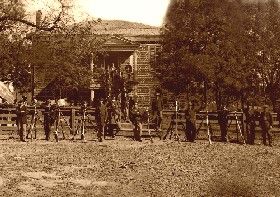
Appomattox Court House, 1865.
Returning to the East in the spring of 1864, Crook led a raid on the Virginia and Tennessee Railroad and in the Valley Campaign battles of Third Winchester, Fisher’s Hill, and Cedar Creek; shortly after, he was promoted to Major General.
In February 1865, Crook was captured by Confederate raiders at Cumberland, Maryland, and held as a prisoner until exchanged on March 20th. He was assigned command of a cavalry division in the Army of the Potomac for the Appomattox Campaign, with notable service at Five Forks, Sayler’s Creek, and the final battle at Appomattox Court House.
He married Mary Tapscott Dailey, from Virginia, in 1865.
After the Civil War, Crook was assigned to the 23rd U.S. Infantry on frontier duty in the Pacific Northwest and served with distinction through the Indian Wars. He fought the Paiute in the rugged desert of eastern Oregon, pacifying the region within a year. When President Ulysses S. Grant sent him to Arizona to fight the Apache, he reorganized his command, employed Indian scouts, and constantly pressured the roving war parties. In two years, most of the Apache were on reservations. General William Sherman said the greatest Indian fighter of them all was General Crook.
As commander of the Department of the Platte, Crook led the Powder River and Yellowstone expeditions against the Sioux. Defeated by Crazy Horse at the Battle of Rosebud, he failed to link up with General Alfred Terry, a circumstance that may have contributed to the massacre at the Little Bighorn.
Crook returned to Arizona in 1881 when the Apache rose again. After eight months of hard campaigning, Crook returned the Apache to their reservations. The Apache went on the warpath two years later, and Crook’s last campaign ended in the surrender of Geronimo. After leaving the army, he worked with the U.S. government to uphold its promises to the conquered tribes and for better treatment of the Indians.
General Crook died suddenly in Chicago, Illinois, on March 21, 1890, while serving as commander of the Division of the Missouri. He was initially buried in Oakland, Maryland. In 1898, Crook’s remains were transported to Arlington National Cemetery, where he was re-interred on November 11. At Crook’s death, his old adversary, Red Cloud, said, “He never lied to us. His words gave my people hope.”
All the tribes tell the same story. They are surrounded on all sides; the game is destroyed or driven away; they are left to starve, and there remains but one thing for them to do – fight while they can.
— General George Crook
© Kathy Alexander/Legends of America, updated May 2024.
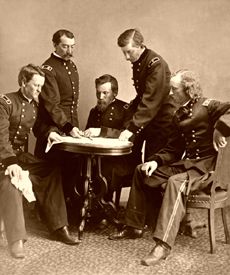
Philip Sheridan’s generals of the Civil War.
Also See:
Fort Apache – Warring with the Indians
Indian War Campaigns and Battles
See Sources.