
By Edgar Beecher Bronson in 1910.
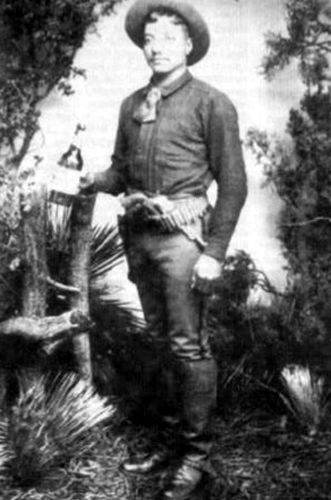
Christopher “Kit” Carson Joy.
Life was never dull in Grant County, New Mexico, in the early 1880s. There was always something to do — usually something the average law-abiding, peace-loving citizen would have been glad enough to dispense with. To say that life then and there was insecure is to describe altogether too feebly a state of society and an environment wherein death, in one violent form or another, was ever abroad, seldom long idle, always alert for victims.
When the San Carlos Apache, under Victorio, Ju, or Geronimo, were not out gunning for the whites, the whites were usually out gunning for one another over some trivial difference. Everybody carried a gun and was more or less handy with it. Indeed, it was a downright lousy plan to carry one unless you were handy. For with gunning — the game most played, if not precisely the most popular –, everyone was supposed to be familiar with the rules and to know how to play, and in a game where every hand is sure to be “called,” no one ever suspected another of being out on a sheer “bluff.” Thus, the coroner invariably declared it a case of suicide where one man drew a gun on another and failed to use it.
This highly explosive state of society was not because there were few peaceable men in the country, for there were many of them, men of character and education, honest and as law-abiding as their peculiar environment would permit. Moreover, the percentage of professional “bad men“– and this was a profession then — was comparatively small. It was due instead to the fact that everyone, no matter how peaceful his inclinations, was compelled to carry arms habitually for self-defense, for the Apache were constantly raiding outside the towns and white outlaws inside. And, with any class of men who constantly carry arms, it always falls out that a weapon is the arbiter of even those minor personal differences in the older civilization of the East are settled with fists or in a petty court.
The prevailing local contempt for any man who was too timid to “put up a gunfight” when the etiquette of a situation demanded it was expressed locally in the phrase that one “could take a corncob and a lightning bug and make him run himself to death trying to get away.” The few men of this sort did not occupy positions of particular prominence. Their opinions did not seem to carry as much weight as those of other gentlemen who were known to be notably quick to draw and shoot.
Outside the towns, there were only three occupations in Grant County in those years: cattle ranching, mining, and fighting the Apache, all of a sort to attract and hold none but the sturdiest types of real manhood, men inured to danger and reckless of it. In the early eighties, no faint heart came to Grant County unless he blundered in — and any such were soon burning the shortest trail out.
Within the towns, there were also only three occupations: first, supplying the cowmen and miners whatever they needed, merchandise wet and dry; second, gambling at Monte, poker, or faro; and third, figuring how to slip through the next 24 hours without getting a heavier load of lead in one’s system than could be conveniently carried, or, having an active enemy on hand, how best to “get” him.
The subject of this story is a cowboy turned outlaw — Christopher “Kit” Carson Joy. Kit worked on the X Ranch in the Gila Wilderness. He was a youngster little over 20. Sure it is that he was a reckless dare-devil, always foremost in the little amenities cowboys loved to indulge in when they came to town, such as shooting out the lights in saloons and generally “shelling up the settlement,”– which meant taking a friendly shot at about everything that showed up on the streets. Nevertheless, Kit was mainly good-natured and amiable.
Early in his career in Silver City, New Mexico, it was observed that his most distinguishing trait was curiosity. Ultimately, his curiosity got him into trouble. One of his first displays of curiosity was a great surprise, even to those who knew him best. It was also a disappointment.
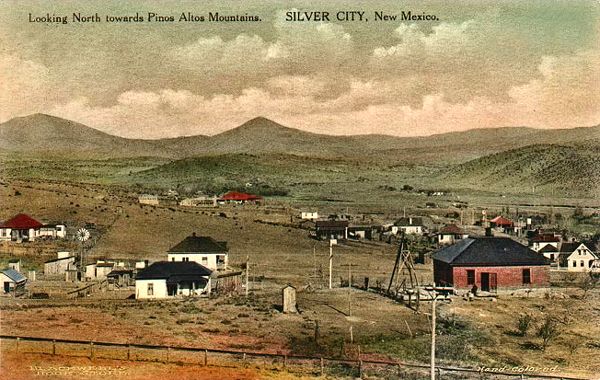
Silver City, New Mexico.
A newly arrived tenderfoot appeared on the streets one day in knickerbockers and stockings. Kit was in town and was observed watching the tenderfoot. To the average cowboy, a silk top hat was like a red flag to a bull, so much like it that it was usually lucky to escape with less than half a dozen holes. But, here in these knee-breeches and stockings was something much more bizarre and exasperating than a top hat, from a cowboy’s point of view. The effect on Kit was, therefore, closely watched by the bystanders.
No one fancied momentarily that Kit would do less than undertake to teach the tenderfoot “the cowboy’s hornpipe,” not a particularly graceful but a rapid step, which is danced most artistically when a bystander is shooting at the dancer’s toes. Indeed, the ball was expected to open early. To everyone’s surprise and disappointment, it did not. Instead, Kit dropped in behind the tenderfoot and began to follow him about town — followed him for at least an hour. Everyone thought he was studying up some more unique penalty for the tenderfoot. But they were all wrong.
Kit was so far consumed with curiosity that he forgot everything else, forgot even to be angry. At last, when he could stand it no longer, he walked up to the tenderfoot, detained him gently by the sleeve, and asked in a tone of genuine sympathy and concern: “Say, Mistah! To’ God, won’t yo’ mah let yo’ wear long pants?”
Naturally, the tenderfoot’s indignation was aroused and expressed, but Kit’s sympathies for a man condemned to such a juvenile costume were so far stirred that he took no notice of it.

Cowboys near Silver City, New Mexico.
Kit was a typical cowboy of the good old Southern Texas breed, industrious, faithful, and uncomplaining. In the saddle from daylight till dark, it never occurred to him even to growl when a stormy night, with thunder and lightning, prolonged his customary three-hour turn at night guard around the herd to an all-night vigil. He took it as a matter of course. His rope and running iron were ever ready, and his weather eye was alert for a chance to catch and decorate with the X brand any stray cattle that ventured within his range. This was a peculiar phase of the cowboy character. While not himself profiting a penny by these inroads on neighboring herds, he was never quite so happy as when he had added another maverick to the herd bearing his employer’s brand, an increase always obtained at the expense of some of the neighbors.
One night on the spring roundup, the day’s work finished, supper was eaten, the night horses were caught and saddled, the herd was driven into a close circle and bedded down for the night in a little glade in the hills, and Kit was standing first relief.
The day’s drive had been a heavy one; the herd was well grazed and watered in the late afternoon, the night was fine, and so the 1,200 or 1,500 cattle in the herd were lying down quietly, giving no trouble to the night herders. Kit, therefore, was jogging slowly around the herd, softly jingling his spurs and humming some rude love song of the sultry sort cowboys never tire of repeating. The stillness of the night got him to thinking. With naught to interrupt it, Kit’s curiosity ran farther afield than usual.
Recently down at Lordsburg, with the outfit shipping a train-load of beeves, he had seen the Overland Express empty its load of passengers for supper, a crowd of well-dressed men and women, the latter brilliant with the bright colors cowboys love and with glittering gems. Tonight, he got to thinking about them.
Wherever did they all come from? However, did they get so much money? Surely, they must come from ‘Frisco. No lesser place could turn out such magnificence. Then Kit let his fancy wander off into crude cowboy visions of what ‘Frisco might be like, for he had never seen a city.
“What a buster of a town ‘Frisco must be!” Kit soliloquized. “Must have more’n a hundred saloons an’ more slick gals than the X brand has heifers. What a lot o’ fun a feller could have out thar! Only I reckon them gals wouldn’t look at him more’n about onct unless he was well fixed for dough. Reckon they don’t drink nothin’ but wine out thar, nor eat nothin’ but oysters. An’ wine an’ oysters cost money, oodles of money! That’s the worst of it! S’pose it’d take more’n a month’s pay to git a feller out thar on the kiars, an’ then about three months’ pay to git to stay a week. Reckon that’s jes’ a little too rich for Kit’s blood. But, Jiminy! Wouldn’t I like to have a big, fat bankroll an’ go thar!”
Here, a crisis suddenly comes in Kit’s life, although he did not then realize it. It is improbable that he had ever felt the need for money. His monthly pay of 35 dollars enabled him to sport a pearl-handled six-shooter and silver-mounted bridle bit, and spurs kept him well clothed and gave him an occasional spree in town. What more could any reasonable cowboy ask?
But tonight, the very elements and all nature were against him. Even a light dash of rain to rouse the sleeping herd or a hungry cow straying out into the darkness would have been sufficient to divert and probably save him, but nothing happened. The night continued fine. The herd slept on. And Kit was thus left easy prey since covetousness had come to aid curiosity in compassing his ruin.
“A bankroll! A big, fat, full-grown, long-horned, four-year-old roll! That’s what a feller wants to do ‘Frisco, right? Nothin’ less. But whar’s it comin’ from, an’ when? S’pose I brand a few mavericks an’ gits a start on my own? No use, Kit; that’s too slow! Time you got a proper roll you’d be so old the skeeters wouldn’t even bite you, to say nothin’ of a gal a-kissin’ of you. ‘Pears like you ain’t liable to git thar very quick, Kit, ‘less you rustles mighty peart somewhar. Talkin’ of rustlin’, what’s the matter with that anyway?”
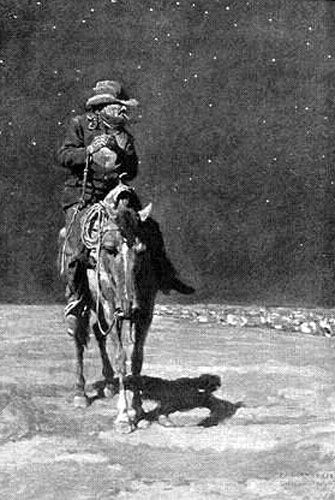
Night Herder.
A cold glitter came in Kit’s light blue eyes. The muscles of his lean, square jaws worked nervously. His right hand dropped caressingly on the handle of his pistol.
“That’s the proper caper, Kit. Why didn’t you think of it before? Rustle, damn you, an’, ef you’re any good, mebbe so you can git to ‘Frisco afore frost comes, or anywhere else you likes. Rustle! By Jiminy, I’ve got it; I’ll stand up that thar Overland Express. Them fellers what rides on it’s got more’n they’ve got any sort o’ use for. ‘Course they’ll kick, an’ thar’ll be a whole passle o’ marshals an’ sheriffs out after you, but what o’ that? Reckon Old Blue’ll carry you out o’ range. He’s the longest-winded chunk o’ horse meat in these parts. Then you’ll have to stay out strictly on the scout fer a few weeks, till they gits tired o’ huntin’ of you, so you can slip out o’ this yere neck o’ woods ‘thout leavin’ a trail.
“An’ Lord! But won’t it be fun! ‘Bout as much fun, I reckon, as doin’ ‘Frisco. Won’t them tenderfeet Beller when they hear the guns a-crackin’ and the boys a-yellin’! Le’ see; wonder who I’d better take along?”
Scruples? Kit had none. Bred and raised a merry freebooter on the unbranded spoils of the cattle range, it was no long step from stealing a maverick to holding up a train.
With a man of perhaps any other class, a plan to engage in a new business enterprise of much greater magnitude than any of those he had been accustomed to would have been the subject of lengthy consideration, not so with Kit. Cowboy life compels a man to think quickly and often to act quicker than he finds it convenient to think. The hand skilled to catch the one possible instant when the broad, circling loop of the lariat may be successfully thrown, and the eye and finger trained to accurate snap-shooting do not well go with a mind likely to be extended in resolving or slow to execute one.
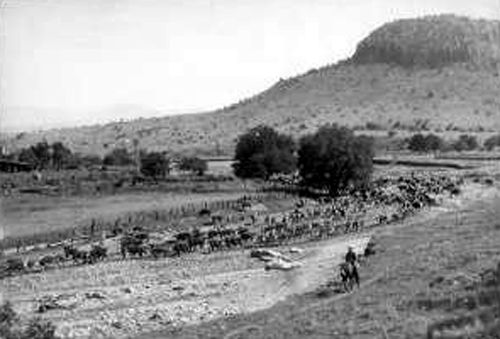
Membris River near Silver City, New Mexico.
So, Kit began to cast about two or three of the right sort of boys to join him. Three were quickly chosen out of his own and a neighboring outfit. They were Mitch Lee and Frank Taggart, two cowboys of his type and temper, and George Washington Cleveland, a black man known as a desperate fellow and game for anything. No great argument was needed to secure the cooperation of these men. A mere tip of the lark and the loot to be had was enough. The boys saw their respective bosses. They “allowed they’d lay off for a few days and go to town.” So they were paid off, slung their Winchesters on their saddles, mounted their favorite horses, and rode away. They met in Silver City and came in separately. There, they purchased a few provisions. Then, they separated and rode out of town to rendezvous at a certain point on the Mimbres River.
The point of attack chosen was the little station of Gage (tended by a lone operator) on the Southern Pacific Railway west of Deming, a point then reached by the westbound express at twilight. After leaving the Gila, Kit and his three compadres rode into Gage the evening of the second day. One or two significant passes with a six-shooter hypnotized the station agent into a docile tool. A dim red light glimmered away off in the East. As the minutes passed, it grew and brightened fast. Then, a faint, confused murmur came singing over the rails to the ears of the waiting bandits. The light brightened and grew until it looked like a great dull red sun, and then the thunder of the train was heard.
The agent was made to signal the engineer to stop. With the lever reversed and the air brakes on, the train was nearly stopped when the engine reached the station. But seeing the agent surrounded by a group of armed men, the engineer, Theopholus C. Webster, shut off the air and sought to throw his throttle open. His purpose discovered that a quick shot from Mitch Lee laid him dead, and, springing into the cab, Mitch soon persuaded the fireman to stop the train.
Instantly, a fusillade of pistol shots and a mad chorus of shrill cowboy yells broke out, which terrorized the train crew and passengers into docility.
Within 15 minutes, the express car was sacked, the postal car gutted, the passengers were laid under unwilling contribution, and Kit and his pals were riding northward into the night, heavily loaded with loot. Riding at great speed due north, the party soon reached the main traveled road up the Mimbres River, in whose loose shifting sands they knew their trail could not be picked up. Still forcing the pace, they reached the rough hill-country East of Silver City early in the night, cached their plunder safely, and a little after midnight were carelessly bucking a Monte game in a Silver City saloon. The next afternoon, they quietly rode out of town and joined their respective outfits to wait until the excitement blew over.
Of course, the telegraph soon started the hue and cry. Officers from Silver City, Deming, and Lordsburg were soon on the ground, led by Harvey Whitehill, the famous old sheriff of Grant County. But, of clues, there were none. Naturally, the station agent had come safely out of his trance, but the absence of memory of what had happened was characteristic of the hypnotized. The trail disappeared in the sands of the Mimbres Road, and shrewd old Harvey Whitehill was at his wit’s end.
Many days passed in a fruitless search. At last, riding one day across the plains at some distance from the flight line north from Gage, Whitehill found a fragment of a Kansas newspaper. As soon as he saw it, he remembered that a particular merchant of Silver City came from Kansas, where this paper was published. Hurrying back to Silver City, Whitehill saw the merchant, who identified the paper and said he was undoubtedly its only subscriber. Asked if he had given a copy to anyone, he finally recalled that sometime before, about the same time as the robbery, he had wrapped in a piece of this newspaper some provisions he had sold to a black man named Cleveland and a white man he did not know.
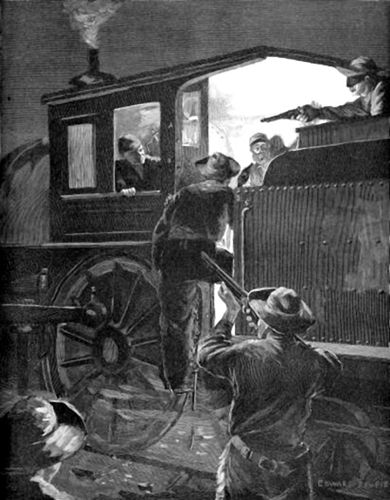
Train Robbery.
Here was the clue, and Whitehill was quick to follow it. Meeting a black man on the street, he pretended to want to hire a cook. But, the man had a job. Well, did he not know someone else? By the way, where was George Cleveland?
“Oh, boss, he left Gila last week and went up to Socorro,” was the answer.
Two days later, Whitehill found Cleveland in a Socorro restaurant, got the “drop” on him, told him his pals were arrested, and had confessed that they were in the robbery but that he, Cleveland, had killed Engineer Theophilus C. Webster. This brought the whole story.
“Foh God, boss, I nebber killed dat engineer. Mitch Lee done it, an’ him an’ Taggart an’ Kit Joy, dey done lied to you outrageous.”
Within a few days, caught singly in ignorance of Cleveland’s arrest and entirely taken by surprise, Joy, Taggart, and Lee were captured on the Gila River and jailed, along with Cleveland, at Silver City and held to await the action of the next grand jury.
But, strong walls did not make a prison adequate to hold these men. Before many weeks passed, an escape was planned and executed. Two other prisoners, one a man wanted in Arizona and the other a Mexican horse thief, were allowed to participate in the outbreak.
Taken unaware, their guard was seized and bound with little difficulty. Quickly arming themselves in the jail office, these six desperate men dashed out of the jail and into a neighboring livery stable, seized horses, mounted, and rode madly out of town, firing at everyone in sight. In Silver City, in those days, no gentleman’s trousers fitted comfortably without a pistol in the waistband. Therefore, the flying desperadoes received as hot a fire as they sent. Cleveland’s horse was shot and killed before they got out of town, but one of his pals stopped and picked him up.
Instantly, the town was in an uproar of excitement. Everyone knew that the capture of these men meant a fight to the death. As usual in such emergencies, there were more talkers than fighters. Nevertheless, six men were in pursuit as soon as they could saddle and mount. The first to start was the driver of an express wagon, a man named Jackson, who cut his horse loose from the traces, mounted bareback, and flew out of town only a few hundred yards behind the prisoners. Six others, led by Charlie Shannon and Joseph N. Lafferr, were not far behind Jackson. The men of this party were greatly surprised to find that a Boston boy of twenty, a tenderfoot lately come to town, who had scarcely ever ridden a horse or fired a rifle, was among their number, well mounted and armed — a man with a line of ancestry worthwhile, and himself a worthy survival of the best of it.
The chase was hot. Jackson was well in advance, engaging the fugitives with his pistol while the fugitives returned the fire and threw up puffs of dust all about Jackson. Behind, he spurred Shannon and his party.

Harvey Whitehill.
At length, the pursuit gained. Five miles out of Silver City, in the Pinon Hills to the northwest, pressed to run farther, the fugitives sprang from their horses and ran into a low post oak thicket covering about two acres, where they could not be seen. The six pursuers sent back a man to guide the sheriff’s party, hasten reinforcements, and began shelling the thicket surrounding it. Whitehill rode up with seven more men a few minutes later, and the thicket was effectually surrounded. To the surprise of everyone, a hot fire poured into the thicket and failed to bring a single answering shot. Whitehill was no man to waste ammunition on such chance firing, so he ordered a charge. His little command rode into and through the thicket at full speed, only to find their quarry gone, all save one. The Mexican lay dead, shot through the head! Kit’s party had dashed through the thicket without stopping, onto another, and their trail was shortly found leading up a rugged canyon of the Pinos Altos Range.
Whitehill divided his party. Three men followed up the bottom of the canyon on foot while five mounted flankers were thrown out on either side. At last, high up the canyon, Kit’s party was found lying in some thick underbrush. It was a desperate position to attack, but the pursuers did not hesitate. Dismounting, they advanced on foot with rifles cocked but with all the caution of a hunter trailing a wounded grizzly. Cleveland opened the ball at barely twenty yards’ range with a shot that drove a hole through the Boston boy’s hat. Dropping at first with surprise, for he had not seen the black man until the instant he rose to fire, the Boston boy returned a quick shot that happened to hit the Cleveland just above the center of the forehead and rolled him over dead.
Approaching from another direction, Shannon was first to draw Taggart’s fire. Taggart was lying in the brush, Shannon standing out in the open. Shot after shot, they exchanged until a ball struck the earth in front of Taggart’s face and filled his eyes with gravel and sand. Blinded for the time, he called for a quarter and came out of the brush with his hands up and another man with him. Asked for his pistol, Taggart replied:
“Damn you, that’s empty, or I’d be shooting yet.”
In the meantime, Whitehill was engaging Mitch Lee. In a few minutes, shot through and helpless, Lee surrendered. It was quick, hot work!
All but Kit were now killed or captured. He had been separated from his party, and Lafferr was seen trailing him on a neighboring hillside.
The sheriff detailed Shannon to return to town and get a wagon to bring in the dead and wounded while he joined Lafferr in pursuit of Kit.
An hour later, as Shannon was leaving town with a wagon to return to the scene of the fight, a mob of men, led by a shyster lawyer, joined him and swore they proposed to lynch the prisoners. This was too much for Shannon’s sense of frontier proprieties. So, rising in his wagon, he made a brief but effective speech.
“Boys, none of our men are hurt, although it is no fault of our prisoners. A dozen of us have risked our lives to capture these men. You men have not seen fit, for what motives we will not discuss, to help us. Now, I tell you right here that any who want can come, but the first man to raise a hand against a prisoner I’ll kill.”
Shannon’s return escort was small.
But, once more, back in the hills of the Pinos Altos, Shannon found a storm he could not quell, even if his sympathies had not drifted with it when he learned its cause. His friend Joseph Lafferr lay dead, filled full of buckshot by Kit before Whitehill’s reinforcements had reached him. In the meantime, Kit had slipped away through the underbrush, over rocks that left no trail.
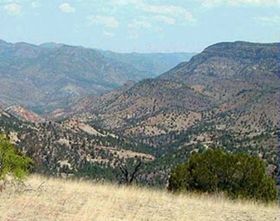
Pinos Altos Range.
Lafferr’s death maddened his friends. There was little discussion. Only one opinion prevailed. Taggart and Lee must die. Nothing was known of the prisoner wanted in Arizona, so he was spared.
Frank Taggart and Mitch Lee were put in the wagon, the former tightly bound, the latter helpless from his wound. Short rope halters barely five feet long were stripped from the horses, knotted around the prisoners’ necks, and fastened to the limb of a juniper tree. Taggart climbed to the high wagon seat, took a header, and broke his neck. The wagon was then pulled away, and Lee was strangled.
Engineer Webster and Joseph Lafferr were fairly well avenged, with Cleveland, Lee, and Taggart dead. But Kit was still out, known as the leader and the man who shot Laffer, and for days, the hills were full of men hunting him. Hiding in the rugged, thickly timbered hills of the Gila, taking needed food at night, at the muzzle of his gun, from some isolated ranch, he was hard to capture.
Had Kit chosen to mount himself and ride out of the country, he might have escaped for good. But this he would not do. Dominated still by the fatal curiosity and covetousness that first possessed him, later mastered him, and then drove him into crime, bound to repossess himself of his hidden treasure and go out to see the world, Kit would not leave the Gila Wilderness. He was alone, unaided, with no man left his friend, with all men on the alert to capture or to kill him. However, the unequal contest nevertheless lasted for many weeks.
There was only one man Kit at all trusted, a small ranchman named Racketty Smith. One day, looking out from a leafy thicket where he lay hidden, Kit saw Racketty going along the road. A lonely outcast, craving the sound of a human voice, believing Racketty at least neutral, Kit hailed him and approached. As he drew near, Racketty covered him with his rifle and ordered him to surrender. Surprised and taken entirely unaware, Kit started to jump for cover when Racketty fired, shattering his right leg and bringing him down.
Seriously wounded, Joy had to undergo the amputation of his left leg just above the knee. In November 1884, he stood trial for the killing of Engineer T.C. Webster and was convicted of second-degree murder. He was imprisoned at Santa Fe, where he learned the tailor’s trade. After serving 12 years, he was released in March 1896 and rejoined his mother near Kingston, New Mexico.
Around 1900, they moved to Arizona, where they settled at Fort Huachuca, and Joy ran a tailor’s shop. After his mother died in 1911, he moved to Buena, Arizona, where he once again opened a tailor shop. However, during Prohibition, he and a partner went into the liquor business. He was arrested in May 1926. Found guilty of manufacturing moonshine, he was sentenced to time in the county jail and released in November 1926.
Ten years later, in the spring of 1936, he entered the Cochise County Hospital in Douglas, Arizona, suffering from influenza and pneumonia and died on April 14 at the age of 76. He was buried at the Bisbee-Lowell Evergreen Cemetery.
By Edgar Beecher Bronson, 1910. Compiled and edited by Kathy Alexander/Legends of America, updated March 2025. About the Author: Edgar Beecher Bronson wrote The Red-Blooded Heroes of the Frontier. This article is a chapter of his book, published by A.C. McClurg & Co. in 1910. Bronson worked not only as a reporter and writer, publishing several books and articles, but also as a cowboy and rancher. The text as it appears here, however, is not verbatim, as it has been heavily edited, including truncation in parts and additional information added.
Also See:
A Cow Hunter’s Court by Edgar Bronson
Cowboys, Trail Blazers & Stage Drivers